

Local search market share is defined as the percentage of total local search queries or visibility controlled by a search engine or brand within a defined geographic market. Understanding what is search market share local means recognizing how consumer attention is distributed across search engines, maps, and AI platforms at the neighborhood or city level. Google held over 90% of worldwide search market share in early 2026, yet local dynamics tell a more complex story. Maps growth, AI adoption, and shifting consumer behavior are reshaping which businesses get found and which get passed over.
What is search market share local and how is it measured?
Local search market share refers to two related but distinct concepts. The first is engine-level share: which search platform (Google, Bing, AI tools) captures the most queries in a given geographic area. The second is brand-level share, often called share of search, which measures how often a specific business or brand appears in relevant local queries compared to all competitors in that category.
These two concepts serve different purposes. Engine-level share tells you where consumers are searching. Brand-level share tells you how visible your business is within that channel.
Share of search is the more actionable metric for most business owners. The formula is straightforward: branded queries divided by total category queries, multiplied by 100. If 10,000 people search for “Italian restaurant downtown Chicago” each month and 800 of those searches include your restaurant’s name, your share of search is 8%. That number reflects real consumer awareness, not just ranking position.
Pro Tip: Track share of search monthly, not just rankings. Rankings fluctuate daily. Share of search reveals the slower, more meaningful trend in consumer attention toward your brand.
- Engine-level local market share: Which platforms capture local queries in your city or ZIP code
- Brand share of search: Your branded query volume divided by total category query volume
- Local visibility share: Your business’s presence in map packs, AI answers, and local organic results combined
Defining your local market area precisely matters before any measurement begins. A plumber serving three ZIP codes has a different competitive set than one serving an entire metro. Granular geographic definitions produce accurate data. Broad definitions produce noise.
How local search trends are reshaping market share in 2026
Consumer behavior in local search shifted sharply in the past year. Maps-based interactions grew 26.2% year-over-year in Q1 2026, while traditional search visibility dropped 14.0% quarter-over-quarter. That gap signals a structural change, not a seasonal blip.

The restaurant sector shows the most dramatic movement. Local search visibility for restaurants jumped 51.9% quarter-over-quarter in Q1 2026. Consumers are using maps to browse, compare, and decide in real time. Businesses with complete, photo-rich profiles capture that attention. Businesses with sparse listings do not.
AI adoption adds another layer. 47% of US adults used AI tools to find local businesses recently as of march 2026. Among daily searchers, that figure reaches 59%. The shift is most pronounced among high-income households, where AI has already surpassed Google as the primary starting point for local business discovery.
This income-based split carries real strategic weight. A luxury spa, a financial advisor, or a high-end contractor whose clients earn $150,000 or more per year now competes for visibility on AI platforms first. Ignoring that channel means ceding market share to competitors who show up in AI answers.
- Maps visibility is growing faster than traditional organic search visibility
- AI tools now serve as the primary local discovery channel for high-income consumers
- AI-driven search is changing how businesses must structure their online presence across multiple platforms
- Sector-specific opportunities exist, with restaurants leading the maps visibility surge
How to measure your local search market share accurately
Accurate measurement starts with defining the right inputs. Three variables determine your share of search: your branded query volume, total category query volume, and the geographic boundary you apply to both.
Step 1: Define your local market. Use ZIP codes, city names, or a service radius. The tighter the boundary, the more accurate the competitive picture.
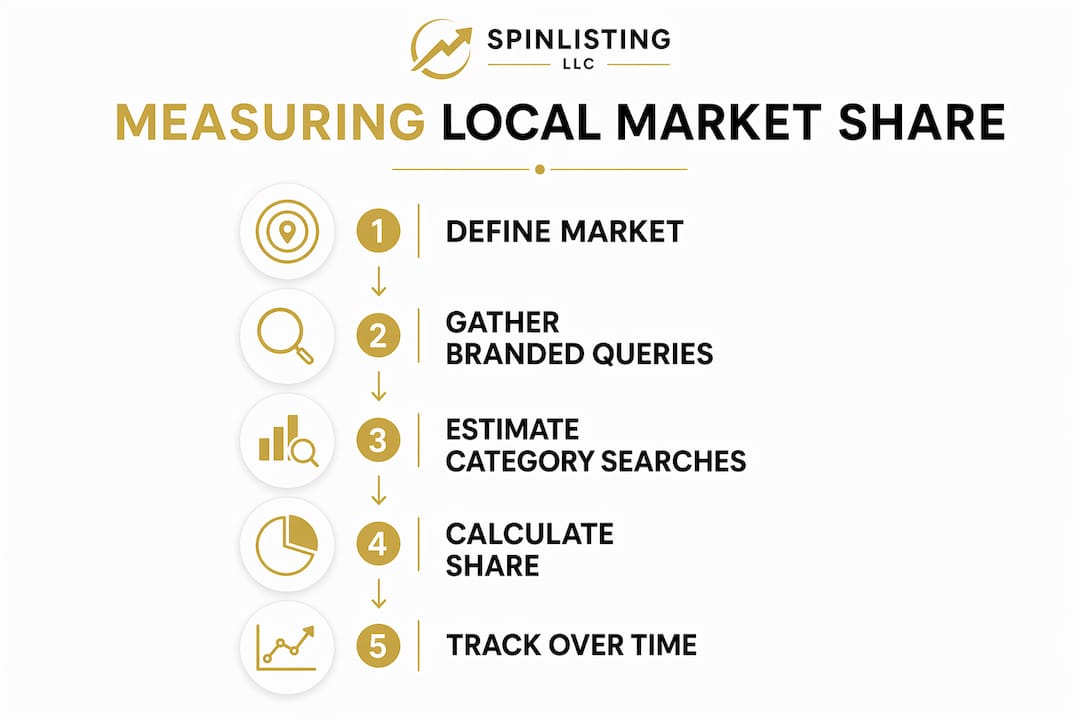
Step 2: Pull branded query data. Google Search Console shows how often your business name appears in search results and how many clicks it generates. This is your numerator.
Step 3: Estimate total category queries. Keyword research tools provide search volume for category terms (e.g., “plumber Austin”) within a geographic filter. This is your denominator.
Step 4: Calculate and track over time. Divide branded queries by category queries and multiply by 100. Run this calculation monthly to spot trends.
One critical complication: 60% of search results are zero-click, meaning consumers get their answer directly from the search results page without clicking through to a website. Zero-click behavior inflates impression counts while suppressing click data. Relying solely on website traffic to measure local visibility will undercount your actual search presence.
The solution is to track impressions and map views alongside clicks. Google Business Profile Insights reports map views, direction requests, and call clicks. These signals reflect real consumer intent even when no website visit occurs.
Pro Tip: Set a monthly calendar reminder to export Google Business Profile Insights data. Most business owners check it quarterly at best. Monthly tracking catches drops before they become costly.
Tracking share of search also functions as a forward-looking sales indicator. When your share of search rises, consumer awareness of your brand is growing. Sales typically follow within one to three months. This makes share of search one of the few marketing metrics that predicts revenue rather than just reporting it.
Strategies to grow your local search market share
Growing local search market share requires presence across every channel where consumers now search. A Google Business Profile alone no longer covers the full picture.
Optimize your Google Business Profile completely. Every field matters: business category, service areas, hours, photos, and Q&A responses. Well-maintained listings deliver significantly greater value than unclaimed or incomplete ones. Spinlisting reports that optimized profiles produce 83% increases in first-place rankings for local queries.
Build presence on maps and AI platforms. Google Maps is the dominant maps channel, but Apple Maps, Bing Places, and AI tools like ChatGPT and Perplexity pull business data from multiple sources. Consistent name, address, and phone number (NAP) data across all directories feeds accurate answers into AI-generated responses.
Use structured data and entity verification. Search engines and AI tools use structured data to confirm that your business is a real, verified entity. Schema markup on your website, combined with consistent citations across authoritative directories, strengthens your entity signals.
Develop a local keyword strategy that covers both branded and category terms. Category terms capture consumers who do not yet know your brand. Branded terms capture consumers who do. Both matter for growing share of search over time.
- Claim and complete profiles on Google Business Profile, Apple Maps, and Bing Places
- Respond to every review, positive and negative, to signal active management
- Add photos monthly to keep your profile fresh and visible in maps results
- Use location-specific landing pages on your website to capture ZIP-code-level queries
- Monitor AI platforms to verify your business data appears accurately in AI-generated answers
The local SEO software market is projected to grow from $9.12 billion in 2025 to $19.36 billion by 2031, a compound annual growth rate of 13.37%. That investment reflects how seriously businesses are taking local search visibility as a competitive asset. Platforms that integrate AI answers, structured data management, and entity verification are becoming the standard, not the exception.
Pro Tip: Use AI in your SEO workflow to identify gaps in your local keyword coverage. AI tools can surface category queries your competitors rank for that you have not yet targeted.
Key Takeaways
Local search market share is a forward-looking competitive metric that measures both engine-level query distribution and brand-level visibility across maps, AI platforms, and organic search within a defined geographic area.
| Point | Details |
|---|---|
| Define your market precisely | Use ZIP codes or a service radius before measuring share of search to avoid inaccurate competitive data. |
| Maps growth outpaces organic | Maps interactions grew 26.2% year-over-year in Q1 2026 while traditional search visibility fell. |
| AI adoption is income-stratified | High-income consumers now use AI tools as their primary local discovery channel, ahead of Google. |
| Zero-click searches distort data | 60% of queries end without a click, so track impressions and map views alongside website traffic. |
| Share of search predicts revenue | Rising branded query share signals growing consumer awareness and typically precedes sales growth. |
The metric most business owners are not watching
Most business owners track rankings. Few track share of search. That gap is where competitive advantage gets lost.
Rankings tell you where you sit on a given day for a given query. Share of search tells you whether consumers are thinking about your brand more or less than they were three months ago. Those are fundamentally different questions. One is tactical. The other is strategic.
The AI adoption data reinforces this point. When nearly half of US adults are already using AI to find local businesses, and that number is higher among the consumers with the most spending power, the businesses that show up accurately in AI answers are building share of search without even knowing it. Their data is clean, their profiles are complete, and AI tools surface them by default.
The businesses that are not showing up in AI answers often have the same problem: inconsistent data across directories. A phone number that differs between Google and Yelp. An address that does not match the website. These small errors compound into lower entity confidence for AI systems, which then surface competitors instead.
My honest take is that local search market share analysis should be a quarterly agenda item for every marketing team, not an annual audit. The channels are shifting fast enough that a six-month lag in measurement means you are reacting to a market that has already moved.
— Against
How Spinlisting helps you capture local search visibility
Understanding local search market share is one thing. Acting on it consistently is another.

Spinlisting specializes in Google Business Profile optimization and local SEO, helping businesses build the kind of complete, accurate, and regularly updated presence that earns visibility across Google Maps, AI platforms, and local organic results. Spinlisting’s approach combines local keyword strategy with ongoing profile management, producing measurable results including 83% increases in first-place local rankings. For marketing professionals and business owners who want to grow their share of local search without managing every detail manually, Spinlisting provides the structure and expertise to make that happen.
FAQ
What is local search market share?
Local search market share is the percentage of local search queries or visibility held by a search engine or brand within a specific geographic area. It measures competitive presence in local consumer discovery across maps, organic results, and AI platforms.
How does share of search differ from search engine market share?
Search engine market share measures which platform (Google, Bing, AI tools) captures the most queries overall. Share of search measures how often a specific brand appears in relevant category queries compared to all competitors in a local market.
Why is Google still dominant in local search despite AI growth?
Google held over 90% of global search market share in early 2026, but AI tools are gaining ground specifically among high-income and daily-searcher segments. Google remains the volume leader while AI platforms capture high-value consumer attention.
How do zero-click searches affect local market share measurement?
Zero-click searches account for 60% of queries, meaning most consumers never visit a website after searching. Measuring only website traffic undercounts actual local visibility, so map views and impression data are necessary for accurate analysis.
What is the fastest-growing sector in local search visibility?
Restaurants saw a 51.9% quarter-over-quarter increase in local search visibility in Q1 2026, making food and beverage the standout sector for maps-based consumer discovery growth.