
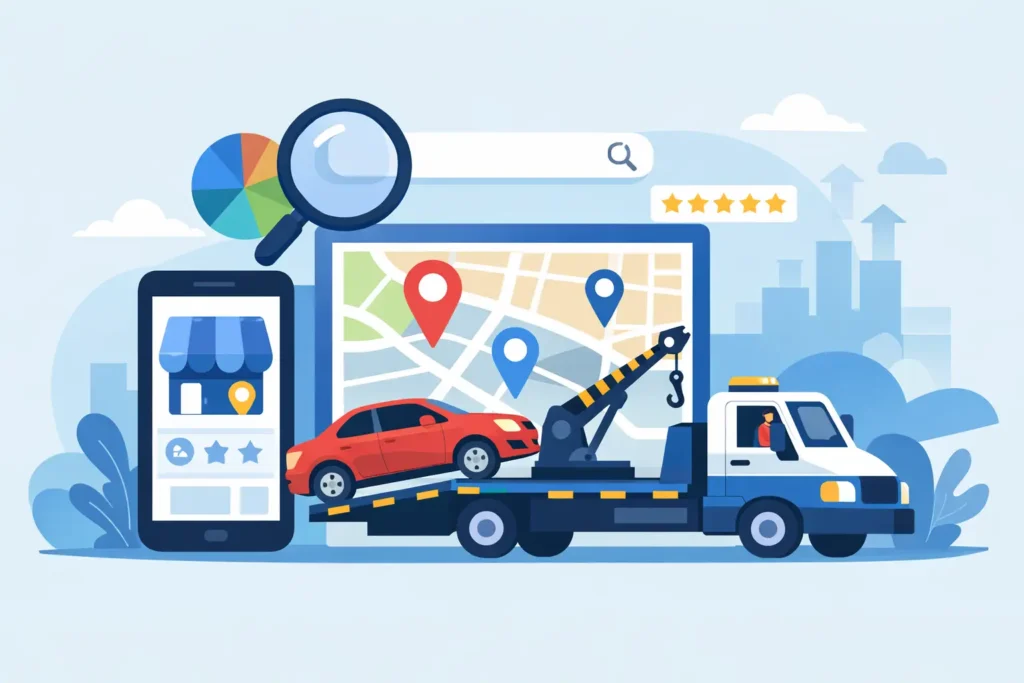
A towing company can have trucks ready, dispatch dialed in, and drivers covering the city fast – and still lose calls to a competitor with a better Google profile. That is why Google My Business for tow companies is not a side task. It is one of the main assets driving local calls, emergency jobs, and after-hours lead volume.
When someone is stranded on the highway, locked out in a parking lot, or dealing with a dead battery before work, they are not researching ten brands. They are searching fast, scanning the map, and calling the business that looks closest, most credible, and most active. If your profile is incomplete, poorly optimized, or buried under stronger local competitors, Google will send that lead somewhere else.
Why Google My Business for Tow Companies Matters More Than Most Industries
Towing is a high-intent local service. The searcher usually needs help now, not next week. That changes the way your Google Business Profile performs compared to slower-decision industries.
In towing, proximity matters, but it is not the only factor. Relevance and prominence still shape who shows up in the map pack. If your business categories are weak, your service areas are confusing, your reviews are thin, or your profile has not been updated in months, you can get outranked by companies with fewer trucks and less real-world capacity.
That gap matters because the top map results capture a large share of calls. Many searchers never go past those first few listings. They look at ratings, hours, photos, and business names, then make a fast decision. Your profile has seconds to earn trust.
What a Tow Company Google Profile Needs to Generate Calls
A lot of towing businesses claim their profile is “set up” when all they really did was verify it. Verification is the starting line, not the work.
A strong profile starts with the right primary category. For most operators, “Towing service” is the obvious choice, but secondary categories may also matter depending on your actual services. If you handle roadside assistance, auto wrecker work, lockouts, jump starts, tire changes, or transport, those details need to be reflected accurately across the profile. Category stuffing is a mistake, but under-defining your service mix is just as costly.
Your business description should be clear, local, and service-focused. This is not the place for vague branding language. It should tell Google and the customer what you do, where you operate, and what kind of calls you handle. If you offer 24/7 towing, heavy-duty towing, accident recovery, motorcycle towing, or private property towing, say it plainly.
Photos matter more than many owners expect. Real truck photos, action shots, yard images, team photos, and service-related visuals help establish legitimacy. Google wants active profiles, and searchers want proof that the business is real. A thin profile with one logo and a blurry truck image does not convert well.
Hours must be accurate, especially if you advertise emergency or 24-hour service. One of the fastest ways to lose trust is to show open hours and miss the call, or show limited hours when you actually run full-time dispatch. If your availability changes by holiday, staffing level, or after-hours structure, keep the listing updated.
Reviews Are Not Just Reputation – They Affect Rankings
Tow companies often treat reviews like a bonus. In local search, they are part of the engine.
A steady review flow helps build prominence. It also improves conversion when a stranded driver compares three local options in the map pack. A profile with recent, specific, positive reviews usually wins more calls than one with a stale rating and no fresh feedback.
The quality of the review matters too. A review that mentions fast response time, roadside assistance, accident towing, fair pricing, or professional drivers gives Google better context and gives customers better reasons to trust you. You cannot script reviews, but you can ask consistently and direct satisfied customers to leave honest feedback.
Responding to reviews is part of the job. It shows activity, professionalism, and customer engagement. For towing, where service can be stressful and emotions run high, thoughtful responses to negative reviews matter even more. You do not need to argue every complaint. You do need to show future customers that your business is active and accountable.
How to Improve Google My Business for Tow Companies
If your listing is underperforming, the fix is usually operational, not mysterious. Rankings improve when the profile is stronger, more active, and better aligned with search intent.
Start with consistency. Your business name, phone number, website, and service information should match across your profile and the rest of your web presence. Conflicting details create trust problems for both Google and customers.
Then look at service coverage. Many tow companies either set service areas too broadly or fail to communicate target markets clearly. If you are trying to rank everywhere in a major metro, but your real operation is strongest in a handful of cities or zones, your optimization needs to reflect that. Broad coverage claims often weaken local relevance.
Posts can help keep the profile active, especially when they highlight actual services, response availability, vehicle types, service areas, and customer trust signals. They are not magic on their own, but they support freshness and make the profile look maintained.
Questions and answers are another overlooked section. If common concerns like response time, payment options, heavy-duty capability, accident towing, impound support, or 24-hour dispatch are not addressed, you leave conversion opportunities on the table. A well-managed profile removes friction before the call.
Common Problems That Hold Tow Companies Back in Maps
Some towing businesses have decent operations but weak local visibility because of preventable profile issues.
The first is category confusion. If your primary category is too broad or inaccurate, Google may not rank you for the searches that matter most. The second is inactivity. Profiles with no new photos, no posts, no review growth, and no updates tend to look neglected.
Another issue is weak location trust. This can happen when the listed address, service setup, or business details create uncertainty. Tow companies have to be careful here because Google can be stricter with service-area and location-based businesses than owners realize. Trying to game the listing can trigger suspensions, and a suspended profile means lost calls immediately.
There is also the website problem. Your Google Business Profile does not operate in isolation. If your site lacks local landing pages, service relevance, technical SEO basics, or clear location signals, your map visibility can suffer. A good profile with a weak site can still underperform.
Google My Business for Tow Companies and Lead Quality
More visibility is not the only goal. Better visibility should produce better calls.
A properly optimized profile helps filter intent. When your services, hours, areas, and business details are clear, you reduce low-fit calls and improve qualified lead volume. That matters in towing, where dispatch time and driver capacity are limited. You do not want to burn resources handling the wrong inquiries because your listing is vague.
This is also where photos, service descriptions, and reviews do real work. They shape expectations before the phone rings. If your profile clearly shows light-duty towing, roadside assistance, lockouts, and jump starts, but not heavy recovery, you are less likely to get mismatched calls.
What Ongoing Optimization Looks Like
Tow company owners often want a one-time setup. The problem is that local competition does not sit still.
Profiles that rank well usually get ongoing work. That includes regular photo uploads, review generation, review responses, weekly posting, service updates, category checks, and monitoring for listing issues. Competitors change. Search behavior shifts. Google updates features. If your profile stays frozen, your rankings often do too.
The businesses that win in Maps usually are not guessing. They are treating their Google Business Profile like an active lead channel. That means measuring calls, tracking visibility, improving conversion elements, and tightening local relevance over time.
For many tow companies, this is where outside help makes sense. A specialized local search team can handle the execution-heavy work most owners never have time to manage consistently. That is the difference between having a listing and having one that actually produces.
If your trucks are moving but your map rankings are not, the market is telling you something. Google rewards the businesses that show up clearly, consistently, and credibly. For tow operators, that can be the difference between a quiet phone and a steady stream of local calls.