

Search engine marketing (SEM) is defined as a paid advertising strategy that places your business at the top of search engine results pages (SERPs) through paid placements, driving immediate targeted traffic to your website. Unlike organic search tactics, SEM delivers visibility the moment a campaign goes live. 15.5% of all U.S. retail sales occurred online in Q2 2025, which means the competition for search visibility has never been more direct or more expensive to ignore. For marketing professionals and business owners, understanding SEM is no longer optional. It is the fastest path to capturing high-intent buyers at the exact moment they are ready to act.
What is search engine marketing and how does it work?
SEM is synonymous with paid search advertising, most commonly executed through Google Ads. Advertisers bid on keywords, write targeted ads, and pay only when a user clicks. That pay-per-click (PPC) model means your budget goes directly toward people who showed enough interest to act.
The mechanics are straightforward. You select keywords that match your audience’s search intent, set a maximum bid, and write ad copy that connects the search query to your offer. Google then runs an auction every time a relevant search occurs, factoring in your bid and your Quality Score to determine where your ad appears.

SEM terminology has shifted over the years. Historically, SEM included both paid and organic search tactics. Today, industry usage has narrowed the term to mean paid search exclusively. When someone says SEM in a marketing meeting, they almost always mean PPC campaigns, not SEO. Knowing this distinction prevents costly miscommunication when planning budgets and reporting results.
How does search engine marketing differ from SEO?
SEO and SEM target the same real estate on a search results page, but they get there through entirely different means. SEO builds authority over months through content, backlinks, and technical site health. SEM buys placement immediately through paid auctions. Both appear on the same page, but the path, timeline, and cost structure are completely different.
The table below captures the core distinctions:
| Factor | SEO | SEM |
|---|---|---|
| Speed to results | Months to years | Immediate |
| Cost model | Time and content investment | Pay per click |
| Placement type | Organic (unpaid) | Paid ad label |
| Longevity | Compounds over time | Stops when budget stops |
| Data feedback | Slower, indirect | Real-time, granular |
A common misconception is that SEM replaces SEO once a business has budget. It does not. Paid and organic search create a cycle where each strengthens the other. Paid search data reveals which keywords convert, and that intelligence sharpens your organic content strategy. Strong organic rankings on certain keywords can justify pausing paid spend on those same terms, freeing budget for gaps where you have no organic presence.
SEM is best deployed for immediate needs: a new product launch, a seasonal promotion, or a competitive keyword where you have no organic ranking yet. SEO handles the long game. The local SEO vs. paid ads decision is one every business owner faces, and the answer is almost always to run both in parallel rather than choosing one.
What are the key benefits of search engine marketing?
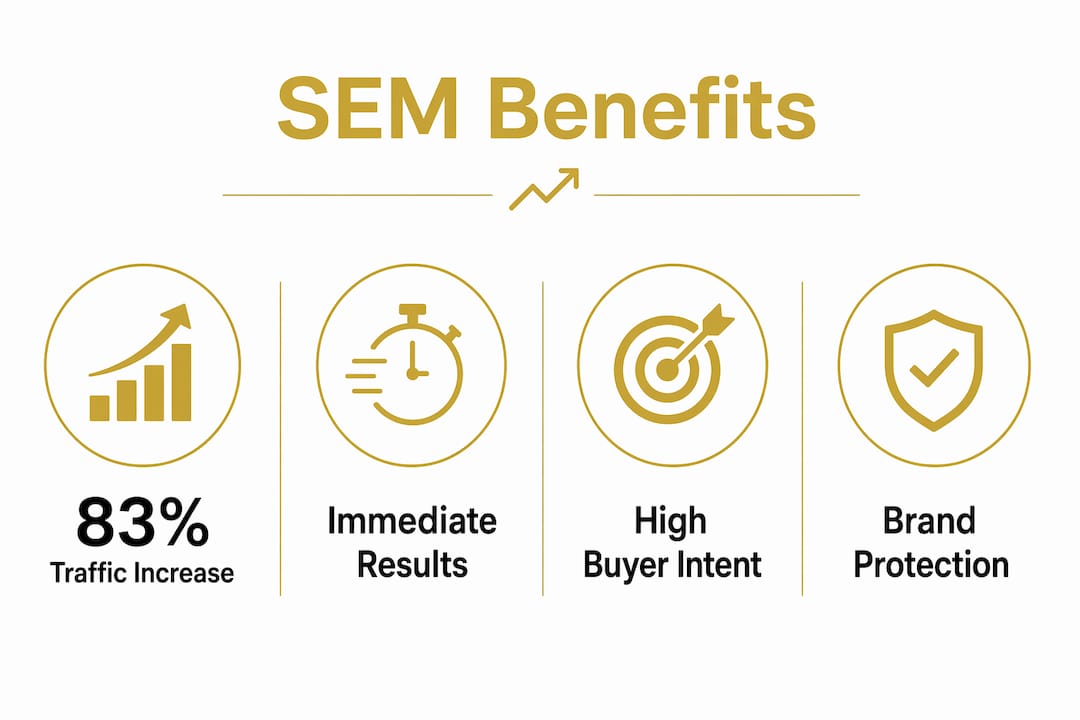
SEM delivers five advantages that no other digital channel matches at the same speed.
- High-intent targeting. Users searching on Google are actively looking for a solution. SEM targets high-intent users who are ready to convert, which is why paid search conversion rates consistently outperform display advertising.
- Instant visibility. A campaign can go live within hours. No waiting for Google to crawl and index content.
- Granular budget control. Ad platforms offer flexible bidding and targeting parameters, letting you cap daily spend, target specific zip codes, and adjust bids by device or time of day.
- Real-time performance data. Every click, impression, and conversion is tracked. You know exactly what each dollar produces.
- Brand awareness at scale. Even when users do not click, seeing your brand name at the top of results builds recognition over time.
15.5% of U.S. retail sales happened online in Q2 2025. That share is growing. Businesses without a paid search presence are handing those buyers to competitors who do show up.
Pro Tip: Run SEM on branded keywords even when you rank organically for your own name. Competitors can bid on your brand terms, and a paid ad protects that top position at a very low cost-per-click.
How do you plan, launch, and optimize an SEM campaign?
Effective SEM campaigns follow a repeatable process. Skipping any step compounds errors downstream.
-
Conduct keyword research by intent. Group keywords into three buckets: informational (researching), navigational (looking for a specific brand), and transactional (ready to buy). SEM budget belongs almost entirely in the transactional bucket. Tools like Google Keyword Planner surface search volume and competition data to guide selection.
-
Write ads that match the search query. Ad copy must reflect the exact language of the keyword. A user searching “emergency plumber Chicago” expects to see those words in your headline. Mismatched copy kills click-through rate (CTR) and raises your costs.
-
Set a bidding strategy aligned with your goal. Google Ads offers manual CPC for tight control, Target CPA for conversion volume, and Target ROAS for revenue-focused campaigns. New advertisers should start with manual CPC until they have enough conversion data to feed automated bidding algorithms.
-
Understand and improve Quality Score. Quality Score measures ad relevance, expected CTR, and landing page experience. A high Quality Score lowers your cost-per-click and improves ad position, meaning a well-optimized campaign can outrank a competitor with a higher bid. This is the single most misunderstood lever in paid search.
-
Run A/B tests continuously. Test one variable at a time: headline, call to action, landing page layout. Let each test run long enough to reach statistical significance before drawing conclusions.
-
Review and adjust weekly. Pause keywords that spend without converting. Increase bids on top performers. Add negative keywords to block irrelevant traffic that wastes budget.
Pro Tip: Negative keywords are as valuable as target keywords. A plumber running ads without negative keywords like “plumbing school” or “DIY plumbing” will burn budget on searches that will never convert.
How is SEM performance measured and integrated with broader marketing?
Measurement is where most SEM campaigns either prove their value or quietly drain budget. The five metrics every marketer must track are:
| Metric | What it measures | Why it matters |
|---|---|---|
| CTR (click-through rate) | Clicks divided by impressions | Indicates ad relevance and copy quality |
| CPC (cost per click) | Average spend per click | Controls budget efficiency |
| Conversion rate | Clicks that complete a goal | Measures campaign effectiveness |
| ROAS (return on ad spend) | Revenue divided by ad spend | Ties spend directly to revenue |
| Impression share | Your ads shown vs. total eligible | Reveals competitive positioning |
Attribution is the hardest problem in SEM measurement. A user might click a paid ad, leave, return through organic search three days later, and then convert. Last-click attribution credits the organic visit. Data-driven attribution models, available in Google Ads, distribute credit across the full path and give a more accurate picture of SEM’s contribution.
Treating SEO and SEM as integrated strategies rather than separate budgets produces better ROI. Paid search data shows which keywords drive conversions. That data directly informs which topics your SEO content team should prioritize. When an organic page reaches position one for a high-converting keyword, you can redirect that paid budget to terms where you have no organic presence. This cycle compounds returns over time.
Tracking SEO performance with the same rigor applied to paid search closes the loop between both channels. Marketers who measure both together make faster, better decisions than those who manage them in separate reporting silos.
Pro Tip: Connect Google Ads to Google Analytics 4 and import conversion goals in both directions. This gives your bidding algorithms the full conversion data they need to optimize spend automatically.
Key Takeaways
SEM is the fastest way to reach high-intent buyers, but it only delivers lasting ROI when paired with disciplined optimization and integrated with organic search strategy.
| Point | Details |
|---|---|
| SEM means paid search | SEM refers specifically to paid advertising on search engines, not organic tactics. |
| Quality Score drives cost | Improving ad relevance and landing page experience lowers CPC and raises ad position. |
| SEM and SEO work together | Paid search data sharpens organic keyword strategy and reduces total acquisition cost. |
| Measure five core metrics | Track CTR, CPC, conversion rate, ROAS, and impression share to evaluate campaign health. |
| Negative keywords protect budget | Blocking irrelevant search terms prevents wasted spend on non-converting traffic. |
Why I think most businesses are running SEM backwards
After years of watching businesses pour money into paid search, the most common mistake I see is treating SEM as a standalone revenue tap rather than an intelligence engine. Marketers launch campaigns, watch the clicks roll in, and never ask what the data is telling them about their customers.
The businesses that win with paid search use campaign data to answer questions their organic strategy could not. Which product descriptions resonate? Which pain points drive clicks? What does the converting customer actually call the problem you solve? Those answers belong in your landing pages, your blog posts, and your Google Business Profile.
The second mistake is neglecting Quality Score. A low Quality Score is not just an ad platform penalty. It is a signal that your ad, your keyword, and your landing page are not aligned. Fixing that alignment does not just lower your CPC. It improves the entire customer experience from search to conversion.
SEM is not a cost. It is a research budget that also happens to drive revenue when managed well. The search engine visibility you build through paid search today funds the organic authority you earn tomorrow.
— Against
How Spinlisting connects SEM strategy to local search growth
Paid search drives traffic, but local search visibility determines whether that traffic converts into real customers walking through your door or calling your number. Spinlisting specializes in the organic side of that equation, building the Google Business Profile presence that makes every paid click more likely to result in a sale.
Spinlisting’s Google Business Profile optimization has delivered 83% increases in first-place local rankings for clients. A well-maintained profile works alongside your SEM campaigns, giving searchers the social proof and location signals they need to choose you over a competitor. Businesses with optimized profiles are worth five times more to searchers than unclaimed listings. Explore Spinlisting’s local SEO services or see exactly how to optimize your Google Business Profile to make your paid search investment go further.
FAQ
What is the SEM definition in simple terms?
SEM stands for search engine marketing and refers to paid advertising on search engines like Google. Advertisers bid on keywords and pay each time a user clicks their ad.
How is SEM different from SEO?
SEO builds organic rankings over time through content and authority. SEM buys immediate placement through paid auctions and stops delivering traffic when the budget runs out.
What is a good Quality Score in Google Ads?
Quality Score is rated on a scale of 1–10. A score of 7 or higher indicates strong ad relevance, expected CTR, and landing page experience, which typically results in lower CPC and better ad positioning.
What metrics matter most in SEM campaigns?
The five metrics that matter most are CTR, CPC, conversion rate, ROAS, and impression share. Together they show whether a campaign is reaching the right people and generating profitable returns.
Can SEM help local businesses compete with larger brands?
Yes. Granular geographic targeting lets local businesses bid only on searches within their service area, keeping budgets focused and allowing them to compete directly for high-intent local customers regardless of brand size.