

Mobile search is the primary driver of local customer traffic, connecting nearby shoppers to physical businesses faster than any other channel. Mobile devices account for over 66% of global web traffic, and that dominance is even more pronounced in local searches. Mobile local searches convert at rates 35% higher for calls and 50% higher for purchases than desktop searches. For local retailers and service providers, understanding why mobile search drives local traffic is not optional. It is the foundation of every effective local SEO strategy in 2026.
Why mobile search drives local traffic so effectively
Mobile search works differently from desktop search. When someone picks up their phone and types “coffee shop near me” or “plumber open now,” they are not browsing. They are ready to act. That immediate, transactional intent is the single biggest reason mobile search converts local browsers into paying customers.
75% of mobile searches use local keywords, including “near me” and city-specific terms. That number tells you something critical: mobile users are not searching for general information. They want a specific business, in a specific location, right now. A local retailer who shows up in those results gets the call. One who does not, loses the customer to whoever does appear.
Mobile search results also look different from desktop results. Google surfaces Local Packs, map-based results, and business profiles directly in the search results page. These features push organic website links further down the page. A business with a well-maintained Google Business Profile appears in the map pack and captures attention before any website link does. That is a structural advantage built into how mobile search results are displayed.
- Immediate intent: Mobile users searching locally are typically within minutes of making a purchase decision.
- Location-based queries: “Near me” searches have grown consistently and now dominate local mobile query patterns.
- Local Pack visibility: Map-based results appear above organic links on mobile, giving optimized profiles prime placement.
- One-tap actions: Mobile search results include call buttons and directions links that remove friction between search and contact.
Pro Tip: Set up your Google Business Profile with your phone number, hours, and address formatted exactly the same way across every online listing. Consistency in your NAP (Name, Address, Phone) data directly affects how often you appear in mobile Local Pack results.
How do search engines rank mobile-friendly local businesses?
Google uses mobile-first indexing, which means it crawls and ranks your site based on its mobile version. Your desktop site’s quality is largely irrelevant if your mobile experience is poor. Poor mobile UX causes ranking gaps of 3–5 positions, and gaps exceeding 5 positions signal critical mobile experience problems that need urgent attention.

The “mobile gap” is a real diagnostic signal. If your business ranks on page one for a keyword on desktop but drops to page two on mobile, your mobile site has a problem. That gap costs you high-intent customers who are searching from their phones at the exact moment they are ready to buy.
AI-driven search has added another layer to this. Google’s AI systems now summarize and surface structured local business information directly in search results, often before a user clicks anything. Schema markup and structured content help AI models parse your business details and present them accurately. Keywords alone are no longer enough. Clear, structured data about your services, hours, and location is what gets you featured. You can learn more about how AI reshapes local visibility to understand why structured content now outperforms keyword stuffing.
- Mobile-first indexing: Google ranks your site based on its mobile version, not desktop.
- Ranking gaps: A 3–5 position drop between desktop and mobile rankings signals a fixable mobile UX problem.
- AI summarization: Search engines pull structured business data to answer queries directly, bypassing traditional organic results.
- Schema markup: Adding structured data markup to your site helps search engines and AI systems understand and display your business accurately.
Pro Tip: Run a mobile usability test on Google Search Console at least once a month. It flags specific pages with mobile UX errors, so you can fix problems before they cost you ranking positions.
What practical steps capture more local mobile traffic?
Site speed is the first thing to fix. 53% of mobile visitors abandon a page that takes more than 3 seconds to load. A 1-second delay in page load time reduces conversion rates by 7%. For a local retailer getting 500 mobile visitors a month, that delay translates directly into lost calls and lost foot traffic.
Here is a practical sequence for improving your mobile presence:
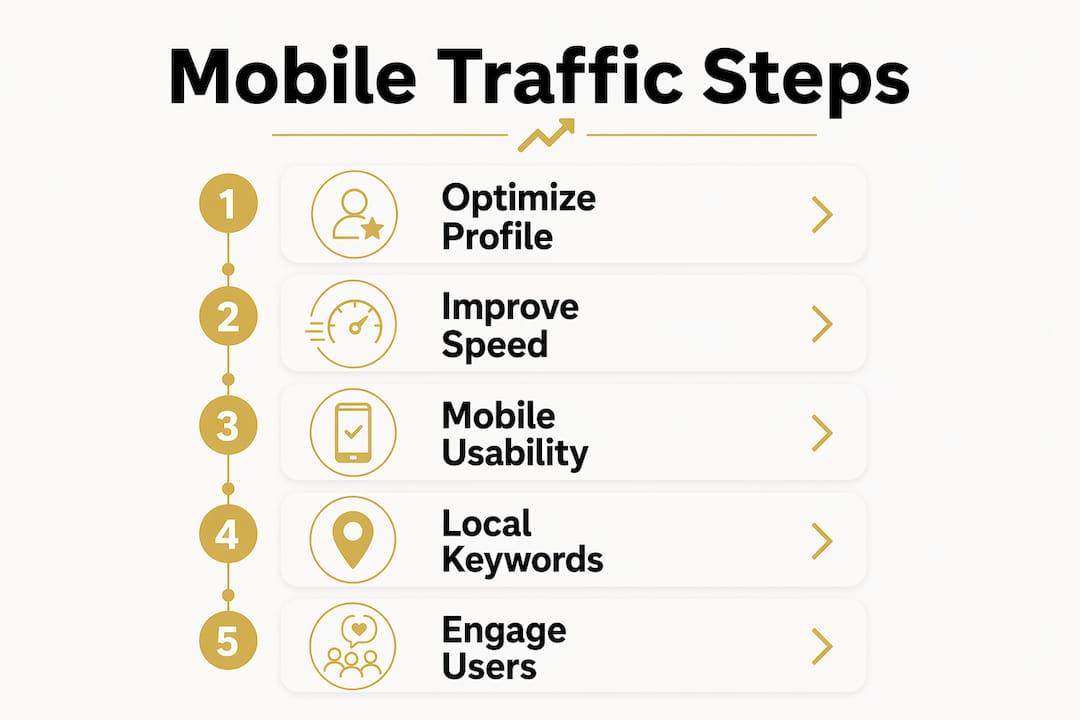
- Test your page speed using Google PageSpeed Insights. Aim for a score above 90 on mobile. Compress images, reduce server response time, and eliminate render-blocking scripts.
- Make your content scannable. Mobile users read in short bursts. Use short paragraphs, clear headings, and bullet points. Put your most important information, your address, phone number, and hours, at the top of the page.
- Optimize your Google Business Profile. An optimized Google Business Profile with accurate hours, photos, and service descriptions directly improves your Local Pack ranking. Businesses with complete profiles consistently outrank those with incomplete ones.
- Add schema markup. Use LocalBusiness schema to tell search engines your name, address, phone number, hours, and service area. This structured data feeds both traditional search and AI-driven results.
- Localize your content. Write service pages that mention your city, neighborhood, and nearby landmarks. Mobile users searching with city-specific terms need to see that your business is genuinely local.
| Optimization Step | Primary Benefit | Time to Implement |
|---|---|---|
| Page speed improvements | Reduces abandonment, lifts conversions | 1–2 days |
| Google Business Profile update | Improves Local Pack ranking | 1–2 hours |
| Schema markup addition | Boosts AI search visibility | 2–4 hours |
| Localized content creation | Captures city-specific mobile queries | Ongoing |
| Mobile usability audit | Identifies ranking-gap issues | 2–3 hours |
Pro Tip: Your local business listing on Google is often the first thing a mobile user sees before they ever visit your website. Treat it as your most important storefront, not an afterthought.
How does mobile search convert local traffic into real visits and sales?
The conversion path from mobile search to physical visit is shorter than most retailers realize. 76% of local mobile searches result in a store visit within 24 hours. That is not a slow, consideration-heavy buying cycle. That is a same-day decision driven by a phone search.
The mechanics of that conversion are built into mobile search results. A Google Business Profile with a visible phone number generates one-tap calls. A map listing with directions removes the friction of figuring out how to get there. An appointment booking link lets a customer schedule a service without calling at all. Each of these features exists specifically because mobile users want to act immediately, and removing steps between search and action increases the rate at which they follow through.
Mobile experience quality determines whether a business captures or loses that high-intent traffic. A site that loads slowly, displays text too small to read, or buries the phone number in a footer will lose the customer to a competitor whose site works cleanly on a phone. The impact of mobile searches on foot traffic is direct and measurable. Businesses that invest in mobile UX see more calls, more direction requests, and more walk-in customers.
- 76% of local mobile searches lead to a store visit within 24 hours, making mobile the fastest conversion channel for local businesses.
- One-tap calls and directions in Google Business Profiles remove friction and increase the likelihood of immediate contact.
- Fast-loading mobile sites retain visitors long enough to convert them into callers or walk-in customers.
- Appointment booking integrations capture customers who prefer scheduling over calling, expanding your conversion options.
Key Takeaways
Mobile search drives local traffic because it connects high-intent customers to nearby businesses at the exact moment they are ready to act, and businesses with fast, well-structured mobile presences capture that traffic while others do not.
| Point | Details |
|---|---|
| Mobile intent converts fast | Local mobile searches are 50% more likely to result in purchases than desktop searches. |
| Site speed is non-negotiable | 53% of mobile visitors leave if a page takes more than 3 seconds to load. |
| Mobile-first indexing is real | Google ranks your site based on its mobile version, so poor mobile UX directly hurts all rankings. |
| Google Business Profile drives visits | 76% of local mobile searches lead to a store visit within 24 hours. |
| Structured data feeds AI search | Schema markup helps AI-driven search surfaces your business details accurately in mobile results. |
The mobile gap is the most underestimated problem in local SEO
Working with local retailers over the years, I have seen one pattern repeat itself constantly. A business owner checks their Google rankings on their desktop computer, sees a page-one result, and assumes everything is fine. They never check from a phone. When I pull their mobile rankings, they are sitting on page two or three for the same keyword. That gap is costing them customers every single day, and they have no idea it exists.
The uncomfortable truth about mobile optimization is that most local businesses treat it as a technical checkbox rather than a business priority. They make their site “mobile-friendly” once, usually years ago, and never revisit it. Meanwhile, Google’s standards for mobile experience keep rising, page speed expectations keep tightening, and AI-driven search keeps demanding cleaner, more structured business information.
The businesses I have seen grow their local foot traffic consistently are not the ones with the biggest marketing budgets. They are the ones who check their local search market share regularly, monitor their mobile rankings separately from desktop, and treat their Google Business Profile as a living document rather than a set-it-and-forget-it listing. That ongoing attention is what separates businesses that capture mobile-driven local traffic from those that wonder why their competitors are always busier. You can also explore how AI search engines affect SEO to stay ahead of the next shift in local search behavior.
— Against
How Spinlisting helps you capture mobile-driven local traffic
Local retailers who want to turn mobile search into real foot traffic need more than a website. They need a complete, accurate, and actively managed local presence.

Spinlisting specializes in exactly that. From Google Business Profile optimization to AI-aware local SEO strategies, Spinlisting builds the kind of structured, mobile-ready presence that search engines surface to high-intent local customers. Clients have seen 83% increases in first-place local rankings after working with Spinlisting. A well-maintained listing delivers five times the value of an unclaimed one. If your mobile presence is not generating the foot traffic your business deserves, Spinlisting’s local SEO services give you a clear path to fix that.
FAQ
Why does mobile search drive more local traffic than desktop?
Mobile users search with immediate, transactional intent and are physically near the businesses they find. Local mobile searches are 50% more likely to result in purchases than desktop searches.
What is mobile-first indexing and how does it affect local rankings?
Mobile-first indexing means Google evaluates and ranks your site based on its mobile version. Poor mobile UX can drop your rankings by 3–5 positions or more, directly reducing your local visibility.
How quickly do mobile searches convert into store visits?
76% of local mobile searches result in a store visit within 24 hours. Mobile search is the fastest conversion channel available to local retailers and service providers.
What is the most important thing a local business can do for mobile SEO?
Optimize your Google Business Profile with accurate hours, photos, a phone number, and service descriptions. This profile appears in mobile Local Pack results above organic website links.
Does site speed really affect local mobile traffic?
53% of mobile visitors abandon a page that loads in more than 3 seconds. A 1-second delay reduces conversion rates by 7%, which translates directly into fewer calls and fewer walk-in customers.
Recommended
- Local Search Market Share: What Businesses Must Know | Google my Business for SEO / ranking services SEO
- Local SEO vs Paid Ads Explained for Business Owners | Google my Business for SEO / ranking services SEO
- Local Online Marketing Budget Tips for Small Businesses | Google my Business for SEO / ranking services SEO
- Local Business Listing Essentials: Your 2026 Guide | Google my Business for SEO / ranking services SEO