
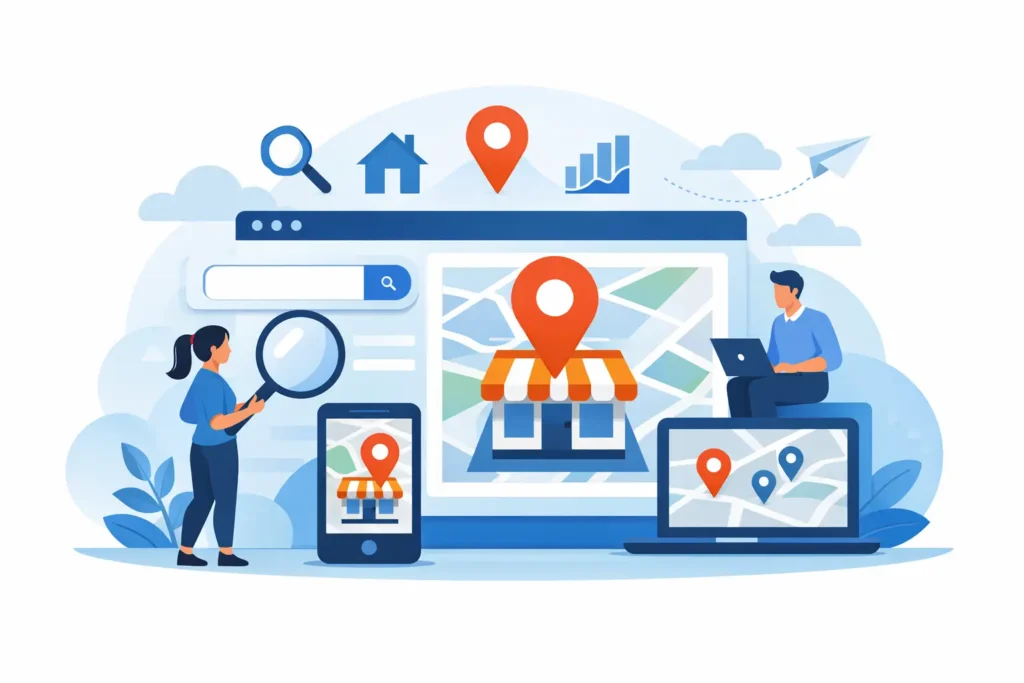
If you’re asking, how do I get my business to show up at the top of Google search?, you’re really asking a revenue question. More visibility means more calls, more form fills, and more booked jobs. For local service businesses, Google is where buyers compare options fast, and the companies that show up first get the first shot at the lead.
The part most business owners miss is that there is no single switch that puts you at the top. Google pulls from multiple systems at once – Google Business Profile, the map pack, organic search results, website quality, review signals, location relevance, and in many cases paid ads. If one of those pieces is weak, your competitors can outrank you even if you do good work.
How do I get my business to show up at the top of Google search?
Start with the right expectation. “Top of Google” can mean three different things. It can mean Google Ads at the top of the page, the local map pack for location-based searches, or the organic website listings underneath. If you’re a roofer, cleaner, electrician, mover, attorney, or HVAC company, the map pack and local organic results usually matter most because that’s where high-intent local buyers make fast decisions.
To rank well, Google has to trust three things. First, that your business is real and active. Second, that your business is relevant to the search. Third, that your business is a strong local option compared with competitors. That means your strategy has to cover your listing, your website, your reviews, and your ongoing activity.
Claim and fully optimize your Google Business Profile
If your Google Business Profile is incomplete, inconsistent, or barely managed, you are handicapping your rankings from day one. Your profile needs accurate business information, the right primary category, strong secondary categories, a real service area, a keyword-aligned business description, current hours, services, products where relevant, and high-quality photos.
This is also where most businesses get sloppy. They verify the profile once, add a few photos, and forget about it. Meanwhile, better-ranked competitors are posting updates weekly, adding fresh photos, answering questions, collecting reviews, and tightening every field Google gives them.
A well-managed profile sends activity and trust signals. An abandoned profile tells Google your business is not being maintained. For local rankings, that difference matters.
Reviews are not optional anymore
A business with a weak review profile usually struggles to hold top positions, especially in competitive local markets. Review count matters, but quality, recency, and response activity matter too. A company with 25 recent, detailed reviews can often outperform one with 100 old reviews and no engagement.
You need a review process, not random luck. Ask every happy customer. Ask at the right moment, usually right after the job is completed and the customer is satisfied. Make it routine for your office staff or field team. Then respond to reviews consistently, because Google sees owner engagement as a positive business signal.
There is a trade-off here. You cannot force review velocity so aggressively that it looks unnatural, and you cannot filter only positive customers in ways that violate platform policies. The goal is steady, legitimate growth.
Your website still decides more than people think
A lot of local business owners assume a Google Business Profile alone is enough. It isn’t. Your listing and your website work together. If your site is thin, slow, outdated, or missing clear service and location signals, your map visibility and organic rankings can both suffer.
Your website needs dedicated service pages and location relevance built into the content. If you serve Dallas and offer roof repair, roof replacement, and storm damage work, those topics should be clearly explained on the site. If you also serve nearby cities, that local coverage needs to be structured carefully, not stuffed awkwardly with city names.
Google wants to understand what you do, where you do it, and why your site deserves to rank. That means clean technical SEO, fast load times, mobile-friendly design, indexable pages, proper title tags, good internal structure, and content that matches what people actually search.
Build pages for real search intent
One homepage cannot rank for everything. Local SEO works better when your website is mapped to actual demand. That usually means separate pages for your main services and, when appropriate, separate location pages for priority cities.
For example, an HVAC company might need pages for AC repair, furnace repair, HVAC installation, heat pump services, and emergency service. A law firm may need separate pages for personal injury, car accidents, workers’ comp, or DUI defense. When each page is focused, rankings become more realistic.
The mistake is building dozens of low-quality pages just to chase keywords. Google is better than that. Thin location pages with near-duplicate text usually do not hold up. Quality beats volume.
Technical SEO is boring until it costs you leads
A lot of ranking problems are not content problems. They’re technical issues. Pages may not be indexed. The site may be too slow on mobile. Metadata may be missing or duplicated. Structured data may be absent. Core pages may be buried too deep in the site. Redirects may be broken. These are quiet issues, but they drag down performance.
If your competitors have cleaner websites and stronger technical foundations, they can outrank you even with weaker branding. That’s why local SEO is not just about keywords. It’s also about execution.
Google Maps rankings depend on local authority
If your goal is calls from nearby buyers, the map pack deserves serious attention. Google Maps rankings are driven by relevance, distance, and prominence. You cannot control the searcher’s location, but you can influence the other two.
Relevance comes from your profile categories, service setup, website content, and listing completeness. Prominence comes from reviews, citations, local mentions, backlinks, brand activity, and overall business authority online. That’s why map rankings improve faster when your listing work and website SEO are aligned instead of handled separately.
Consistent business information across key directories also helps. If your name, address, phone number, and business details are inconsistent across the web, Google gets mixed signals. Cleaning that up will not magically put you in position one overnight, but it strengthens trust and removes friction.
If you need leads now, use Google Ads too
Organic SEO and Google Business Profile optimization are strong long-term assets, but they take time. If you need immediate lead flow, Google Ads can put your business at the top of the page while your organic presence improves.
This is where a lot of service businesses make a costly mistake. They either ignore ads completely or run them without structure. A profitable campaign needs proper geographic targeting, strong keyword selection, negative keywords, conversion tracking, landing page relevance, and regular optimization. Otherwise you end up paying for junk clicks.
Paid search is not a replacement for SEO. It’s a complement. SEO builds durable visibility. Ads buy speed. In many markets, the best strategy is both.
What usually stops businesses from getting to the top
Most local companies do not have one major problem. They have ten small ones stacked together. An incomplete profile, weak categories, poor photos, no posting activity, inconsistent reviews, a thin website, weak service pages, technical errors, no backlinks, and no clear ad strategy. None of those alone is fatal. Combined, they make top rankings very hard.
There’s also the competition factor. If you’re in a light market, you may move quickly with basic fixes. If you’re in a dense metro with aggressive competitors, ranking at the top takes more work and more consistency. That is why results vary by industry and city.
What to focus on first if you want better Google visibility
If your business is not showing up where it should, start with the highest-impact fixes. Make sure your Google Business Profile is fully optimized and actively managed. Build a repeatable review system. Improve your core website pages so they match your services and service areas. Fix technical SEO issues. Then support it all with either local authority work or paid traffic, depending on how fast you need results.
This is also where hands-on execution matters more than theory. Rankings improve when the work gets done every week – new content, better photos, profile updates, review growth, page improvements, and performance tracking. That’s the difference between hoping Google notices your business and giving Google strong reasons to rank it.
For service businesses that rely on local calls and booked jobs, visibility is not a branding exercise. It’s pipeline. If you want to show up at the top, treat Google like an ongoing sales channel, not a one-time setup task. That’s where the real gains happen.