

Local search marketing is the process of maximizing your business’s visibility to nearby customers by combining organic local SEO with paid advertising, reputation management, and social engagement. Unlike broad digital marketing, it targets people who are ready to buy, visit, or call right now. A well-maintained Google Business Profile alone delivers 5x more value than an unclaimed listing. Spinlisting’s data shows clients achieve 83% increases in first-place rankings when all local search elements work together. This guide breaks down every component so you can build a system that works in 2026.
What is local search marketing explained in simple terms?
Local search marketing is a multi-channel system that combines local SEO, paid media, social engagement, and reputation management to capture visibility on maps, AI answer engines, and local packs. Local SEO is one piece of that system. Local search marketing is the whole machine.
The distinction matters because business owners often treat local SEO as the finish line. Organic rankings are powerful, but they build slowly. Paid local ads deliver immediate visibility while organic authority grows. Reputation signals, like review volume and response rate, influence both your ranking and whether a customer chooses you over the next result. All three work together, not in isolation.

Google Business Profile sits at the center of this system. It feeds your map pack ranking, your AI overview appearances, and your local knowledge panel. Every other tactic, from citation building to paid ads, either supports or amplifies what your profile communicates to Google.
What components make up a modern local search marketing strategy?
A complete local search marketing strategy runs across four channels. Each one serves a different function, and cutting any of them creates a gap competitors will fill.
Organic local SEO is the foundation. It includes:
- Google Business Profile optimization with accurate categories, hours, photos, and posts
- On-page SEO with geo-modified keywords on service and location pages
- Consistent NAP data across every citation and directory listing
- Local backlinks from geographically relevant sources like chambers of commerce and local news sites
- Schema markup using LocalBusiness structured data so AI and voice assistants can read your details accurately
Paid local advertising fills the gap while organic results build. Google Local Services Ads appear above standard search results and charge per lead, not per click. Programmatic geo-targeting lets you serve display ads within a defined radius. Social media advertising on platforms like Facebook and Instagram reaches local audiences by zip code, neighborhood, or radius. Understanding the difference between local SEO and paid ads helps you allocate budget without overlap.
Reputation management shapes both rankings and conversions. Review volume, recency, and your response rate all send trust signals to Google’s algorithm. A business that responds to every review, positive or negative, signals active management.
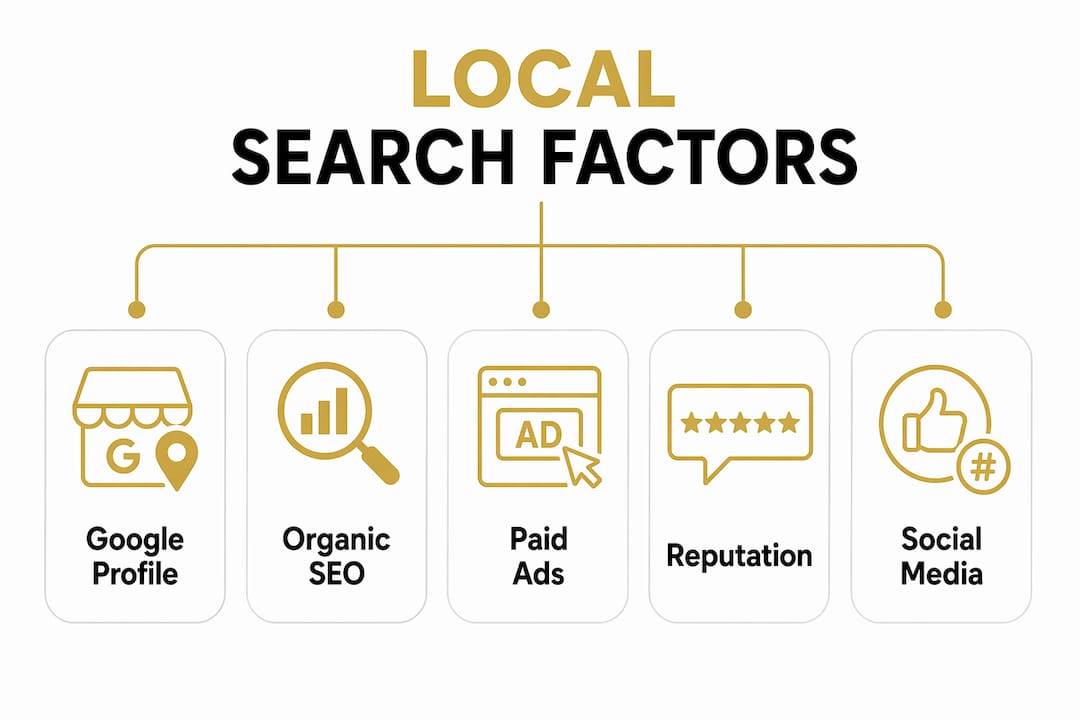
Social engagement builds brand recognition in your community. Regular posts, local event coverage, and tagged location content create behavioral signals that reinforce your geographic relevance.
Pro Tip: Do not treat local SEO and paid ads as competing budget items. Run them in parallel. Paid ads capture demand today; organic SEO captures it tomorrow.
How does local search intent shape keyword and content strategies?
All Google searches carry some level of local intent, even when the user does not type a city name. A search for “emergency plumber” implies the user wants someone nearby. Ignoring that implicit signal costs you high-value traffic.
Local search intent falls into two types. Explicit intent includes a location in the query, like “dog groomer in Tampa.” Implicit intent omits the location but assumes it, like “best coffee near me” or just “coffee shop.” Both types require different keyword strategies but the same underlying goal: matching what the user needs right now.
Query types map to content in a predictable way:
- Do queries (transactional): “emergency plumber Park Slope” or “book a haircut Williamsburg.” These map to service pages with clear calls to action, phone numbers, and booking links.
- Go queries (navigational): “coffee shop Williamsburg” or “dentist office downtown Austin.” These map to location pages with address, hours, photos, and embedded maps.
- Know queries (informational): “best dog groomer in Tampa” or “how much does a roof repair cost in Denver.” These map to blog posts, FAQs, and comparison guides that build trust before the user is ready to act.
Intent-driven, geo-modified keywords consistently outperform broad terms because they reflect user readiness. “Plumber” is a broad term. “24-hour plumber Brooklyn” is a buyer. Voice search amplifies this further. Conversational queries like “who fixes AC units near me open now” require content written in natural language, not keyword-stuffed headers.
Effective keyword research is not a one-time spreadsheet exercise. It runs as a cycle: discover new terms, prioritize by intent and volume, create content, measure performance, then repeat. That cycle keeps your content aligned with how your market actually searches.
Pro Tip: Build a separate location page for each city or neighborhood you serve. Each page should target one primary geo-modified keyword and answer the specific questions buyers in that area ask.
What are the critical ranking factors in local search?
Google ranks local results using three core factors: relevance, distance, and prominence. Relevance measures how well your profile and website match the search query. Distance measures how close your business is to the searcher. Prominence measures how well-known and trusted your business is, based on reviews, backlinks, and citation consistency.
Consistent NAP data across every directory is a foundational trust signal. If your address appears differently on Yelp, your website, and your Google Business Profile, Google’s algorithm treats those as separate entities. That inconsistency suppresses your ranking even when your reviews and content are strong.
Reviews carry more weight than most business owners realize. Businesses with 4.5 stars or higher rank 70% better than lower-rated competitors in local search results. That gap is not just about perception. It reflects a direct algorithmic advantage. Review recency matters too. A business with 200 reviews from three years ago loses ground to one with 40 reviews from the past 90 days.
AI overviews and voice assistants pull business data from Google Business Profile, citations, and your website simultaneously. If those sources conflict, AI systems default to the most authoritative or most recent source, which may not be yours. Structured data and schema markup give AI systems a clean, machine-readable version of your business details. LocalBusiness schema and review markup are no longer optional in 2026.
Behavioral signals also influence ranking. Clicks to your website, calls from your profile, and requests for directions all tell Google that real users find your listing relevant. A fully optimized profile with photos, posts, and accurate hours generates more of these signals than a bare-bones listing.
| Ranking factor | What it measures | How to strengthen it |
|---|---|---|
| Relevance | Match between query and your profile | Add accurate categories, keywords, and service descriptions |
| Distance | Proximity to the searcher | Set correct address or service area in Google Business Profile |
| Prominence | Trust and authority signals | Build reviews, citations, and local backlinks consistently |
| Behavioral signals | User engagement with your listing | Add photos, posts, and complete contact details |
How can local businesses implement a local search marketing strategy?
Implementation works best as a sequence. Start with the foundation, then layer in paid and reputation tactics once the organic base is solid.
- Claim and verify every Google Business Profile. For multi-location businesses, each location needs its own verified profile with unique photos, descriptions, and categories. Do not copy and paste the same content across locations.
- Build dedicated location pages on your website. Each page needs unique localized content, real photos of that location, embedded customer reviews, a local FAQ section, and LocalBusiness schema markup. Template pages with swapped city names trigger duplicate content issues and rank poorly.
- Audit and fix your citations. Use your Google Business Profile as the master record. Every directory listing, from Yelp to Apple Maps to industry-specific sites, should match it exactly. Check your local business listing accuracy at least quarterly.
- Build a review acquisition system. Ask every satisfied customer for a review at the moment of highest satisfaction, whether that is at checkout, after delivery, or at the end of a service call. Respond to every review within 48 hours.
- Launch geo-targeted paid campaigns alongside organic efforts. Google Local Services Ads work well for service businesses. Set your radius to match your actual service area, not a wishful one. Track calls and leads separately from website traffic.
- Add local SEO keywords to your listing and website. Integrate geo-modified terms into your Google Business Profile description, service names, and website headers. Spinlisting’s guide on adding local keywords walks through this process step by step.
- Audit your strategy every quarter. Search algorithms, AI behavior, and competitor activity all shift. What ranked you six months ago may not rank you today. Review your local search ranking performance regularly and adjust.
Businesses without a physical storefront can still rank in local packs. Service area businesses that configure their coverage zones in Google Business Profile appear regularly in local results. The key is specifying your service area accurately rather than leaving it blank.
Pro Tip: For location pages, include a short paragraph written by or about a real employee at that location. That level of specificity signals genuine geographic relevance to both Google and AI systems.
The benefits of local SEO compound over time. Each review, citation, and piece of localized content adds to a cumulative authority that paid ads alone cannot replicate.
Key Takeaways
Local search marketing requires integrating organic SEO, paid advertising, reputation management, and consistent business data to build lasting visibility in local results.
| Point | Details |
|---|---|
| Google Business Profile is the core | Every local tactic supports or amplifies what your profile communicates to Google. |
| NAP consistency is non-negotiable | Mismatched name, address, or phone data across directories suppresses your ranking. |
| Reviews drive rankings and revenue | Businesses rated 4.5 stars or higher rank 70% better than lower-rated competitors. |
| Intent shapes your content strategy | Map Do, Go, and Know queries to service pages, location pages, and blog content respectively. |
| Paid and organic work together | Paid ads capture demand immediately; organic authority sustains visibility long term. |
Why local search marketing is harder than it looks
Most business owners underestimate local search marketing because the entry point looks simple. Claim your Google Business Profile, add some photos, and wait. That approach worked in 2018. It does not work now.
The shift I see most clearly is the move from map-pack rankings to entity-centric optimization for AI answer engines. Google no longer just matches keywords to listings. It builds a model of your business as an entity, cross-referencing your profile, citations, website, reviews, and structured data. If those sources conflict or lack detail, AI systems simply skip you and recommend a competitor whose data is cleaner.
The second mistake I see constantly is treating local SEO as a one-time project. Business owners invest in a profile setup, get a small ranking bump, and then stop. Six months later, a competitor with fresher reviews and updated photos has taken their spot. Local search marketing is a maintenance system, not a launch event.
The third blind spot is implicit local intent. Business owners optimize for “plumber Denver” but ignore “emergency plumber” or “pipe burst fix.” Those shorter, urgent queries carry massive commercial value, and ignoring implicit local signals means leaving high-intent traffic on the table.
The businesses winning in local search right now treat it as an integrated operation. They run paid ads, manage reviews weekly, update their profiles monthly, and build location content on a schedule. That consistency compounds. It is not glamorous work, but it is what separates page one from page three.
— Against
How Spinlisting helps you rank in local search
Spinlisting specializes in Google Business Profile optimization and local SEO for businesses that need real, measurable results, not generic advice.

Spinlisting’s approach covers the full local search marketing system: profile optimization with local SEO keywords, citation audits, review strategy, and AI-ready structured data. Clients see an average 83% increase in first-place rankings. If you are ready to build a local search presence that holds up in 2026, explore Spinlisting’s local SEO services and see what a fully managed strategy looks like for your business.
FAQ
What is local search marketing?
Local search marketing is the practice of increasing a business’s visibility to nearby customers through a combination of organic local SEO, paid advertising, reputation management, and social engagement. The goal is to drive qualified local traffic, not just website visits.
How is local SEO different from local search marketing?
Local SEO covers only organic tactics like Google Business Profile optimization, citations, and on-page content. Local search marketing includes local SEO plus paid ads, reputation management, and social signals working together as one system.
What is local search intent?
Local search intent is the expectation that a search query relates to a nearby business or location, either explicitly (the user types a city name) or implicitly (the user types “near me” or a service name without a location). Most searches carry some local intent, even without a geographic modifier.
How do reviews affect local search rankings?
Reviews influence local rankings through volume, recency, star rating, and response rate. Businesses rated 4.5 stars or higher rank significantly better than lower-rated competitors, and fresh reviews outperform older ones regardless of total count.
Do service area businesses rank in local search?
Yes. Service area businesses that configure their coverage zones in Google Business Profile appear regularly in local packs, even without a physical storefront. Accurate service area settings are required for consistent visibility.
Recommended
- Local SEO vs Paid Ads Explained for Business Owners | Google my Business for SEO / ranking services SEO
- Local Search Market Share: What Businesses Must Know | Google my Business for SEO / ranking services SEO
- Local Online Marketing Budget Tips for Small Businesses | Google my Business for SEO / ranking services SEO
- Why Mobile Search Drives Local Traffic to Your Business | Google my Business for SEO / ranking services SEO