

Local SEO ranking factors are the specific signals Google uses to decide which businesses appear in nearby search results. Understanding these factors is the difference between showing up in the Local Pack and being invisible to customers searching a block away. Google Business Profile signals carry roughly 32% of total local ranking weight, making profile optimization the single highest-leverage activity for most local businesses. This guide breaks down every major signal, assigns real weights to each, and tells you exactly where to focus first.
What are the core local SEO ranking factors in 2026?
Google ranks local businesses using three foundational pillars: relevance, distance, and prominence. Every local SEO signal you can name feeds into one of these three categories. Knowing which pillar each signal belongs to tells you how much control you actually have over it.
Relevance measures how well your business matches what the searcher wants. A plumber who lists only “plumbing” as a category is less relevant to a “drain cleaning near me” search than one who lists “drain cleaning” as a secondary category with supporting website content.

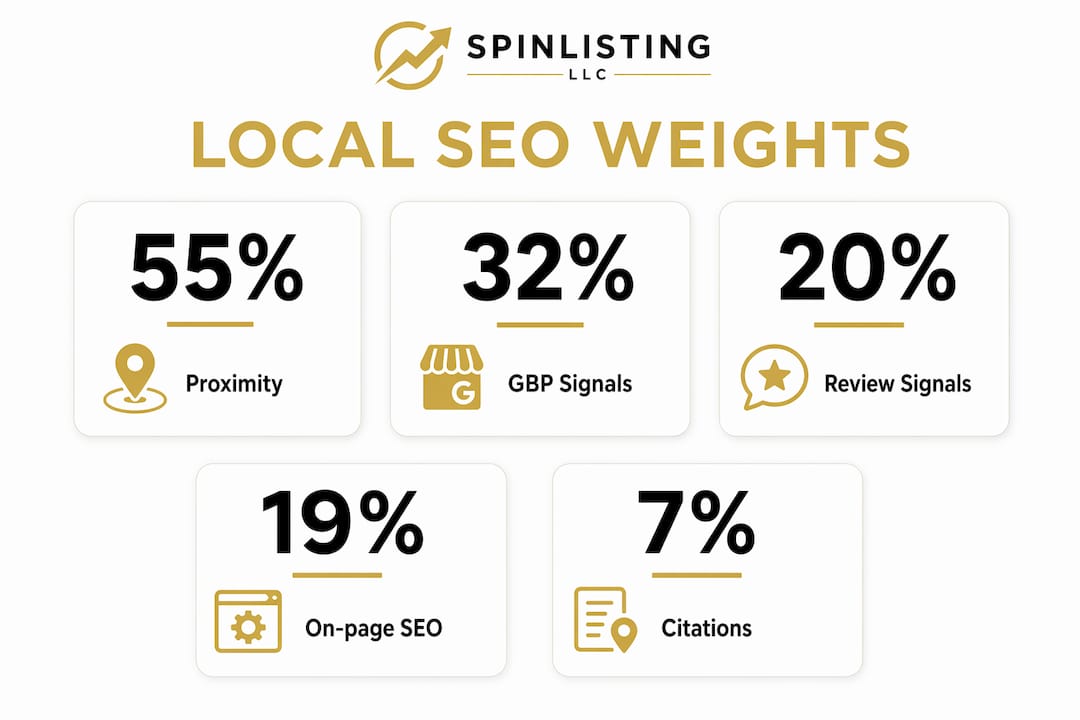
Distance is the most powerful pillar and the one you control least. Proximity drives roughly 55% of all local pack ranking decisions, and 70% of top Local Pack spots go to businesses within 1–3 miles of the searcher. That stat should reset your expectations. If a competitor is physically closer to your customer, no amount of profile optimization will fully overcome that gap.
Prominence reflects how well known and trusted your business is, both online and offline. This is where reviews, backlinks, citations, and behavioral signals all live. Prominence is the pillar where consistent effort pays off most reliably over time.
Here is how the major ranking signals break down by estimated weight:
- Google Business Profile signals: ~32% (categories, completeness, posts, photos)
- Review signals: ~20% (velocity, recency, sentiment, star rating)
- On-page SEO: ~19% (NAP consistency, local content, schema markup)
- Link signals: ~15% (local authority backlinks, topical relevance)
- Behavioral signals: ~8% (CTR, calls, direction requests)
- Citation signals: ~7% (directory listings, NAP accuracy)
The importance of local SEO becomes clear when you see these weights. More than half of your ranking influence comes from factors you can directly control.
Which Google Business Profile signals most impact local rankings?
Your Google Business Profile is the single most controllable ranking asset you have. GBP signals account for approximately 32% of local pack ranking influence, which means an incomplete or neglected profile is leaving a third of your potential ranking power on the table.
The primary category you select is the most critical field in your entire profile. Google uses it to determine which searches your business is eligible to appear for. A dental practice that selects “Dentist” as its primary category and adds “Cosmetic Dentist” and “Teeth Whitening Service” as secondary categories captures a far wider range of relevant searches than one with a single category.
Profile completeness matters more than most business owners realize. Every field you leave blank is a relevance signal you are not sending. Fill in your business description with locally specific language, add your service areas, list your products or services with descriptions, and keep your hours accurate, including holiday hours.
Regular posts and photo updates tell Google your business is active. A profile that has not been updated in six months signals low engagement. Businesses that post weekly and add new photos monthly maintain stronger freshness signals than those that set up a profile and walk away.
Pro Tip: Treat your Google Business Profile like your most important storefront window. A customer who finds it dark and empty will keep walking.
One critical warning: keyword stuffing your business name field triggers policy enforcement suspensions. Writing “Joe’s Plumbing Best Plumber Chicago” instead of “Joe’s Plumbing” violates Google’s guidelines and can get your profile suspended entirely. The risk is never worth it.
Key GBP elements to complete and maintain:
- Primary and secondary business categories
- Full business description with local keywords used naturally
- Service area settings (for service-area businesses)
- Products and services with descriptions and prices
- Q&A section with pre-answered common questions
- Weekly posts with offers, updates, or events
- Fresh photos added at least monthly
Use Spinlisting’s guide on optimizing your Google Business Profile to work through every field systematically.
How do review signals influence local rankings and trust?
Review signals carry about 20% of local ranking weight, making them the second most influential factor you can actively manage. The mechanics of how reviews affect rankings are more nuanced than most business owners expect.
Review velocity and recency now outrank total review count as ranking signals. A business that receives five new reviews per month consistently will outrank a competitor sitting on 200 stale reviews from three years ago. That shift in Google’s algorithm rewards businesses that maintain ongoing customer engagement rather than those that ran a one-time review campaign.
Star rating quality matters in a counterintuitive way. A 4.5 to 4.9 average star rating outperforms a perfect 5.0 because Google’s authenticity algorithms flag perfect ratings as potentially manipulated. A small number of honest critical reviews actually builds credibility rather than hurting it.
Online reviews directly drive revenue growth for small businesses, which means the ranking benefit and the conversion benefit work together. Every review you earn improves both your position in search and your appeal to customers who find you there.
AI-driven local recommendations add another layer. Businesses with 150 or more quality reviews are more reliably surfaced in AI-generated local recommendations, including Google’s AI Overviews. That threshold is a practical benchmark worth targeting.
Key review signal factors ranked by impact:
- Velocity: Steady monthly flow of new reviews
- Recency: Reviews from the past 90 days weighted most heavily
- Sentiment: Positive language around specific services boosts relevance
- Response rate: Replying to reviews strengthens engagement signals
- Star rating: Target 4.5–4.9, not 5.0
- Platform diversity: Reviews on Google, Yelp, and industry-specific platforms increase AI entity recognition
What roles do on-page SEO, links, and citations play?
On-page SEO contributes about 19% of local ranking influence, making your website the second most important asset after your Google Business Profile. The website’s job in local SEO is to validate and reinforce everything your GBP claims.
NAP consistency is the foundation. Single errors in your name, address, or phone number across directories reduce trust signals significantly. If your GBP says “Suite 200” and your website says “Ste. 200,” that inconsistency creates entity fragmentation. Google becomes less confident your profile and website belong to the same business.
LocalBusiness schema markup on your website helps Google verify your business information with structured data. A mismatch between your schema data and your GBP can actively hurt rankings. Keep both in sync.
Local backlinks carry significant weight within the 15% allocated to link signals. Links from local news sites, chambers of commerce, and community organizations build both topical and geographic relevance. A link from your city’s business journal is worth more than 50 links from generic national directories.
Pro Tip: Before chasing new citations, audit the ones you already have. One wrong phone number on a high-authority directory does more damage than ten missing listings.
| Signal type | Estimated weight | Priority action |
|---|---|---|
| On-page SEO | ~19% | NAP consistency, local content, schema |
| Link signals | ~15% | Local authority backlinks |
| Citation signals | ~7% | Accuracy over quantity |
Citations still matter at roughly 7% of ranking weight, but their influence has declined. Unstructured mentions in local blog posts and news articles now complement structured directory citations. Use a local business listing guide to audit your existing citations before building new ones.
Trust in local SEO is increasingly tied to E-E-A-T, meaning geographic relevance backed by local projects, testimonials, and community involvement carries more weight than generic content targeting broad regions.
How do behavioral and AI-driven signals affect rankings in 2026?
Behavioral signals represent about 8% of local pack ranking weight, and that share grows every year. Click-through rate, direction requests, and click-to-call actions feed Google real-world evidence that your business is relevant and trusted by actual people.
Here is how behavioral signals build on each other:
- Click-through rate: A higher CTR from search results tells Google your listing is more relevant than competitors for that query.
- Direction requests: Frequent requests signal physical prominence and confirm your location is actively sought out.
- Click-to-call: Mobile users who call directly from your listing generate strong engagement signals tied to purchase intent.
- Website visits from GBP: Traffic from your profile to your website confirms relevance across both assets.
- Photo views: High photo engagement correlates with stronger profile authority.
AI personalization adds a new dimension to local rankings. Google’s Gemini AI adjusts local results dynamically based on user history, device type, and time of day. Two people searching the same phrase in the same city can see different Local Pack results. That personalization makes consistent, broad engagement signals more valuable than ever.
AI now evaluates the semantic content of reviews and unstructured mentions to score relevance. When a customer writes “their emergency plumbing team fixed our burst pipe in under an hour,” that specific language becomes a relevance signal for “emergency plumber” searches. Encouraging customers to describe their experience in detail produces better ranking signals than generic “great service!” reviews.
A business with clear service area pages and steady active engagement maintains stronger rankings than one using generic broad geographic targeting. Specificity wins in both content and engagement.
Key Takeaways
Google Business Profile optimization, review velocity, and NAP consistency are the three highest-impact controllable factors in local SEO, and businesses that prioritize them in that order will see the fastest ranking gains.
| Point | Details |
|---|---|
| GBP signals lead all factors | At ~32% weight, your Google Business Profile is the single most important ranking asset to maintain. |
| Review velocity beats total count | A steady flow of recent reviews outranks a large, stale review history every time. |
| Distance is largely fixed | Proximity drives ~55% of local pack decisions, so focus your energy on the factors you can control. |
| NAP consistency is non-negotiable | A single address mismatch across directories creates entity fragmentation that hurts rankings. |
| Behavioral signals grow yearly | CTR, calls, and direction requests now account for ~8% of ranking weight and are rising. |
Why I stop telling small businesses to chase citations first
The conventional advice for local SEO has always started with citations. Build your listings, get consistent NAP data everywhere, then worry about the rest. After working with local businesses across dozens of markets, I think that order is backwards for most of them.
The businesses I see move fastest in local rankings are the ones that fix their Google Business Profile first, then build a review generation habit, and only then clean up citations. The reason is simple: GBP signals carry 32% of ranking weight and citations carry 7%. If you spend three months building directory listings before your profile is complete, you are working on the wrong problem.
Distance is the factor that trips people up emotionally. Business owners want to believe that if they just do enough SEO work, they can outrank a competitor who is physically closer to their customers. Sometimes they can, especially when that competitor has a weak profile and no reviews. But accepting the distance constraint frees you to focus on what actually moves the needle: a complete profile, a steady review stream, and locally relevant website content.
The shortcut tactics worry me most. Keyword stuffing a business name for a quick ranking bump is the kind of move that gets a profile suspended right before a busy season. The businesses that win long-term treat their GBP like a living asset, not a one-time setup task. Run a local SEO audit at least twice a year to catch drift before it costs you rankings.
— Against
How Spinlisting helps you rank where it counts
Ranking in the Local Pack requires consistent attention to the signals that matter most. Spinlisting specializes in exactly that work.

Spinlisting’s Google Business Profile optimization service covers every ranking signal covered in this article, from category selection and profile completeness to photo strategy and post scheduling. The team also manages review generation programs that build the steady velocity Google rewards. Spinlisting clients have seen 83% increases in first-place local rankings through this approach. If you want a clear picture of where your local SEO stands right now, the 2026 local search ranking guide is the right place to start.
FAQ
What is the most important local SEO ranking factor?
Google Business Profile signals carry the highest weight at approximately 32% of total local ranking influence. Completing and actively maintaining your GBP is the single highest-impact action most local businesses can take.
How much does proximity affect local search rankings?
Proximity drives roughly 55% of all local pack ranking decisions, with 70% of top spots going to businesses within 1–3 miles of the searcher. Distance is largely outside your control, which is why optimizing controllable signals matters so much.
What star rating is best for local SEO?
A 4.5 to 4.9 average star rating performs better than a perfect 5.0. Google’s authenticity algorithms interpret a flawless rating as potentially manipulated, so a small number of honest critical reviews actually supports credibility.
How many reviews do I need for AI-driven local recommendations?
Businesses with 150 or more quality reviews are more reliably surfaced in AI-generated local recommendations, including Google’s AI Overviews. Reaching that threshold makes your business a recognized entity in AI-driven local search.
Does NAP consistency still matter for local SEO in 2026?
NAP consistency remains critical. A single error in your name, address, or phone number across directories creates entity fragmentation that reduces Google’s confidence in your business data and can lower your rankings.
Recommended
- Improve Local Search Ranking: 2026 Strategy Guide | Google my Business for SEO / ranking services SEO
- Local SEO Audit Checklist: Your 2026 Strategy Guide | Google my Business for SEO / ranking services SEO
- Local Search Market Share: What Businesses Must Know | Google my Business for SEO / ranking services SEO
- Local Business Listing Essentials: Your 2026 Guide | Google my Business for SEO / ranking services SEO