

Business age is not a direct ranking factor in Google’s algorithm. The role of business age in SEO is indirect: it reflects the cumulative trust signals a business builds over time, including backlinks, reviews, citations, and profile completeness. A five-year-old business does not outrank a two-year-old business because of age alone. It outranks because it has had more time to accumulate evidence of value. The good news for newer businesses is that evidence can be built fast, and local search rankings reward momentum as much as longevity.
How does business age affect SEO rankings?
Search engines treat business age as a proxy for authority, not as a direct signal. Google confirms that website age is not a direct ranking factor. A newer site can outrank an older one by demonstrating superior relevance and value. Age matters only because older businesses have had more time to accumulate the signals that actually move rankings.
Those signals fall into three categories:
- Backlinks: External sites linking to your business signal credibility. Older businesses accumulate these over years of operation, press coverage, and partnerships.
- Reviews: A consistent stream of positive reviews builds trust with both search engines and customers. Review volume and recency both count.
- Citations: Mentions of your business name, address, and phone number across directories and local sites reinforce your legitimacy in local search.
“Age matters only insofar as it allowed accumulation of meaningful reviews, backlinks, and citations. Search engines treat business age as a proxy for cumulative authority signals rather than an intrinsic ranking signal.”
The median age of pages ranking in Google’s top 10 exceeds two years, and only 5.7% of new pages reach top rankings within their first year. That statistic does not mean age causes rankings. It means authority takes time to build when businesses grow it passively. Businesses that build authority actively can compress that timeline significantly.
Can newer businesses outrank older ones in search?

Newer businesses can absolutely outrank older ones, and they do it regularly. The key is documented, current evidence. AI-driven search engines favor four types of evidence: recent reviews, complete profiles, fresh content, and third-party validation. A business that opened six months ago with 80 recent reviews and a fully optimized Google Business Profile will outperform a ten-year-old business with 12 outdated reviews and a stale listing.
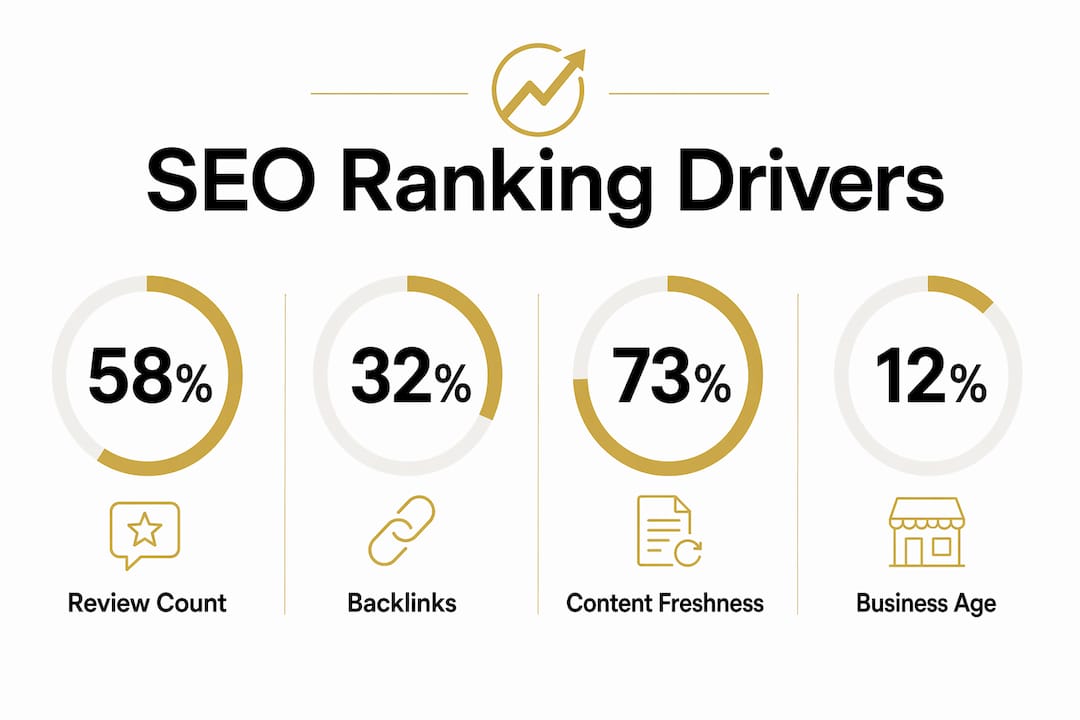
Newer businesses also carry a structural advantage that most owners overlook: agility. They can update their profiles, publish new content, and respond to reviews faster than large, established operations with slow internal processes. That speed translates directly into the freshness signals that search algorithms reward.
Pro Tip: Focus your first 90 days on review velocity. Ask every satisfied customer for a Google review immediately after the transaction. Recency matters more than total volume in local search.
The specific advantages newer businesses can act on include:
- Publishing fresh, locally relevant content at least twice per month
- Completing every field in the Google Business Profile, including services, hours, and photos
- Earning citations from local directories, chambers of commerce, and industry associations
- Targeting long-tail keywords with lower competition while building domain authority
- Responding to every review, positive or negative, within 48 hours
Listing age serves as a maturity marker in local SEO but is not a standalone Google Business Profile ranking factor. What the listing age actually correlates with is the accumulation of reviews and citations over time. Replicate that accumulation quickly, and the age gap closes.
Common myths about business age and search performance
The biggest myth in local SEO is that longevity protects rankings. It does not. Older businesses lose top positions every day because they stop actively managing their online presence. Stale profiles, low review recency, and poor category alignment reduce older listings’ performance despite any age advantage they once held.
The three real ranking factors in local SEO are relevance, distance, and prominence. Age does not appear in that list. A business that matches the searcher’s query precisely, sits close to the searcher’s location, and shows strong engagement signals will rank above an older business that scores poorly on any of those three dimensions.
| Factor | What it means | Who it favors |
|---|---|---|
| Relevance | How well your profile matches the search query | Any business with a complete, accurate profile |
| Distance | Proximity to the searcher’s location | Any business in the right geographic area |
| Prominence | Reviews, backlinks, citations, and engagement | Businesses actively building authority signals |
| Freshness | Recency of content, reviews, and profile updates | Businesses with active ongoing optimization |
| Profile completeness | All fields filled, photos added, services listed | Any business willing to invest the time |
Older businesses that coast on their history face a specific risk from AI-powered search. AI search engines reward recent, documented evidence and third-party validation. Years of offline reputation count only when converted into accessible online data. A business with 20 years of excellent service but no recent reviews and an incomplete profile loses to a two-year-old competitor with strong digital documentation.
The incumbent advantage in search rankings is declining because of this shift. AI does not assume a long-standing business is trustworthy. It looks for proof.
Practical SEO strategies for new businesses to build authority fast
Building authority quickly requires a structured approach, not random effort. The businesses that close the age gap fastest focus on three pillars: technical excellence, content quality, and active reputation management.
-
Complete your Google Business Profile fully. Add every service, upload at least 10 photos, write a keyword-rich business description, and set accurate hours. An incomplete profile signals neglect to both search engines and customers. Spinlisting’s Google Business Profile optimization guide covers every field that moves rankings.
-
Build review velocity from day one. Ask for reviews systematically, not occasionally. Set up a follow-up process that prompts customers within 24 hours of a positive experience. The recency of reviews heavily impacts recommendation algorithms.
-
Publish locally relevant content consistently. Write about neighborhood events, local customer stories, and service-specific topics that target long-tail keywords. Fresh content signals an active, relevant business.
-
Earn citations from authoritative local sources. Get listed in your local chamber of commerce directory, industry associations, and established local directories. Consistent name, address, and phone number data across all listings reinforces your local authority.
-
Prioritize technical SEO from the start. Newer websites that close the authority gap fastest focus on technical SEO excellence, superior content, and strategic authority building. Core Web Vitals, mobile performance, and crawlability are table stakes, not optional extras.
Pro Tip: Run a local SEO audit every quarter. Identify gaps in citations, profile completeness, and review recency before they cost you rankings.
| Action | Timeline | Expected impact |
|---|---|---|
| Complete Google Business Profile | Week 1 | Immediate improvement in profile visibility |
| Launch review request process | Week 1–2 | Builds review velocity within 30 days |
| Publish 2 local content pieces per month | Ongoing | Freshness signals improve within 60–90 days |
| Build 10+ local citations | Month 1–2 | Strengthens local authority over 90 days |
| Technical SEO audit and fixes | Month 1 | Crawlability and speed improvements immediate |
Understanding local search market share helps you prioritize which actions deliver the fastest competitive return in your specific market.
Key Takeaways
Business age influences SEO only as a proxy for accumulated authority signals, and newer businesses that build reviews, citations, and content actively can compete with and outrank older rivals.
| Point | Details |
|---|---|
| Age is a proxy, not a signal | Google does not rank businesses by age; it ranks by relevance, prominence, and distance. |
| Authority can be built fast | Newer businesses that focus on reviews, citations, and content can close the gap within 90 days. |
| Stale profiles hurt older businesses | Outdated listings and low review recency cost established businesses their ranking advantage. |
| AI favors fresh documentation | AI search rewards recent reviews and complete profiles over years of offline reputation. |
| Profile completeness is non-negotiable | Every unfilled field in a Google Business Profile is a missed ranking opportunity. |
The illusion of tenure in local search
I have worked with businesses on both ends of the age spectrum, and the pattern is consistent: the ones that treat SEO as a one-time setup always lose ground, regardless of how long they have been operating. A 15-year-old plumbing company with a neglected Google Business Profile and 8 reviews from 2021 is not competing. A two-year-old competitor with 90 recent reviews, weekly photo updates, and a complete profile is winning that market.
What surprises most business owners is how quickly the gap closes when they commit to active optimization. The shift toward AI-powered search makes this even more pronounced. AI does not give credit for years in business. It reads the available evidence and recommends whoever looks most credible right now. That is a fundamentally different game than the one older businesses learned to play.
My honest advice to newer businesses: stop waiting to feel established. Document your value aggressively from day one. Collect reviews, fill out every profile field, and publish content that proves your expertise. The businesses that win in local search in 2026 are the ones that treat their online presence as a living record of their quality, not a static listing they set up once and forgot.
For older businesses, the caution is equally direct. Your history is invisible to search engines unless it is converted into current, accessible signals. Audit your profile, refresh your content, and restart your review collection process. Tenure is not a ranking factor. Documented excellence is.
— Against
How Spinlisting helps businesses of all ages rank higher

Whether your business opened last month or has operated for a decade, the path to stronger local rankings runs through the same place: a fully optimized, actively managed Google Business Profile. Spinlisting specializes in exactly that. The team builds profiles that are accurate, keyword-rich, and updated consistently, which is the combination that drives the 83% increases in first-place rankings Spinlisting clients see. For business owners who want a clear, structured approach to improving local visibility, Spinlisting’s 2026 optimization strategies cover every ranking signal that matters, from review management to citation building to profile completeness.
FAQ
Does business age directly affect Google rankings?
No. Google confirms that website age is not a direct ranking factor. Rankings depend on relevance, prominence, and the quality of accumulated authority signals.
Why do older businesses often rank higher in local search?
Older businesses typically have more reviews, backlinks, and citations built up over time. Those signals drive rankings, not the age itself.
How long does it take a new business to rank well in SEO?
Only 5.7% of new pages reach top Google rankings within their first year. Businesses that actively build reviews, citations, and content can significantly compress that timeline compared to passive approaches.
Can a new business outrank an established competitor?
Yes. A newer business with a complete Google Business Profile, strong review velocity, and fresh content regularly outranks older businesses with stale or incomplete profiles.
What is the fastest way for a new business to build local SEO authority?
Complete your Google Business Profile fully, launch a systematic review request process, and build citations from local directories in your first 30 days. Those three actions deliver the fastest measurable impact on local rankings.
Recommended
- Improve Local Search Ranking: 2026 Strategy Guide | Google my Business for SEO / ranking services SEO
- Why Mobile Search Drives Local Traffic to Your Business | Google my Business for SEO / ranking services SEO
- Why GMB Optimization Beats Competitors in Local Search | Google my Business for SEO / ranking services SEO
- Local Search Market Share: What Businesses Must Know | Google my Business for SEO / ranking services SEO