

Targeting local customers on Google search means configuring your online presence and ad settings to appear prominently when nearby shoppers search for what you sell. Google Business Profile (GBP) signals carry 36% of local ranking weight, making your listing the single most powerful lever you control. The industry term for this discipline is local SEO, and it combines profile optimization, citation building, and paid location targeting into one system. Get all three working together, and you reach nearby customers who are already ready to buy.
How to target local customers on Google search with your Business Profile
Your Google Business Profile is the foundation of every local SEO strategy. Complete, verified profiles are 2.7x more likely to be seen as reputable by Google’s algorithm. That credibility directly translates into higher placement in the Local Pack, the three-business block that dominates local search results pages.
A fully built profile does more than rank better. Verified, complete profiles generate 4x more website visits than incomplete ones. That gap exists because Google rewards profiles that give searchers everything they need without clicking away.
Here is what a complete profile requires:
- Accurate NAP: Your business name, address, and phone number must match exactly what appears on your website and every directory listing.
- Primary category: Choose the most specific category that describes your core service. A plumber should select “Plumber,” not “Home Services.”
- Business description: Write 2–3 sentences using location-specific keywords naturally. Mention the city or neighborhood you serve.
- Photos: Upload at least 10 photos at launch, then add new ones monthly. Profiles with fresh photos signal active management to Google.
- Posts and Q&A: Publish a Google Post at least twice per month. Answer every question in the Q&A section, even if you write the question yourself.
- Reviews: Review signals account for 15–20% of Local Pack ranking weight. Businesses with over 100 reviews earn 3.2x higher rankings than those with fewer.
The review threshold matters more than most business owners realize. Reaching 100 reviews is not about vanity. It is a measurable ranking trigger. Ask every satisfied customer by text or email within 24 hours of service, when the experience is still fresh.
Pro Tip: Set a recurring calendar reminder every Monday to check your GBP for new questions, flag outdated hours, and respond to any reviews from the prior week. Consistent engagement signals to Google that your listing is actively managed.
For a detailed walkthrough of every profile field, the 2026 GBP optimization guide from Spinlisting covers each step with current best practices.
How does Google Ads location targeting help you reach nearby customers?
Google Ads location targeting lets you control exactly who sees your ads based on where they physically are. The default setting, called “Presence or interest,” includes people who have recently searched for your area but may live hundreds of miles away. That default wastes 20–30% of ad budgets on clicks from people who will never walk through your door.

Switch the setting to “Presence” only, and your ads show exclusively to people physically located in your target area. This one change alone can significantly improve your cost per lead without touching your bids or creative.
Follow these steps to set up location targeting correctly:
- Set location match to “Presence.” Go to Campaign Settings, then Locations, then Location Options. Select “People in or regularly in your targeted location.”
- Start with a 3–5 mile radius. Radius targeting under 3 miles limits the data Google’s machine learning needs to optimize delivery. A 3–5 mile radius gives the algorithm enough volume to learn.
- Add negative locations. Exclude zip codes or cities outside your service area. A roofing company in Austin should exclude suburbs it does not serve, even if they fall within the radius.
- Apply bid adjustments. After two weeks of data, identify the zip codes driving the most conversions. Raise bids by 15–25% in those areas and lower them in underperforming zones.
- Skip “near me” keyword stuffing. Google resolves “near me” searches by the user’s physical location, not by keywords on your page or in your ad copy. Adding “near me” to every headline does not improve proximity matching.
Pro Tip: Download your location report from Google Ads every 30 days. Sort by cost per conversion by zip code. You will almost always find two or three zip codes driving 60–70% of your results. Concentrate budget there before expanding.
| Targeting method | Best use case | Key risk |
|---|---|---|
| Radius (3–5 miles) | Service-area businesses, restaurants | Too narrow limits machine learning |
| City or zip code | Retailers with fixed locations | May include non-service areas |
| Negative locations | Excluding out-of-area clicks | Easy to overlook, costs budget |
| Bid adjustments | Scaling high-performing zones | Requires 2+ weeks of data first |
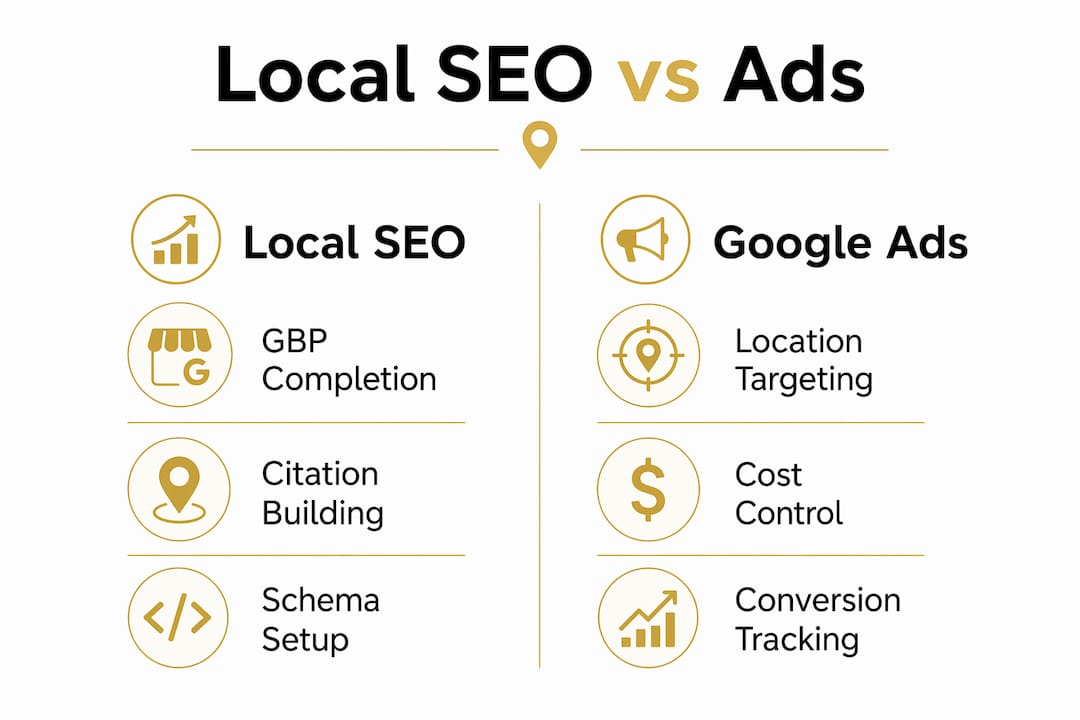
For business owners weighing organic versus paid approaches, the local SEO vs. paid ads breakdown from Spinlisting explains when each channel delivers better returns.
What local SEO practices increase local visibility beyond your GBP?
Google’s local ranking algorithm scores every business on three factors: relevance, distance, and prominence. Distance is largely outside your control. On-page signals and citations account for 33% of ranking weight, which means prominence is where you compete.
These tactics build the prominence signals Google measures:
- NAP consistency: Your name, address, and phone number must be identical across Google, Yelp, Bing Places, Apple Maps, and every industry directory. Even minor differences, like “St.” versus “Street,” create conflicting signals.
- LocalBusiness schema markup: Add structured data to your website’s homepage and contact page. Schema tells Google’s crawlers your exact address, hours, and service area in machine-readable format, which improves Local Pack appearance.
- Service area pages: Create a dedicated page for each city or neighborhood you serve. A landscaper covering three suburbs should have three separate pages, each with unique content about local projects and service details.
- Review diversity: Collect reviews across Google, Facebook, and industry-specific platforms. Google’s AI now analyzes semantic review content to match listings with keyword-rich searches. A review that mentions “emergency plumber in downtown Denver” carries more ranking value than a generic five-star rating.
- Social media location tags: Tag your city and neighborhood in every post. Location engagement on Instagram and Facebook feeds brand signals back into Google’s prominence scoring.
Understanding why local SEO benefits local businesses goes beyond rankings. It builds the kind of sustained visibility that paid ads cannot replicate on their own.
The local business listing essentials guide from Spinlisting covers citation building and schema setup in detail for business owners who want a step-by-step reference.
Common mistakes that hurt your local Google search targeting
Most local targeting failures come from a small set of repeatable errors. Knowing them in advance saves weeks of wasted budget and lost rankings.
- Radius set too narrow: A targeting radius under 3 miles starves Google’s algorithm of the data it needs to optimize. Start wider and tighten once you have performance data.
- Unclaimed or stale GBP: An unclaimed profile cannot be optimized. A stale one, with outdated hours or no recent photos, signals neglect to both Google and potential customers.
- Ignoring behavioral signals: Click-through rate, click-to-call actions, and direction requests all feed Google’s ranking model. A profile that gets views but no clicks tells Google it is not satisfying searchers.
- Default Google Ads location settings: Leaving the location match on “Presence or interest” instead of “Presence” is the single most common paid search mistake for local businesses.
- Review request spikes: Sending a mass review request to your entire customer list at once creates an unnatural spike. Google’s spam filters flag sudden surges. Build reviews steadily, five to ten per week, rather than in bursts.
Consistent, incremental improvement across your GBP, your ad settings, and your citation profile compounds over time. The businesses that dominate local search in 2026 are not the ones that ran one big campaign. They are the ones that maintained their signals every single week.
Run a local SEO audit at least once per quarter to catch these issues before they cost you rankings.
Key Takeaways
Targeting local customers on Google search requires a complete Google Business Profile, precise ad location settings, and consistent citation signals working together.
| Point | Details |
|---|---|
| GBP is the top ranking signal | Complete, verified profiles carry 36% of local ranking weight and generate 4x more website visits. |
| Reviews drive rankings measurably | Businesses with 100+ reviews rank 3.2x higher in the Local Pack than those with fewer. |
| Fix your Google Ads location setting | Switch from “Presence or interest” to “Presence” to stop wasting 20–30% of your ad budget. |
| Build prominence through citations | NAP consistency and LocalBusiness schema markup account for 33% of local ranking weight. |
| Avoid review spikes | Build reviews steadily at 5–10 per week. Sudden surges trigger Google’s spam filters. |
What I’ve learned from watching local businesses win and lose on Google
The businesses I see consistently win in local search share one habit: they treat their Google Business Profile like a storefront window, not a set-and-forget form. They update photos after every project, respond to every review within 48 hours, and post weekly. That cadence is not glamorous. It is just effective.
The shift toward AI-driven personalization in Google’s local algorithm changes the game in a way most business owners have not caught up with yet. Google now tailors Local Pack results by search history, device type, and time of day. A searcher who has visited your website before is more likely to see your listing again. That means every interaction, every click, every call, feeds a feedback loop that either reinforces or weakens your position.
What I find most underused is the combination of semantic review content and service area pages. A review that names a specific neighborhood, service type, and outcome is worth more than ten generic five-star ratings. Coaching your customers to write descriptive reviews, not just star ratings, is one of the highest-return activities a local business owner can do.
The integrated approach matters most. Paid location targeting and organic local SEO are not competing strategies. Paid ads capture high-intent searchers immediately while your organic rankings build. Once your GBP reaches critical mass with reviews and engagement, the organic position often outperforms paid in cost per lead. The local search ranking guide from Spinlisting maps out exactly how to sequence these efforts.
— Against
How Spinlisting helps local businesses rank where it counts
Spinlisting specializes in Google Business Profile optimization and local SEO for businesses that need real, measurable results in local search. Every client engagement starts with a full audit of their GBP, citation consistency, and review profile, then moves into ongoing optimization built around the signals that actually move rankings.

Spinlisting clients have seen 83% increases in first-place local rankings by applying the same data-driven approach described in this article. The team handles profile updates, keyword placement, review strategy, and location targeting support so business owners can focus on running their business. If you want to attract local clients without guessing which tactics work, the local SEO services at Spinlisting give you a proven system backed by current 2026 best practices. Visit Spinlisting.com to see what a fully optimized local presence looks like.
FAQ
What is the most important factor for local Google rankings?
Google Business Profile signals carry 36% of local ranking weight, making a complete, verified GBP the single most impactful factor you control.
How many Google reviews do I need to rank higher locally?
Businesses with over 100 reviews rank 3.2x higher in the Local Pack. Build reviews steadily at 5–10 per week to avoid spam filter flags.
What Google Ads location setting should local businesses use?
Set location targeting to “Presence” (people physically in your area), not the default “Presence or interest,” which wastes 20–30% of ad budgets on out-of-area clicks.
Does adding “near me” to my website help local search rankings?
No. Google resolves “near me” searches using the searcher’s physical location, not keywords on your page. Focus on location-specific content and schema markup instead.
How wide should my Google Ads radius be for local targeting?
Start with a 3–5 mile radius. Narrower targeting limits the data Google’s machine learning needs to optimize your campaign performance.
Recommended
- Improve Local Search Ranking: 2026 Strategy Guide | Google my Business for SEO / ranking services SEO
- Why Mobile Search Drives Local Traffic to Your Business | Google my Business for SEO / ranking services SEO
- Local Search Market Share: What Businesses Must Know | Google my Business for SEO / ranking services SEO
- Customer Retention Local Search Explained for Local Businesses | Google my Business for SEO / ranking services SEO