

Local keywords are geographic-specific search terms that signal to search engines exactly where your business operates and who it serves. Understanding why local keywords boost visibility is the first step toward capturing nearby customers who are ready to buy. Approximately 46% of all Google searches carry local intent. That means nearly half of all searches are opportunities for local businesses to appear in front of motivated, location-aware shoppers. The businesses that show up consistently in those results share one thing: a deliberate local keyword strategy built around how real people search in their neighborhoods.
Why local keywords boost visibility in Google’s local rankings
Google ranks local results using three factors: relevance, distance, and prominence. Distance is the only factor you cannot change. Your business address is fixed. That makes relevance and prominence the two levers every small business owner can actually pull, and local keywords are the primary tool for both.
Relevance tells Google what your business does and where it does it. When your Google Business Profile and website copy include terms like “emergency plumber in Oak Park” or “vegan bakery near Wicker Park,” Google can confidently match your listing to searches in those areas. Prominence reflects how well-known and trusted your business appears across the web, built through reviews, citations, and content authority. Local keywords are the roadmap for building that prominence because they guide the content, citations, and profile attributes that reinforce your geographic identity.

The payoff is real. The top 3 spots in Google’s Local Pack capture 44% of local search clicks. Optimized Google Business Profiles using local keywords average 1,200 views per month and generate 70% more visits than neglected listings. That gap between an optimized and an unoptimized listing is not marginal. It is the difference between being found and being invisible.
The 2026 search landscape has made geographic precision even more important. Following March 2026 core updates, 34% of local-intent SERPs reshuffled to prioritize neighborhood-specific content over national brand pages. Broad city-level terms no longer carry the weight they once did. Google now rewards businesses that speak the language of specific communities.
Pro Tip: Add your neighborhood name, not just your city, to your Google Business Profile description and at least one service page. This single change can shift your relevance score for hyper-local queries without any technical work.
| Ranking factor | What it means | How local keywords help |
|---|---|---|
| Relevance | How well your listing matches the search | Keywords in profile, posts, and web copy |
| Distance | Physical proximity to the searcher | Cannot be changed; keywords compensate elsewhere |
| Prominence | How well-known your business is online | Keywords guide citations, reviews, and content |
What types of local keywords should small businesses target?
A successful local SEO strategy addresses four distinct query patterns, and each one requires a different approach.
- Geo-modified queries include an explicit location in the search phrase, such as “roof repair Denver” or “Italian restaurant Chicago Loop.” These are the most straightforward to target with dedicated service pages or location landing pages that use the city or neighborhood name naturally in headings, body copy, and meta descriptions.
- “Near me” queries are triggered by GPS and device location data, not by the words “near me” appearing on your website. Stuffing “near me” in page titles is ineffective. What actually works is accurate schema markup, a verified business address, and a complete Google Business Profile.
- Implicit-local queries carry local intent without stating a location, such as “best coffee shop” or “24-hour urgent care.” Google infers location from the user’s device. Winning these requires a strong Google Business Profile with consistent NAP (name, address, phone) data and high review velocity.
- Service-area queries target customers searching for businesses that travel to them, such as “mobile dog groomer in Naperville.” These require service-area pages that name the specific towns or zip codes you cover, not just your home base.
Targeted neighborhood-level and hyper-local keywords convert better than city-level terms because they address specific community needs with less competition. A plumber targeting “pipe repair Pilsen Chicago” faces far fewer competitors than one targeting “plumber Chicago.” Lower competition and higher specificity together produce better conversion rates.
Pro Tip: Mine the Questions and Answers section of your Google Business Profile. Customers ask real questions using real local language. Those questions are keyword gold that most competitors ignore entirely.
How to conduct effective local keyword research for maximum visibility
National keyword tools undercount local-intent queries by 5 to 12 times due to data normalization. A term that looks like it gets 50 monthly searches nationally might generate 400 searches in your metro area alone. Relying on national data causes businesses to miss their highest-converting local terms.
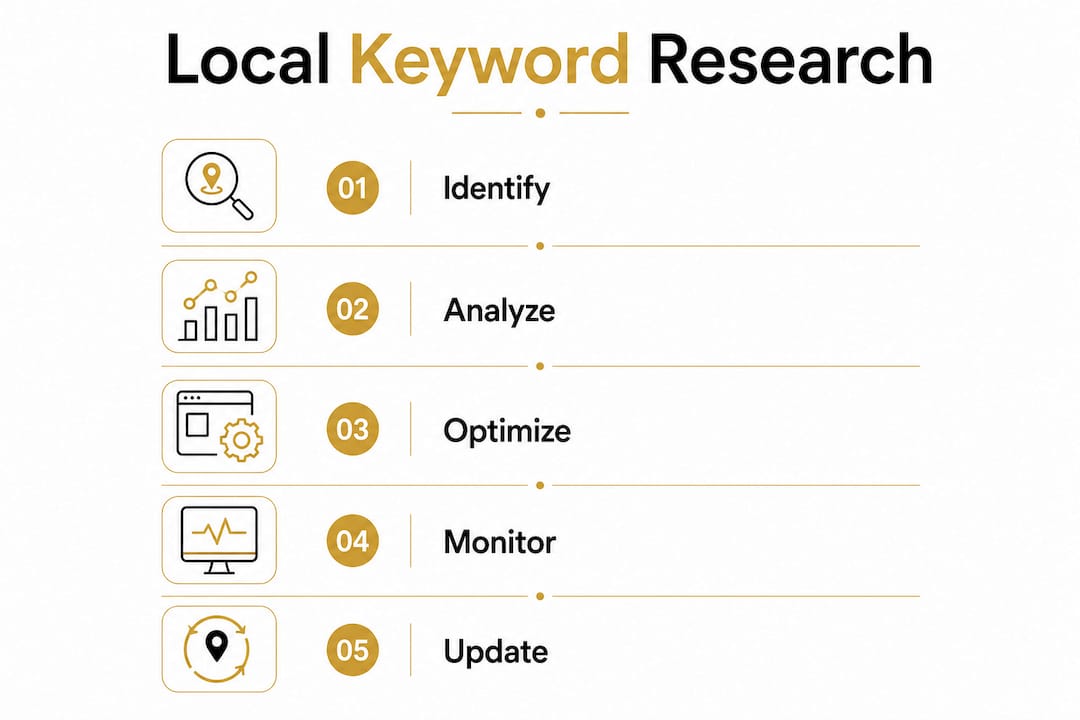
A five-step local keyword research process produces better results.
- Identify explicit and implicit keywords. Start with your core services and add geographic modifiers at the city, neighborhood, and zip code level. Then list service terms that carry implicit local intent even without a location word.
- Apply geographic filters. Use localized data sources such as Google Search Console filtered by city, Google Business Profile Insights, and location-specific keyword tools. These surfaces show what people in your actual market are searching for.
- Validate SERP features. Search each candidate keyword yourself from your target location. Check whether Google shows a Local Pack, organic results, or both. Keywords that trigger a Local Pack are worth prioritizing in your Google Business Profile. Keywords that show organic results need dedicated web pages.
- Analyze the competitive landscape. Look at which businesses rank for each term and what content they use. Identify gaps where neighborhood-specific pages could outrank broader city pages, especially after the 2026 algorithm changes.
- Map keywords to specific pages. Assign each keyword cluster to one page or profile section. Avoid placing the same geographic term on multiple pages. That creates keyword cannibalization, where your own pages compete against each other and dilute your ranking potential.
Google Business Profile questions reveal net-new keyword insights that add unique, high-conversion content opportunities per location. Check them monthly and turn recurring questions into FAQ content on your website and profile posts.
Local SERPs reshuffle 2 to 3 times faster than national results due to personalization by location, time, and query history. Weekly rank tracking is the minimum for meaningful insight. Daily tracking is better for competitive markets.
| Research step | Tool or source | Output |
|---|---|---|
| Identify keywords | Google Search Console, GBP Insights | Keyword seed list with local modifiers |
| Validate SERP features | Manual search by location | Pack vs. organic targeting decision |
| Competitive gap analysis | Manual SERP review | Neighborhood page opportunities |
| Track rankings | Local rank tracker | Weekly position changes by keyword |
You can find a practical walkthrough of this process in Spinlisting’s guide on how to add local SEO keywords to your listing.
What common pitfalls should you avoid when optimizing with local keywords?
The most common mistake is treating local SEO as a one-time setup. Rankings shift constantly. A keyword strategy that worked in january may underperform by march if a competitor launches a neighborhood page or earns a surge of new reviews.
- Avoid keyword stuffing. Repeating “best plumber in Chicago” six times in a paragraph does not help rankings. Google’s natural language processing recognizes forced repetition and treats it as a quality signal against your page.
- Keep NAP data consistent. Your business name, address, and phone number must match exactly across your website, Google Business Profile, and every directory listing. Inconsistencies confuse Google and reduce your prominence score.
- Use schema markup. LocalBusiness schema tells Google your address, hours, and service area in a structured format it can read directly. Accurate address verification combined with schema markup is what captures implicit “near me” intent, not keyword repetition.
- Write unique content for each location page. Copying the same page template and swapping city names produces thin content that Google penalizes. Each neighborhood page needs locally relevant details: nearby landmarks, community-specific services, or local customer references.
- Monitor and update regularly. Review your local search ranking performance at least monthly. Adjust keyword targets when rankings drop and when new neighborhood-level opportunities appear.
Pro Tip: Integrate local keywords into your Google Business Profile posts, not just your website. Posts appear directly in search results and give you a second chance to rank for terms your main listing does not cover.
Understanding the benefits of local SEO for small businesses goes beyond rankings. Local keyword optimization builds the citation and review ecosystem that sustains visibility over time.
Key Takeaways
Local keywords boost visibility by establishing geographic relevance and prominence, the two ranking factors every small business can directly control.
| Point | Details |
|---|---|
| Local Pack dominance | The top 3 Local Pack spots capture 44% of clicks; optimized profiles average 1,200 views per month. |
| Four query patterns | Target geo-modified, near-me, implicit-local, and service-area queries with separate page strategies. |
| Avoid national data | National tools undercount local queries by 5 to 12 times; use Google Search Console and GBP Insights instead. |
| Schema over stuffing | “Near me” rankings depend on schema markup and verified addresses, not keyword repetition in titles. |
| Track weekly | Local SERPs reshuffle 2 to 3 times faster than national results; weekly tracking is the minimum. |
The real cost of treating local SEO as a checkbox
I have watched small business owners spend months building a website, then wonder why no one calls. The site looks good. The services are clear. But the words on the page describe what the business does in a vacuum, with no geographic signal that tells Google or a customer where the business actually operates.
The 2026 algorithm shifts made this problem more visible, not less. Neighborhood-specific content now outranks national brand pages in a third of reshuffled local SERPs. That is not a minor tweak. That is Google telling every local business owner that generic city-level targeting is no longer enough.
The businesses I see winning consistently are not the ones with the biggest budgets. They are the ones that treat local keyword research as an ongoing practice, not a one-time task. They check their Google Business Profile Insights every month. They add neighborhood-level pages when they expand their service area. They mine customer reviews and questions for new keyword ideas. That kind of continuous refinement compounds over time in a way that a single optimization sprint never will.
Local SEO is not a technical mystery. It is a commitment to staying specific, staying current, and staying visible in the exact communities your business serves.
— Against
How Spinlisting helps you put local keywords to work
Spinlisting specializes in Google Business Profile optimization built around local keyword strategy. Every profile Spinlisting manages gets accurate NAP data, keyword-rich descriptions, regular post updates, and performance tracking tied to real ranking outcomes.
Spinlisting clients have seen 83% increases in first-place local rankings. Well-maintained listings deliver 5x more value than unclaimed ones, and Spinlisting’s approach is built around that gap. If you want a profile that works as hard as your business does, the 2026 local SEO strategy guide is a strong starting point. For hands-on profile optimization, visit Spinlisting to see how the service works.
FAQ
Why do local keywords improve search rankings?
Local keywords establish geographic relevance, one of Google’s three core local ranking factors. When your content and profile match the location and service in a search query, Google ranks your listing higher in local results.
Do “near me” keywords need to appear on my website?
No. “Near me” rankings depend on GPS data, verified business addresses, and LocalBusiness schema markup, not on the phrase appearing in your page text or title tags.
How often should I update my local keyword strategy?
Update your strategy at least monthly. Local SERPs reshuffle 2 to 3 times faster than national results, so rankings can shift quickly based on competitor activity and algorithm changes.
What is the difference between geo-modified and implicit-local keywords?
Geo-modified keywords include an explicit location, such as “dentist in Austin.” Implicit-local keywords carry local intent without naming a place, such as “dentist open now,” and rely on Google inferring location from the user’s device.
Are neighborhood-level keywords worth targeting for a small business?
Yes. Hyper-local keywords convert better than city-level terms because they face less competition and match the specific needs of nearby customers more precisely.
Recommended
- Local Search Visibility Score Explained for Business Owners | Google my Business for SEO / ranking services SEO
- How to Launch Your Local Business Online Presence | Google my Business for SEO / ranking services SEO
- Local Online Marketing Budget Tips for Small Businesses | Google my Business for SEO / ranking services SEO
- Improve Local Search Ranking: 2026 Strategy Guide | Google my Business for SEO / ranking services SEO