
Google My Business (now officially called Google Business Profile, or GBP) consistently outperforms social media for local customer acquisition, and the conversion data makes the case plainly. GBP converts at an average rate notably higher than social media. That gap exists because of one fundamental difference: when someone finds your GBP listing, they searched for exactly what you sell. When someone sees your Facebook post, they were scrolling for entertainment.
Here is why GMB outperforms social media for local marketing in 2026:
- Search intent alignment: GBP captures buyers at the moment of decision, not during passive browsing.
- Ranking impact: GBP signals make up a significant portion of Local Pack ranking factors, being among the largest drivers in Google’s local algorithm.
- Integrated conversion tools: Direct call buttons, Google Maps directions, and verified reviews close sales without requiring a website visit.
- Lower maintenance: A well-optimized GBP profile drives traffic 24/7 without daily posting demands.
- Transparent visibility: GBP shows your listing to anyone searching your category nearby, with no algorithm suppression or pay-to-play gating.
Why GMB outperforms social media for local search visibility
The core difference between GBP and social media is not reach volume. It is reach quality.
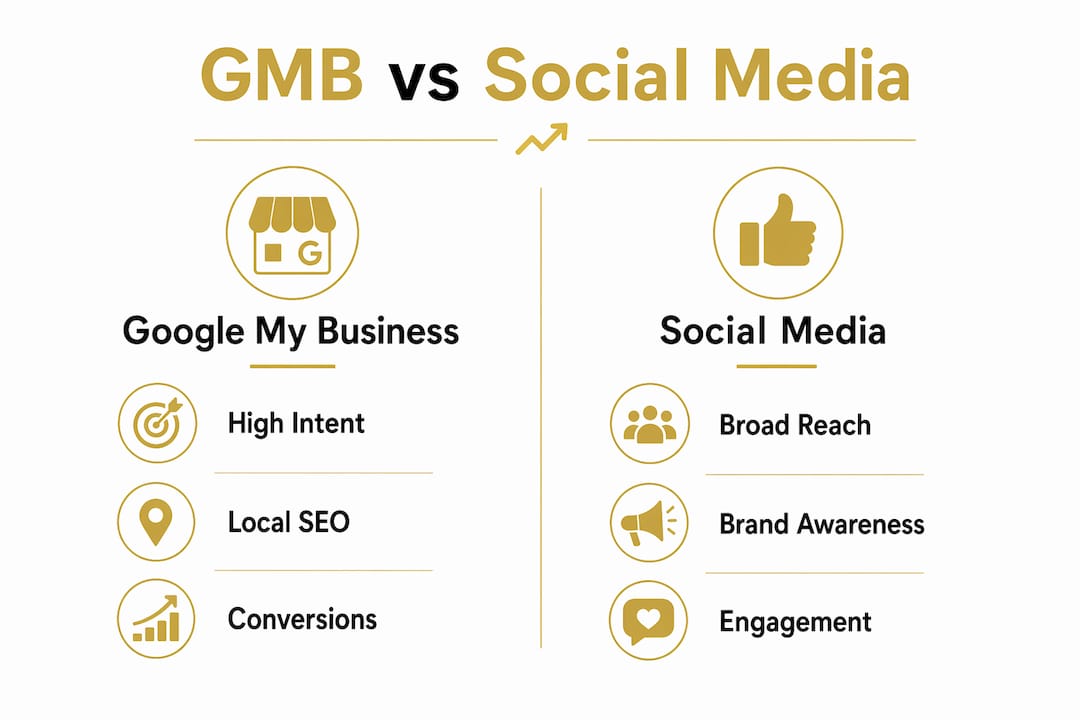
When someone types “emergency plumber near me” or “best coffee shop downtown,” they have already decided they need something. Your GBP listing appears at that exact moment. A large majority of GBP profile views come from discovery searches, meaning users found the business without searching for it by name. That is passive reach built on active intent, a combination social media cannot replicate.
Social media works the opposite way. Your Instagram post or Facebook update lands in a feed while someone scrolls through vacation photos and news headlines. Even if they follow your business, organic reach on Facebook business pages averages just 2–5% of followers. Instagram trends in the same direction. The platform’s algorithm decides who sees your content, and it optimizes for the platform’s engagement, not your sales.
| Factor | Google Business Profile | Social media |
|---|---|---|
| Search intent alignment | High (active searchers) | Low (passive browsers) |
| Organic reach | Query-driven, no follower cap | 2–5% of followers |
| Local targeting | Built in by default | Requires paid configuration |
| Algorithm transparency | Ranking signals are documented | Opaque, changes frequently |
| Conversion efficiency | 3.2% average | 0.7% average |
GBP signals, including accurate business categories, hours, photos, and reviews, account for 32% of Local Pack rankings. No single social media activity comes close to that ranking weight. The Local Pack itself, the top three map-based results shown above organic listings, captures high-intent traffic and drives calls and direction clicks directly from the search results page.
Pro Tip: Understanding search intent is the foundation of why GBP outperforms social media. Align your GBP categories and description with the exact phrases your customers search, not just your business name.
How GMB posts drive better engagement and conversions than social media
GBP posts appear at the moment of purchase intent. A social media post appears when someone is bored.

That timing difference changes everything about engagement quality. A GBP post promoting a weekend special reaches someone who just searched “Italian restaurant near me.” A Facebook post promoting the same special reaches whoever the algorithm decides to show it to, most of whom are not hungry right now and not near your location.
GBP’s built-in conversion tools remove friction at the critical moment:
- Call buttons let searchers contact you directly from the search results page.
- Direction requests via Google Maps send foot traffic straight to your door.
- Booking links allow appointment scheduling without a phone call.
- Offer posts display discounts with expiration dates, creating urgency for ready-to-buy customers.
The analytics tell a different story too. GBP Insights track calls, direction requests, website clicks, and the actual search queries that surfaced your listing. Social media metrics lean heavily on likes, shares, and impressions, which measure attention, not revenue. Knowing that 47 people requested directions to your shop last Tuesday is more useful than knowing your post got 200 likes.
Pro Tip: Post a GBP update every time you run a seasonal promotion or want to generate new reviews. A short post with a call-to-action button and a photo outperforms a passive listing with no recent activity.
How GMB and social media work together in a local marketing strategy
GBP and social media are not competitors in your marketing plan. They serve different stages of the customer journey, and the strongest local businesses use both deliberately.

GBP captures demand. When someone is ready to buy, they search Google. Your GBP listing is where that decision happens. Social media builds awareness. Facebook, Instagram, and similar platforms put your brand in front of people who do not yet know they need you. The two channels work sequentially, not in opposition.
Here is how to integrate them without wasting effort:
- Repurpose content across both channels. A great customer story works as an Instagram post and a GBP update. A seasonal promotion can run on both platforms with minimal extra work.
- Use social media for community and storytelling. Behind-the-scenes content, team introductions, and real-time event updates suit Instagram and Facebook far better than GBP’s format allows.
- Let social media feed your GBP reviews. Customers you have built relationships with on social are more likely to leave a Google review when asked. Strong Google reviews then give social media audiences confidence to take action.
- Reserve time-sensitive content for social. Tonight’s live music lineup or a flash sale happening right now suits social media’s real-time push notifications. GBP posts are better for stable offers and ongoing promotions.
The declining organic reach on social platforms makes it harder to justify heavy investment in social-only strategies for local businesses. GBP’s query-driven visibility does not require you to build a following first. A brand-new business with zero social followers can still appear prominently in local search results with a well-optimized GBP profile.
What Spinlisting’s results reveal about GMB optimization’s real impact
The performance gap between an optimized GBP profile and a neglected one is not marginal. Spinlisting clients have achieved 83% increases in first-place local rankings through dedicated GBP optimization, and well-maintained listings deliver 5x higher value than unclaimed profiles.
Those results come from a specific set of optimization levers that social media activity cannot replicate:
| Optimization lever | Impact on local performance |
|---|---|
| Accurate categories and business details | Improves relevance matching for local search queries |
| Regular photo uploads | Signals activity to Google; increases click-through rates |
| Review management and responses | Builds trust signals and strengthens topical authority |
| GBP posts with call-to-action buttons | Drives direct conversions from search results |
| Consistent NAP (name, address, phone) | Reinforces credibility across Google’s local ranking system |
Review management deserves particular attention. Google analyzes review content to understand which services a business provides. When customers consistently mention “fast delivery” or “emergency repairs,” that language strengthens the profile’s relevance for those search terms. Social media comments do not feed into Google’s local ranking algorithm the same way.
Google Maps integration compounds the advantage further. GBP listings provide real-time directions, travel time estimates, and proximity notifications. A customer standing two blocks away searching “coffee near me” gets a Maps result that shows your distance, hours, and rating in one glance. No social media platform delivers that kind of functional, location-aware conversion trigger.
Spinlisting’s approach to GMB profile optimization focuses on the elements that move ranking signals: category accuracy, photo freshness, review velocity, and post consistency. The result is a listing that works as a 24/7 lead generation asset rather than a static directory entry.
If your GBP profile is incomplete, outdated, or unmanaged, you are handing customers to competitors who show up above you in the Local Pack. Spinlisting’s local SEO optimization services are built specifically to close that gap, with a tailored strategy for each client and measurable ranking results.
Key Takeaways
Google My Business outperforms social media for local businesses because it captures high-intent searchers at the moment of purchase, converts at 3.2% versus social media’s 0.7%, and drives rankings through documented signals that social activity cannot replicate.
| Point | Details |
|---|---|
| Conversion rate gap | GBP converts at 3.2% on average; social media averages 0.7%. |
| Local Pack ranking weight | GBP signals account for 32% of Local Pack ranking factors, the largest single driver. |
| Discovery reach | About 84% of GBP views come from discovery searches, not branded queries. |
| Social media organic reach | Facebook and Instagram business pages reach only 2–5% of followers organically. |
| Optimization ROI | Spinlisting clients achieve 83% increases in first-place rankings through dedicated GBP optimization. |
Recommended
- Why GMB Optimization Beats Competitors in Local Search | Google my Business for SEO / ranking services SEO
- How to Launch Your Local Business Online Presence | Google my Business for SEO / ranking services SEO
- Why Location Pages Boost Rankings for Local Businesses | Google my Business for SEO / ranking services SEO
- How to Target Local Customers on Google Search | Google my Business for SEO / ranking services SEO