
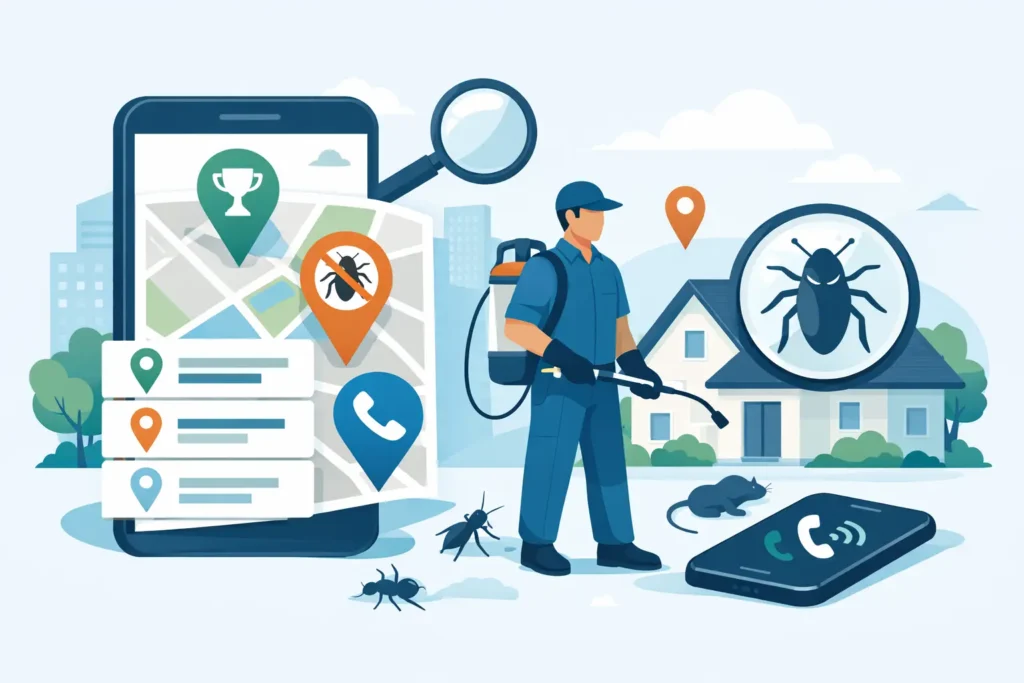
If your pest control company is stuck below the local 3-pack, you are losing calls to businesses that are not necessarily better – just more visible. Map ranking for pest control is not a branding exercise. It is a lead generation channel. When a homeowner searches for termite treatment, rodent removal, or same-day exterminator near me, Google Maps often decides who gets the first shot at that job.
That is why local map visibility has to be treated like an operating system, not a one-time setup. A profile can look decent and still underperform. A website can rank organically and still miss the highest-intent local clicks. For pest control companies, the difference between showing up in the top results and sitting lower on the map is usually a mix of category alignment, review velocity, location relevance, and ongoing profile activity.
Why map ranking for pest control matters more than most channels
Pest control is a high-intent service. People rarely browse it for fun. They search because they have a problem now, or they know one is coming. That makes Google Maps especially valuable because it captures immediate commercial intent. The person searching is usually deciding between a short list of providers and wants fast proof that your company is legitimate, nearby, responsive, and well-reviewed.
Paid ads can help, and organic SEO still matters, but the map pack often gets the first look. On mobile, it can dominate the screen. If your listing is weak, incomplete, inactive, or poorly optimized, you are making it easier for competitors to win jobs you were already in position to earn.
This is also one of the few channels where local trust signals are visible before the click. Reviews, photos, business hours, service categories, and proximity all shape conversion. In other words, map ranking is not just about exposure. It directly affects whether a searcher calls you or keeps scrolling.
What Google actually looks at in map ranking for pest control
Google does not publish a simple checklist, but the pattern is clear. Local rankings are built around relevance, distance, and prominence. For pest control businesses, those broad factors show up in very practical ways.
Relevance starts with how clearly your Google Business Profile matches what people search for. If your primary category is off, your service list is thin, or your business description is vague, Google has less confidence in showing you for core searches like pest control, exterminator, bed bug treatment, or wildlife removal. Category selection is one of the biggest levers here, and many companies get it wrong by choosing a broader or less commercially useful option.
Distance is exactly what it sounds like, but it is not always as simple as having an address in the city. Service area businesses have to work harder because they are often trying to rank across multiple nearby markets. You can still perform well without a storefront in every city, but you need supporting location signals from your website, your profile activity, your citations, and your local content.
Prominence is where execution separates serious operators from everyone else. Reviews matter, but not just the total count. Recency, rating quality, and keyword context all help. So do branded searches, local mentions, strong organic signals, and regular Google Business Profile updates. If your profile has been sitting untouched for months while a competitor is posting weekly, adding job photos, answering questions, and collecting reviews consistently, that gap usually shows up in rankings.
The profile setup mistakes that hold pest companies back
A lot of pest control businesses think they have a ranking problem when they actually have a setup problem. The listing is claimed, the phone number works, and the hours are posted, so it feels complete. It is not.
The first issue is category selection. Your primary category should reflect the main service you want to rank for most often. Secondary categories can support specialties, but they should not dilute the profile. Adding every possible option is not strategy. It is noise.
The second issue is weak service coverage. If your services are not built out clearly inside the profile, you are missing relevance signals. Pest control is not one service. It includes termite control, ant control, roach extermination, mosquito treatment, rodent control, bed bug treatment, wasp nest removal, and more. If those are real revenue lines, they should be reflected in your profile and backed up on your website.
The third issue is inconsistent business data. Even small differences in name, address, phone number, or service area details across the web can create trust problems. Google wants clean, consistent entity signals. Sloppy listings elsewhere can slow down local performance.
Then there is inactivity. Too many listings are built once and left alone. Google Business Profile is not a static directory. It performs better when it looks alive. Fresh photos, weekly posts, review responses, updated services, and ongoing management signal that the business is active and credible.
Reviews are not optional if you want map pack visibility
In pest control, reviews do two jobs at once. They improve ranking signals and they improve conversion once someone sees your listing. That second part matters just as much. A company with a decent position and strong reviews can outperform a higher-ranked listing with weak social proof.
The key is consistency. Ten reviews in one month and then nothing for six months is less effective than steady review growth. Google wants to see a real operating business with ongoing customer feedback. Pest control companies should build review requests into the job completion process, especially after successful treatments where the customer is relieved and likely to respond.
It also helps when reviews mention actual services and locations naturally. You cannot script customers, and you should not fake this, but when homeowners mention termite treatment in Dallas or rodent removal in Phoenix, that creates stronger local relevance than a generic five-star rating with no detail.
Responding matters too. It shows engagement, adds fresh content to the profile, and reinforces trust. A short, professional response is enough. Silence looks lazy.
Your website still influences Google Maps performance
Some business owners treat their Google Business Profile and website like separate assets. They are connected. A weak site can limit your map ranking ceiling, especially in competitive cities.
Your website should support the same services, cities, and trust signals shown in your profile. If your listing says you handle termite control, wildlife removal, and bed bugs, your site should have strong service pages for those terms. If you want to rank in multiple surrounding markets, location pages need to be useful and specific, not thin copies with swapped city names.
Technical SEO matters here too. Slow load times, weak internal structure, poor indexing, and generic title tags all reduce your overall authority. Google Maps rankings are local, but they do not happen in isolation. A solid local SEO foundation makes the profile stronger.
This is why execution-heavy agencies tend to outperform light consulting models. Real gains usually come from profile optimization, review strategy, photo activity, content support, citation cleanup, and site improvements working together.
What pest control companies should do every month
Map growth is rarely the result of one dramatic change. It usually comes from consistent pressure in the right places. Pest control businesses that improve rankings tend to manage their listing actively instead of treating it like a directory entry.
That means publishing fresh posts, adding real jobsite photos, monitoring category relevance, earning new reviews, responding to customer feedback, checking for spam competitors, and updating services as the business grows. It also means watching what top competitors are doing in your city. If they are gaining traction, there is usually a visible reason.
There is also a spam angle in some markets. Fake listings, keyword-stuffed business names, and lead-gen profiles can distort the map pack. Reporting clear violations can help, but it is not a complete strategy. The bigger win comes from building a stronger local entity than the businesses trying to game the system.
When rankings do not improve right away
This is where a lot of business owners get frustrated. They fix a few fields, ask for some reviews, and expect a jump in a week. Sometimes that happens. Often it does not.
Map ranking for pest control depends on competition, geography, profile history, and the current strength of your site and reviews. A suburban service area can move faster than a dense metro market. A well-aged profile with good history can respond quicker than a newer one. If your market is crowded with established competitors, progress may come in stages.
The right question is not whether one tweak worked overnight. It is whether your overall local authority is moving in the right direction month after month. That is the mindset serious operators use.
For pest control companies that rely on inbound calls, map visibility is too valuable to leave to guesswork. When your profile, website, reviews, and local signals are aligned, Google has a clearer reason to trust you – and searchers have a clearer reason to call.