
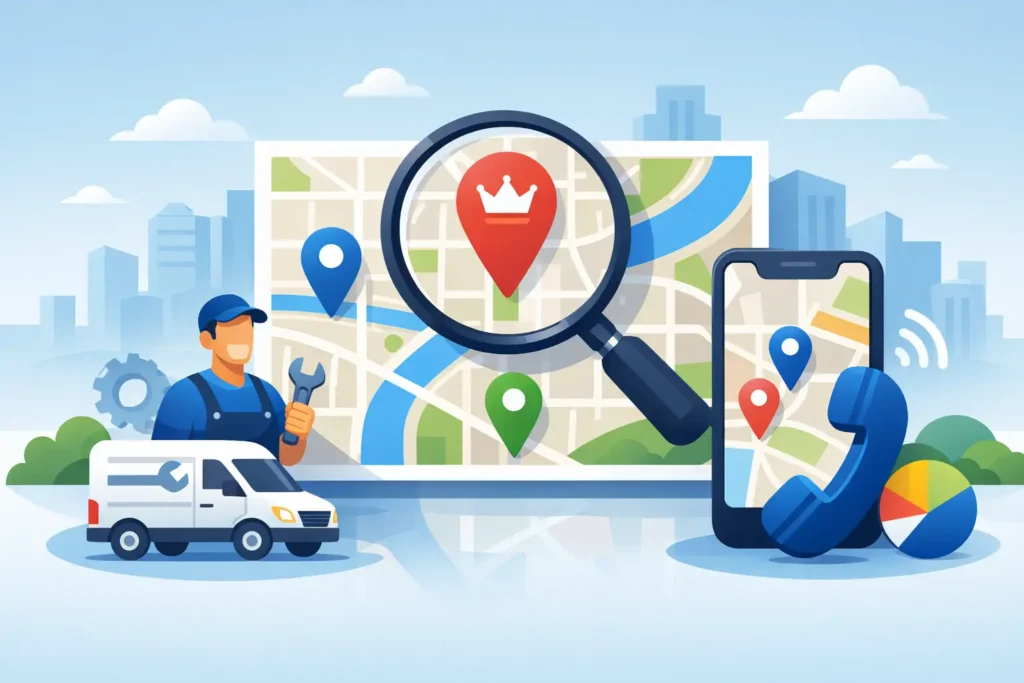
When a homeowner has a leaking water heater at 7:30 a.m., they are not reading blogs for fun. They search plumber near me, scan the map pack, and call one of the first few businesses they trust. That is why map ranking for plumbers is not a vanity metric. It directly affects call volume, estimate requests, and how often your company gets picked before a competitor does.
Most plumbing companies do not have a visibility problem everywhere. They have a visibility problem in the exact zip codes where they want more work. That distinction matters, because Google Maps rankings are not fixed across an entire city. You may rank well near your shop and disappear five miles away. You may show for drain cleaning but not water heater repair. Better map performance comes from improving the actual signals Google uses, not from guessing or making random profile edits.
How map ranking for plumbers actually works
Google wants to show local businesses that are relevant, nearby, and credible. For plumbers, that usually comes down to three core forces: proximity, relevance, and prominence.
Proximity is the hardest one to control. If someone searches from across town, Google often favors plumbers physically closer to that searcher. That does not mean you are stuck. It means your strategy has to be realistic. You are far more likely to expand visibility outward from your service base than to dominate an entire metro overnight.
Relevance is where your Google Business Profile and website do real work. If your profile is thin, your services are vague, and your site barely mentions key plumbing jobs, Google has less confidence in what you do. A company that clearly signals sewer line repair, emergency plumbing, tankless water heater installation, leak detection, and repiping will usually outperform a generic listing that says plumbing services.
Prominence is your authority layer. Reviews, review velocity, business citations, website strength, branded searches, local mentions, and overall profile activity all feed this. Prominence is also where many plumbers fall behind, because they set up a profile once, collect a few reviews, and assume that is enough.
The Google Business Profile issues holding plumbers back
The biggest ranking losses usually come from weak execution, not mystery penalties. A half-built profile will not compete well in a crowded service area.
Your primary category matters more than most owners realize. If your main category is not set to Plumber, you are making it harder for Google to match you to core searches. Secondary categories matter too, but they should support your main services, not create confusion. If you add categories that do not match your actual operation, you dilute the profile.
Service setup is another common weak spot. If your services are missing, too broad, or poorly described, Google has less context. A plumbing company should clearly define high-value services and align them with the wording real customers use. Emergency plumber, drain cleaning, water heater repair, pipe repair, and sewer services all deserve clear representation when they are actually offered.
Then there is business completeness. Hours, service areas, business description, photos, review responses, and regular updates all shape trust. None of these items alone guarantees higher rankings. Together, they create a stronger profile that is more likely to compete in local search.
Reviews are not just social proof
For plumbers, reviews influence both rankings and conversion rate. You can rank in the map pack and still lose the click if the business below you has 40 more reviews and a stronger recent rating trend.
What matters is not just total review count. Recency matters. Keyword relevance in reviews matters. Owner responses matter. A profile with a steady flow of legitimate reviews that mention water heaters, drain issues, leaks, and emergency calls gives Google and customers more confidence.
There is a trade-off here. Chasing reviews aggressively without a process can create risk if you push the wrong customers at the wrong time. The better approach is operational. Ask after successful jobs, make the request easy, and build it into your team workflow. Review growth should be consistent, not desperate.
Your website still affects map ranking for plumbers
A lot of owners treat Google Business Profile like it exists on an island. It does not. Your website supports your map visibility, especially in competitive plumbing markets.
If your homepage barely mentions service areas and your service pages are thin, Google has less evidence that you are a strong local result. Strong local SEO for plumbers usually includes a well-optimized homepage, focused service pages, and city or area pages where it makes sense. The key phrase there is where it makes sense. Thin location pages copied across dozens of suburbs can do more harm than good.
Your site should reinforce the same services and locations your profile is trying to rank for. It should also be technically clean. Slow load times, weak mobile experience, indexing problems, and poor internal structure do not help local performance. Plumbing customers are usually searching from a phone, often during a problem. If the site is clunky, you lose both ranking support and leads.
Photos, posts, and activity signals
Plumbers often overlook media because it feels secondary. It is not. A profile with fresh job photos, team images, branded trucks, equipment shots, and completed work tends to look more trustworthy than one with three old logo images.
Photos also help validate that your business is active, local, and real. Geotagging alone is not some magic ranking trick, but organized photo uploads tied to actual service activity can support a healthier profile over time.
Google posts are similar. They are not a shortcut to the top of the map pack, but regular posting helps show profile activity and keeps the listing from going stale. For plumbers, useful post topics include emergency service availability, water heater promotions, seasonal freeze prevention, drain service reminders, and recent project highlights. The point is consistency, not filler.
Service area strategy matters more than plumbers think
A lot of plumbing companies want to rank everywhere at once. That is usually where strategy breaks down. If your office is in one suburb and you serve a large metro, your strongest rankings will usually start closest to your base and expand from there.
That means you should prioritize the cities and zip codes with the best mix of profitability, proximity, and competition level. Trying to force visibility in distant areas before you have built authority in your core market is usually a losing play.
This is also where tracking matters. Rankings vary by location, so checking from your office computer does not tell the full story. You need map grid tracking or localized rank checks to see where you actually show for terms like plumber, emergency plumber, or water heater repair. Without that, you are making decisions blind.
Spam and competitor noise are real
Some plumbing markets are crowded with fake listings, keyword-stuffed business names, lead gen spam, and competitors using tactics that should not be working. That is frustrating, but pretending it does not exist is worse.
Sometimes the right move is to strengthen your own assets and outrank them cleanly. Other times, spam fighting is worth the effort. It depends on the market and how aggressive the abuse is. What you should not do is copy bad tactics just because a competitor is getting away with them right now. Short-term gains can create long-term problems.
What actually moves rankings over time
Better map rankings usually come from stacked improvements, not one dramatic change. Profile optimization, better reviews, stronger service pages, more local trust signals, regular updates, and accurate business information work together. That is why local SEO for plumbers is execution-heavy. Anyone can claim a listing. Very few companies manage it like a lead-generation asset.
For plumbing businesses that want more calls from Google Maps, the practical question is simple: are you giving Google enough reasons to rank you, and are you giving customers enough reasons to choose you? If either side is weak, the result is usually the same – lower visibility and fewer booked jobs.
A strong map strategy is not about gaming the system. It is about building the strongest local signal set in your market and maintaining it week after week. That is where consistent optimization wins. Spinlisting works in that exact lane, helping service businesses turn better local visibility into actual leads instead of empty ranking reports.
If your plumbing company is serious about growth, treat your map presence like a revenue channel, not a profile you set up once and forget.