

The customer journey in local search is the sequence of discovery, evaluation, and conversion moments a local shopper experiences across Google Search, Google Maps, your website, and real-world touchpoints. The fastest way to capture it: claim and fully optimize your Google Business Profile (GBP).
These three steps cost nothing but time, and they directly affect whether Google shows your business to nearby shoppers at all. Complete profiles improve your chances of appearing in local results and help customers know when and how to visit.
Table of Contents
- How does the customer journey work in local search?
- How Google decides who shows up: relevance, distance, and prominence
- What does a fully optimized GBP checklist look like?
- How do reviews move customers through the journey?
- What belongs on your local landing pages and citations?
- How do you measure local search performance, and when do results show up?
- What mistakes are quietly killing your local search visibility?
- How do paid local ads and organic local search work together?
- Key Takeaways
- What Spinlisting sees working for local clients
- Spinlisting’s local search optimization service
- Further reading and official sources
How does the customer journey work in local search?
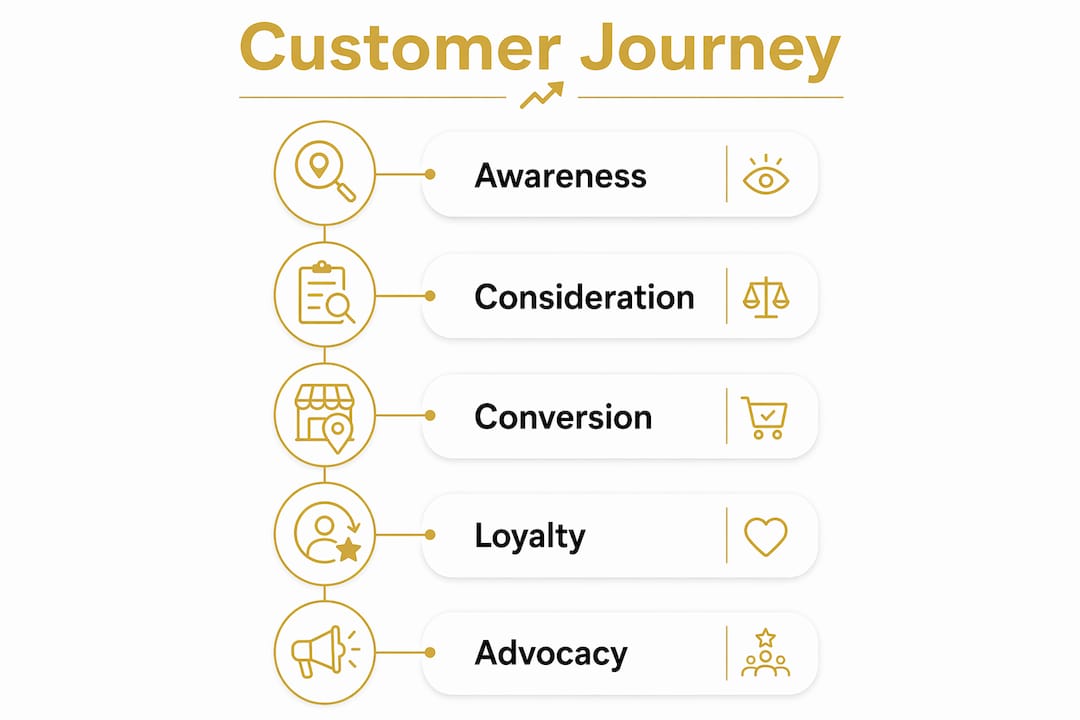
The standard customer journey maps cleanly onto local-search touchpoints. Each stage has a different user mindset and a different set of signals that either keep them moving toward you or send them to a competitor.
| Journey Stage | User Mindset | Primary Local Touchpoints | What They Need |
|---|---|---|---|
| Awareness | “I have a need” | Google Search, Google Maps local pack | Business name, category, location, hours |
| Consideration | “Who’s the best option?” | GBP reviews, photos, website, Q&A | Social proof, service details, pricing signals |
| Decision | “I’m ready to act” | GBP call/directions button, booking link, website | Frictionless contact, clear address, availability |
| Loyalty | “I’ll come back and tell others” | Review prompts, email/SMS follow-up, GBP posts | Appreciation, incentives, easy review path |
A quick real-world example: Someone searches “auto repair near me” on a Saturday morning. Google surfaces a local pack of three shops. She taps the one with the most photos and a 4.8-star rating, reads two recent reviews, checks the hours, and hits “Call.” That entire sequence took under 90 seconds. If your hours were wrong, your photos were missing, or your rating was below 4.0, she never called. The local results she saw were customized to her exact location at that moment, not a universal ranking.

How Google decides who shows up: relevance, distance, and prominence
Google’s three official local ranking factors are relevance, distance, and prominence. Understanding them tells you exactly where to spend your optimization effort.
Relevance is how well your profile matches what someone searched for. The fix: choose the most accurate primary category, fill in every service, and write a business description that uses the words your customers actually type.
Distance is how far your business is from the searcher (or from the location they specified). You can’t move your building, but you can make sure your address is pinned correctly on Google Maps and that your service-area settings reflect where you actually work.
Prominence is how well-known and trusted Google perceives your business to be. This is where reviews, backlinks, citations, and press mentions matter. A business with 200 reviews and consistent NAP across 40 directories will outrank a newer competitor with a prettier website but no off-site signals.
Statistic callout: A significant portion of people who search for nearby businesses on their phones visit those businesses shortly after, and a notable share of those searches lead to a purchase. Prominence is the factor you can build fastest through review volume and citation consistency.
What does a fully optimized GBP checklist look like?
Think of GBP optimization in three tiers: what to do immediately, what to build over the next 30 days, and what to maintain on an ongoing basis.
Immediate (this week):
- Claim and verify your listing through Google’s official verification flow.
- Set your primary category to the single most accurate option.
- Enter your exact business name, address, and phone number, matching your website character-for-character.
- Add your hours, including holiday hours.
- Upload at least five photos: exterior, interior, team, and product or service shots.
Short-term (next 30 days):
- Add secondary categories and all relevant services with descriptions.
- Write a 750-character business description using natural language and local keywords.
- Enable messaging and set up a booking link if your business takes appointments.
- Populate the Q&A section with the five questions customers ask most often.
- Add attributes (women-owned, wheelchair accessible, outdoor seating, etc.) that match your actual setup.
Ongoing:
- Publish at least one GBP post per week (offer, event, or update).
- Add new photos monthly. Profiles with fresh visual content consistently outperform static ones.
- Review and update hours any time they change, not just at holidays.
GBP optimization done right is not a one-time project. Google treats active profiles as signals of a healthy, engaged business, and that activity feeds directly into prominence.
How do reviews move customers through the journey?
Reviews are the single most visible trust signal at the consideration stage. A shopper comparing two plumbers will almost always call the one with more reviews and a higher average rating, even if the other business has a nicer website.
Getting reviews ethically and consistently:
- Ask within 24 hours of a completed job or visit, when the experience is fresh.
- Send a direct link to your GBP review form via text or email. Fewer steps means more completions.
- Train your front-line staff to mention reviews naturally at checkout or service completion.
- Never offer incentives for reviews. Google’s policies prohibit it, and it can get your listing suspended.
Responding to reviews:
- Positive reviews: thank the customer by name, mention a specific detail they raised, and keep it under three sentences.
- Neutral reviews (3–4 stars): acknowledge what went well, address the gap directly, and invite them back.
- Negative reviews: stay factual, apologize for the experience without admitting fault on specifics, and offer to resolve it offline with a phone number or email.
Pro Tip: Set a weekly calendar block of 20 minutes specifically for review responses. Businesses that respond to reviews consistently signal engagement to Google and build visible credibility for future shoppers reading those exchanges.
Metrics to track: total review count, average star rating, and review velocity (how many new reviews per month). A flat velocity often means your ask process has stalled.
Failing to respond to reviews is one of the most common mistakes local businesses make, and it costs them on both the ranking and the conversion side.
What belongs on your local landing pages and citations?
Your website and your off-site citations work together to reinforce the signals Google picks up from your GBP. Neither alone is enough.
Local landing pages (one per location or service area) should include:
- The full address, phone number, and hours in crawlable text, not an image.
- A Google Maps embed for that specific location.
- Unique content referencing the neighborhood, nearby landmarks, or local context. Pages that reference local landmarks and neighborhood names consistently outperform generic location pages for geographically specific queries.
- LocalBusiness schema markup (or more specific types like MedicalBusiness or FoodEstablishment) so Google can parse your structured data directly.
- At least one locally sourced testimonial or case reference.
NAP and citation cleanup:
- Your name, address, and phone number must be identical across Google, Yelp, Apple Maps, Bing Places, and every industry directory where you appear. Even small differences (“St.” vs. “Street”) create conflicting signals. NAP consistency is a foundational trust signal Google uses to verify your business information.
- Audit your citations using a tool like BrightLocal or Whitespark. Fix the highest-authority directories first (Google, Yelp, Apple Maps, Facebook), then work down the list.
- Build local backlinks through local chamber of commerce memberships, sponsorships, and press mentions. A link from a local newspaper or community organization carries more geographic relevance than a generic directory link.
A blended approach combining GBP, local pages, citations, and quality links drives sustained visibility. No single tactic does it alone.
How do you measure local search performance, and when do results show up?
Measurement without a clear KPI map is just data collection. Tie each metric to the journey stage it reflects.
| KPI | Journey Stage | Where to Find It |
|---|---|---|
| Search impressions, profile views | Awareness | GBP Insights (Performance tab) |
| Direction requests, calls | Consideration | GBP Insights |
| Bookings, form fills, purchases | Decision | GA4 goal conversions, POS/CRM |
| Repeat visits, referral reviews | Loyalty | CRM, review velocity, GBP Insights |
Data sources and attribution:
- GBP Insights shows impressions, clicks, calls, and direction requests directly from your profile.
- GA4 tracks website sessions from local search and lets you set conversion events for bookings or contact form submissions.
- A dedicated call-tracking number (via CallRail or a similar service) separates GBP-driven calls from other channels.
- Your POS or CRM closes the loop by connecting online discovery to actual revenue.
Realistic timeline: Most businesses see measurable GBP Insights improvements within 4–8 weeks of completing their profile and launching a review-request process. Ranking improvements in competitive markets can take 3–6 months. Citation cleanup and local page work compound over time. Local rankings also shift based on the searcher’s exact location, so track performance across multiple ZIP codes, not just one.
What mistakes are quietly killing your local search visibility?
Most local search problems come from neglect, not bad strategy. The fixes are faster than you think.
- Wrong or missing hours cause Google to show “hours not listed” or display outdated times, which drives customers to competitors. Fix: update hours today and set a quarterly reminder.
- Unverified listing: you cannot respond to reviews, edit your profile, or use GBP posts without verification. This is the single highest-priority fix for any unclaimed business.
- Keyword stuffing in your business name: adding “best HVAC contractor Chicago” to your GBP name when your legal name is “Smith Heating & Cooling” violates Google’s guidelines and can get your listing suspended. Use your real business name.
- Fake reviews: Google detects and removes them, and a pattern of fake reviews can result in a listing penalty. Build reviews through legitimate ask processes instead.
- No photos: profiles with photos receive significantly more direction requests and website clicks than those without. Five photos is the floor, not the goal.
- Ignoring the Q&A section: anyone can post a question on your GBP, and anyone can answer it. Seed the section yourself with accurate answers before misinformation appears.
For a deeper look at what’s costing you visibility, the common local search mistakes guide covers the full list with corrective steps.
How do paid local ads and organic local search work together?
Organic local SEO and paid local advertising are not competing priorities. They cover different parts of the same funnel.
Google Local Services Ads (LSAs) appear above the standard local pack and carry a “Google Guaranteed” or “Google Screened” badge. They charge per lead, not per click, and they work best for service businesses (plumbers, electricians, lawyers, cleaners) where a single job justifies the cost per lead. LSAs also factor in your review count and rating, so strong organic review activity directly improves your paid ad performance.
Google Ads with location extensions pull your GBP address into standard search ads, showing your business address and a map pin alongside your ad copy. This is useful for driving foot traffic during a promotion or for capturing high-intent searches in a specific radius.
The practical integration: use organic GBP optimization to build long-term prominence and capture the local pack, while running LSAs or location-targeted Google Ads to fill gaps during slow periods or to dominate a specific keyword where your organic ranking isn’t yet strong. Local SEO benefits compound over time in a way paid ads alone never do. Paid ads stop the moment the budget runs out; a well-optimized GBP keeps working.
Key Takeaways
A verified, fully optimized Google Business Profile is the single highest-leverage action for capturing customers at every stage of the local search journey.
| Point | Details |
|---|---|
| GBP verification is non-negotiable | You cannot manage reviews, edit your profile, or use posts without completing Google’s verification process. |
| Reviews drive consideration-stage decisions | Track review count, average rating, and monthly velocity; respond to reviews consistently each week. |
| NAP consistency builds trust signals | Your name, address, and phone number must match exactly across Google, Yelp, Apple Maps, and every directory. |
| Measurement ties to journey stages | Use GBP Insights for awareness and consideration KPIs; use GA4 and CRM data for decision and loyalty metrics. |
| Spinlisting’s GMB-first approach | Spinlisting’s maintained GBP listings deliver much greater value than unclaimed ones, with clients seeing substantial increases in first-place rankings. |
What Spinlisting sees working for local clients
The pattern Spinlisting sees repeatedly across local clients: businesses that treat GBP as a living asset, not a one-time setup, consistently outperform those that optimize once and walk away. Well-maintained GBP listings have 5x greater value than unclaimed ones, and Spinlisting’s tailored local SEO strategies have produced an 83% increase in first-place rankings for clients.
The sequence Spinlisting recommends first: GBP verification and completion, then local landing pages, then a systematic review-request process. That order matters because GBP work yields the fastest measurable signal, while local pages and review systems compound over months.
One honest note on effort: getting a GBP to a competitive state takes a focused week of work. Maintaining it takes roughly 30–60 minutes per week. If that time isn’t available internally, the case for professional help becomes straightforward. The local SEO ranking factors that drive visibility don’t change, but staying on top of them does require consistency.
Spinlisting’s local search optimization service
For local businesses that want measurable ranking improvements without managing GBP optimization themselves, Spinlisting handles the full process: profile completion, keyword-aligned category and service setup, photo strategy, review response workflows, and ongoing maintenance.

The concrete difference: instead of spending hours each week on profile updates and review management, your team focuses on running the business while Spinlisting keeps your listing active, accurate, and competitive. Clients have seen first-place ranking increases of 83%, and the work starts with a free local search audit that shows exactly where your profile stands today. Request your audit at Spinlisting.com and get a clear picture of what’s holding your local rankings back.
Further reading and official sources
- Google Business Profile Help: Improve your local ranking — Google’s official guidance on relevance, distance, and prominence; the authoritative source for GBP ranking factors and verification steps.
- Ahrefs: Local SEO Complete Guide — Covers mobile-local behavior statistics and a full tactical breakdown of local SEO signals.
- Search Engine Journal: Local SEO Definitive Guide — Practitioner-focused guide on NAP consistency, review engagement, and blended local strategy.
- Search Engine Land: What Is Local SEO? — Explains how local pack results vary by searcher location and why universal rankings don’t exist.
- Shopify: Local SEO Tips — Practical on-site and GBP tips for merchants; good for understanding how profile verification unlocks key features.
Recommended
- Customer Retention Local Search Explained for Local Businesses | Google my Business for SEO / ranking services SEO
- Local Search Marketing Explained for Business Owners | Google my Business for SEO / ranking services SEO
- How to Target Local Customers on Google Search | Google my Business for SEO / ranking services SEO
- Why Mobile Search Drives Local Traffic to Your Business | Google my Business for SEO / ranking services SEO