

Start by locking down a verified Google Business Profile (GBP), then layer in community partnerships, localized content, and targeted hyperlocal ads. Those three moves cover the fastest path from invisible to recognized in your neighborhood.
Your immediate action list:
- Claim and verify your GBP (24–72 hours) — go to business.google.com, claim your listing, and complete verification
- Fix your NAP — make sure your name, address, and phone number match exactly across Google, Yelp, Facebook, and Nextdoor
- Ask for some reviews this week — text or email your five most recent happy customers with a direct link to your GBP review page
- Schedule one community activation — a pop-up, a co-hosted event, or a local sponsorship within the next 30 days
- Run a $100 hyperlocal test ad on Facebook or Instagram (7–14 days) to validate your audience and creative before spending more
Verified and maintained listings serve as a critical trust signal that increases visibility in local search and map results. A well-maintained GBP has been shown to deliver up to 5x greater value than an unclaimed one. That gap is the single fastest win available to most local businesses.
Table of Contents
- How do you define and segment your local audience?
- What are the local SEO foundations that actually get you found?
- How do local events and partnerships build real neighborhood familiarity?
- How do you use social media to build local awareness on a small budget?
- How do you create neighborhood content that builds long-term recognition?
- What KPIs and timelines should you expect from local brand campaigns?
- Your 10-step Google Business Profile quick audit
- What does a 30/90/180-day local marketing roadmap look like?
- How do local loyalty programs build repeat business and neighborhood recognition?
- Key Takeaways
- Why one-off campaigns almost never build a local brand
- Spinlisting gets your GBP working harder than you can alone
- Useful sources for deeper implementation
How do you define and segment your local audience?
Most local businesses try to reach too many people at once. The fix is simple: get specific about geography first, then layer in behavior.
Hyperlocal campaigns typically focus on a 1–2 mile radius for immediate neighborhood reach, while broader local operations can extend up to 75 miles depending on your service area. A nail salon or coffee shop almost never needs to go beyond two miles. A plumber or HVAC contractor might reasonably target 20–30 miles. The rule of thumb: if a customer would drive past a competitor to reach you, you’re in hyperlocal territory.
Customer profiles worth prioritizing:
- Neighborhood residents — people who live within walking or short driving distance and make repeat purchases
- Commuters — pass your location daily but may not have stopped yet; morning and evening timing matters here
- Business district workers — high-frequency lunch and errand customers if you’re near an office corridor
- Event attendees — temporary but high-intent visitors during festivals, farmers markets, or sports events
A quick worked example: A neighborhood café should target a 1.5-mile radius around its address, focus on residents aged 25–45 who follow local parenting or neighborhood Facebook groups, and time posts for 7–9 AM and 3–5 PM. A boutique clothing shop might expand to 5 miles and target Instagram users who follow local lifestyle accounts and have engaged with nearby fashion brands.
Pro Tip: For free micro-segmentation data, check Google Business Profile Insights (it shows where your viewers are coming from), browse your local Facebook neighborhood groups to see what residents are asking about, and use foot-traffic pattern tools like Placer.ai’s free tier to understand peak hours and visitor origins.
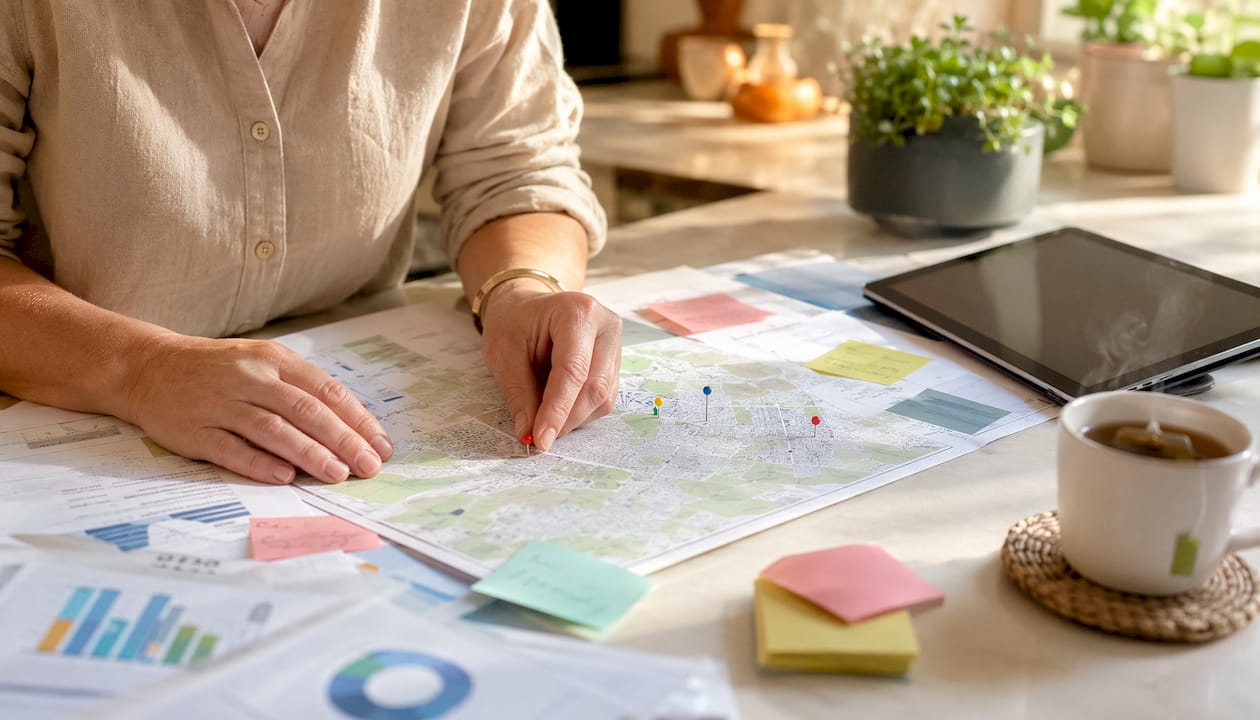
Closing the feedback loop after community input is critical. Businesses that collect neighborhood feedback but never report back on how they used it consistently lose the trust they worked to build.
What are the local SEO foundations that actually get you found?
Your Google Business Profile is your most important piece of digital real estate. A complete, verified listing is what gets you into the local map pack — the three results that appear above organic search results for queries like “coffee shop near me.”
GBP optimization checklist (do these in order):
- Claim and verify your listing at business.google.com
- Select the most specific primary category that matches your core service
- Add all secondary categories that apply
- Confirm your hours, including holiday hours
- Upload at least 10 photos (exterior, interior, products, team)
- Add your services or menu with descriptions and prices
- Enable messaging and respond within 24 hours
- Write a keyword-rich business description (750 characters max)
- Set up Google Posts and publish at least twice per month
- Monitor and respond to every review, positive or negative
Beyond GBP, your citation foundation matters:
- Keep your NAP identical across every directory: Google, Yelp, Nextdoor, Facebook/Meta Business, Apple Maps, and Bing Places
- Structured citations (directories) build baseline trust; unstructured citations — mentions in local news, blogs, or podcasts — increasingly validate authority to AI-powered search tools
- Location pages on your website with city, neighborhood, and street-level signals help both search engines and AI discovery tools surface your business for geo-specific queries
Before/after example: A bakery in Austin with an unclaimed GBP, no photos, and inconsistent hours across directories was invisible in map results for “bakery near me.” After a 10-minute fix — verifying the listing, correcting hours, and uploading 8 photos — it appeared in the local pack within two weeks. Reviews did the rest.
For a deeper walkthrough, Spinlisting’s guide on how to optimize your Google Business Profile covers every signal that matters in 2026. You can also review local SEO priorities for a broader overview of why this work pays off.
How do local events and partnerships build real neighborhood familiarity?
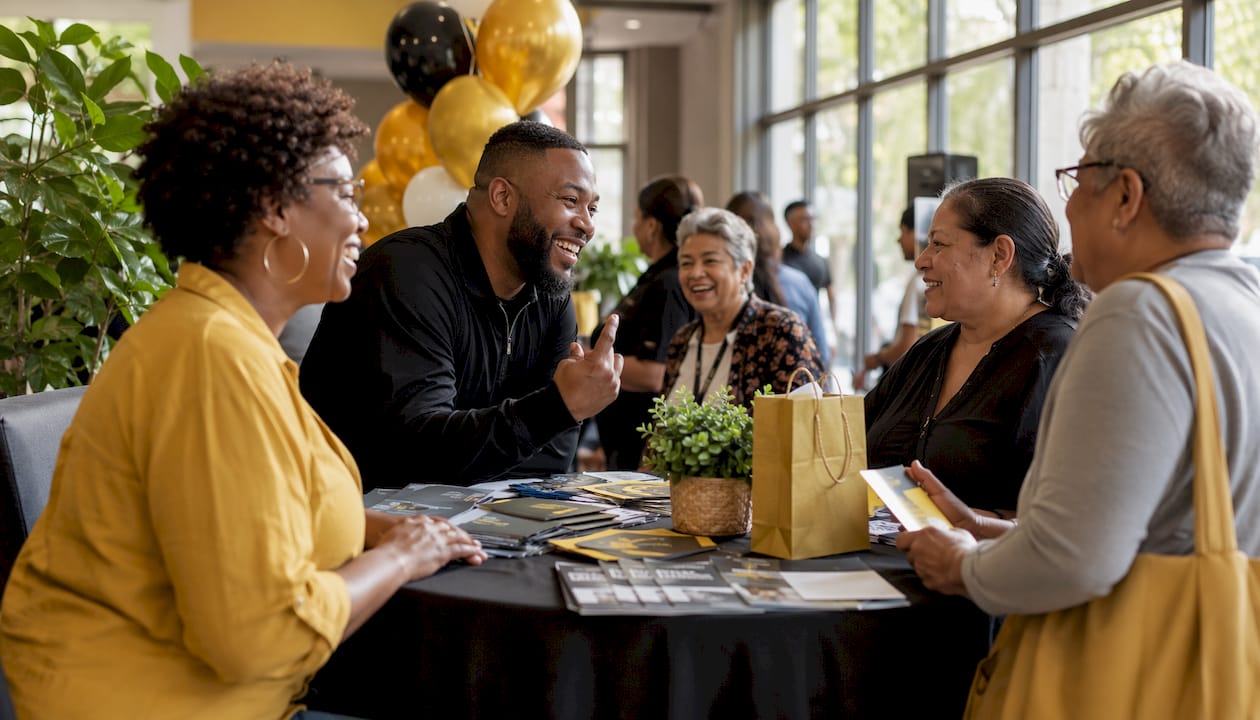
Offline presence still drives online results. Events and in-person experiences generate the reviews, photos, and earned mentions that feed digital visibility — and they create the kind of word-of-mouth that no ad budget can replicate.
Types of activations that scale awareness:
- Pop-up booths at farmers markets, street fairs, or school events
- Co-hosted events with a complementary business (a gym and a smoothie bar, a bookstore and a wine shop)
- Charity or school sponsorships — your name on a banner, a jersey, or a program
- Local Chamber of Commerce participation — monthly mixers, ribbon cuttings, and referral networks
Pitching a partnership is easier than most owners expect. Walk in, introduce yourself, and lead with what you bring to the table: your customer list, your foot traffic, your social following. A simple mutual-promotion arrangement — you feature them, they feature you — costs nothing and reaches two audiences at once.
Simple partnership checklist:
- Agree on a shared offer or discount for each other’s customers
- Decide on co-branded signage or social posts
- Set a start and end date so both parties stay accountable
- Track results with a unique promo code or QR code
Measurement matters here. Offline strategies like events and strong customer service drive reviews and mentions that improve digital discovery, but you need a way to connect the dots. Use a unique promo code for each event, count foot traffic on event days versus baseline days, and watch your GBP review count in the two weeks after each activation.
Effective community engagement requires consistent partnerships and closing the feedback loop — not a string of one-off activations. One well-executed recurring event beats five forgettable pop-ups.
How do you use social media to build local awareness on a small budget?
Channel choice matters more than posting frequency. Pick the platform where your specific neighborhood audience actually spends time, then commit to it before spreading thin.
Channel-match guide:
- Facebook/Meta Business — best for residents 35+, neighborhood groups, and event promotion; strong geotargeting for ads
- Instagram — visual businesses (food, retail, fitness, beauty) with audiences 18–40; Stories and Reels drive local discovery
- TikTok — works well for businesses with a strong personality or behind-the-scenes story; younger demographics, but local reach is growing fast
- Nextdoor — underused and underrated; neighbors actively ask for business recommendations here, and a free business page gets you in front of hyper-local intent
- Eventbrite — list every event you host or attend; it feeds local discovery and drives RSVPs from people who don’t follow you yet
Running a $100 test campaign:
- Pick one platform (Facebook or Instagram for most local businesses)
- Set a 1–2 mile radius around your address
- Choose one audience: neighborhood residents, or a specific age/interest overlay
- Run one ad creative for 7 days
- Measure reach, link clicks, and any in-store visits or calls
- Adjust the audience or creative, then run a second $50 test before scaling
Practitioners recommend starting with a modest test budget — around $100 — to validate creative and targeting before committing larger spend. It’s the fastest way to learn what your neighborhood actually responds to.
Content formats that work locally:
- Staff spotlights and behind-the-scenes clips
- Customer stories (with permission)
- Local event recaps with tagged locations
- “Did you know?” posts about your neighborhood’s history or hidden spots
- Community shoutouts for other local businesses
Track reach versus engagement versus visit intent separately. Reach tells you how many people saw it; engagement tells you who cared; visit intent (clicks on directions, calls, website) tells you who acted.
How do you create neighborhood content that builds long-term recognition?
Content that names your neighborhood, your street, and your community earns trust that generic content never can. It also feeds the geo-signals — city, street, neighborhood, and service area pages — that search engines and AI discovery tools use to match your business to local queries.
Content ideas that resonate locally:
- Neighborhood guides (“Best spots for a Saturday morning in [your neighborhood]”)
- “Who to know” posts featuring local figures, other business owners, or longtime residents
- A local events calendar you curate and share monthly
- Customer stories tied to a specific local context
- Staff spotlights that mention where your team lives or grew up
Local PR pitch template: Lead with a human-interest angle, not a product announcement. “We’ve been serving the Wicker Park neighborhood for 8 years and we’re hosting a free financial literacy workshop for local small business owners” lands better than “We’re excited to announce our new service.” Local outlets care about community improvement, events, and stories that make their readers feel seen.
Repurposing one story across channels:
One customer story becomes a blog post, three Instagram captions, an email newsletter paragraph, a press pitch to the local paper, and a quote on your location page. That’s five pieces of content from one conversation.
Working with micro-influencers: Local creators with 1,000–10,000 followers often have higher engagement rates than larger accounts and charge far less. Offer a free product or experience in exchange for an honest post. Tag your location, ask them to tag it too, and the post becomes a local discovery signal.
What KPIs and timelines should you expect from local brand campaigns?
Local brand awareness doesn’t show up in revenue overnight. Here’s what to track, when to expect it, and what budget ranges are realistic.
Core KPIs for local awareness:
- GBP views and impressions (search vs. maps)
- Branded search volume (people searching your business name)
- Social reach within your target radius
- Event attendance and foot traffic on activation days
- Earned mentions in local press, blogs, or podcasts
- Review count and average rating
| Phase | Timeframe | Expected Results |
|---|---|---|
| Quick wins | 0–30 days | GBP verified, NAP corrected, 5+ new reviews, first ad test complete |
| Early traction | 30–90 days | GBP views up, first local press mention, social following growing, event attendance tracked |
| Authority building | 90–180 days | Branded search lift, map pack appearances, repeat event attendance, referral traffic from local blogs |
Budget ranges for small local campaigns:
- Micro ($0–$200/month): GBP optimization, organic social, free Nextdoor listing, one community event
- Small ($200–$800/month): Add $100–$300 in social ads, one paid event booth, local PR outreach
- Moderate ($800–$2,000/month): Consistent paid social, local influencer partnerships, monthly events, citation management
Attribution checklist for offline activations:
- Unique promo codes per event or channel
- QR codes on flyers and signage that link to a trackable landing page
- Ask new customers “How did you hear about us?” and log answers
- Watch GBP call and direction requests in the days after an activation
- Monitor review mentions for event-specific language
Your 10-step Google Business Profile quick audit
A GBP audit takes about 20 minutes and often produces visible results within 30–90 days. Work through this list in order.
- Verify ownership — confirm the listing is claimed and verified (look for the blue checkmark in your GBP dashboard)
- Primary category — is it the most specific option available? “Italian Restaurant” beats “Restaurant”
- Secondary categories — add every relevant one (up to 10)
- Services and menu — list every service with a description; this feeds AI-powered search results
- Photos — minimum 10, including exterior, interior, team, and products; update quarterly
- Google Posts — publish at least twice per month; use offers, events, and updates
- Q&A section — seed it with your own questions and answers; it controls the narrative
- Attributes — check every applicable attribute (wheelchair accessible, women-owned, outdoor seating, etc.)
- Hours — verify regular and holiday hours are current; wrong hours are the #1 trust-killer
- Owner responses — respond to every review within 48 hours; this signals active management to Google
Quick wins that move visibility fast: Correcting hours and adding 10 photos typically produces the fastest GBP ranking lift. Adding services with keyword-rich descriptions feeds AI search tools that pull structured data from your listing.
| Priority action | Expected impact |
|---|---|
| Verify and claim listing | Unlocks all optimization features |
| Fix hours and NAP | Reduces trust-killing inconsistencies |
| Add 10+ photos | Increases click-through rate on map results |
| Add services with descriptions | Feeds AI-powered local search results |
| Respond to all reviews | Signals active management; improves ranking |
For a complete field-ready checklist, Spinlisting’s local SEO audit guide walks through every signal step by step.
What does a 30/90/180-day local marketing roadmap look like?
The biggest mistake local owners make is trying to do everything at once. Sequence matters. Here’s a realistic phased plan.
Days 1–30 (foundation):
Claim and verify your GBP. Fix NAP across Google, Yelp, Nextdoor, and Facebook. Ask 5 customers for reviews. Set up your free Nextdoor business page. Run your first $100 Facebook or Instagram test ad. Identify one local business for a cross-promotion conversation.
Days 31–90 (traction):
Publish two GBP posts per month. Host or participate in one community event. Pitch one local media outlet with a human-interest story. Build one neighborhood-focused page on your website. Review your ad test results and run a second, refined campaign. Join your local Chamber of Commerce.
Days 91–180 (authority):
Track branded search volume monthly. Publish a neighborhood guide or local events calendar. Secure one micro-influencer post. Establish a recurring monthly event or sponsorship. Review your GBP Insights data and adjust categories or services based on what queries are driving views.
Roles for a small team or solo owner:
- GBP and listings: owner or office manager (30 minutes per week)
- Social content: whoever is most comfortable on camera or writing; batch-create content monthly
- Events and partnerships: owner-led; delegate logistics to a part-time employee if available
- Paid ads: owner sets budget and reviews results; consider outsourcing creative to a local freelancer
If you’re time-strapped, outsource GBP optimization first. It’s the highest-leverage task and the one most owners neglect after the initial setup. Spinlisting’s local search visibility guide covers the ongoing optimization signals that matter most after launch.
How do local loyalty programs build repeat business and neighborhood recognition?
A loyalty program designed for your specific neighborhood does two things a generic points app can’t: it rewards the behavior patterns of your actual customers, and it gives people a reason to talk about you to their neighbors.
The most effective local loyalty programs are simple and tangible. A coffee shop punch card still works because it’s frictionless. A “neighborhood regular” discount for customers who visit three times in a month creates a status that people mention. A referral reward — “bring a neighbor, both of you get 15% off” — turns your loyalty program into a word-of-mouth engine.
A few design principles worth following: tie rewards to your community identity (a local bookstore might offer a “neighborhood reader” tier with early access to author events), keep the redemption path short (no app downloads required for first-time participants), and make the program visible in-store with signage that reinforces your local brand.
Digital loyalty tools like Square Loyalty, Stamp Me, or Fivestars integrate with point-of-sale systems and send automated reminders. They also give you data: which customers visit most, what they buy, and when they lapse. That data feeds your segmentation work from the audience section above.
The loyalty program is also a review-generation tool. When a customer hits a reward milestone, that’s the right moment to ask for a Google review. They’re already feeling good about you.
Key Takeaways
The highest-impact local brand awareness building strategies combine a verified Google Business Profile, consistent community presence, and localized content — all measured against clear KPIs from day one.
| Point | Details |
|---|---|
| GBP is your first move | Claim, verify, and fully optimize your Google Business Profile before investing in ads or events. |
| Hyperlocal radius targeting | Start campaigns within a 1–2 mile radius for neighborhood reach; expand to 75 miles only for broader service areas. |
| Test ads before scaling | Run a $100 hyperlocal ad test to validate creative and targeting before committing larger budgets. |
| Sustained engagement wins | Recurring events and partnerships build lasting trust; one-off activations rarely create lasting recognition. |
| Spinlisting accelerates GBP results | Spinlisting’s GBP optimization service has delivered significant increases in first-place rankings for local businesses. |
Why one-off campaigns almost never build a local brand
The conventional wisdom says “get your name out there” — run a booth at the street fair, sponsor the Little League team, post a few times on Instagram. Check the boxes, move on. The problem is that local brand recognition doesn’t work like a campaign. It works like a relationship.
Think about the businesses you actually trust in your own neighborhood. You probably didn’t become a regular after one visit or one ad. You became a regular because you saw them consistently, heard neighbors mention them, noticed they showed up at the same events every year, and felt like they were genuinely part of the fabric of the place. That’s not a campaign outcome. That’s a compounding effect.
What most guides miss is that transparency about how community input affects decisions is what separates authentic local brands from businesses that are just doing marketing. When you ask your neighborhood what they want and then actually deliver it — and tell them you did — you create advocates, not just customers. When you run a pop-up, collect feedback, and never follow up, you’ve spent money on goodwill you didn’t keep.
The businesses that win local brand recognition over a 12–18 month horizon are the ones that treat every activation as a relationship touchpoint, not a transaction. They respond to every review. They show up at the same farmers market every Saturday. They remember names. None of that is scalable in the traditional sense, and that’s exactly why larger competitors can’t replicate it.
Short-term activations have their place — they generate the reviews and mentions that feed your digital visibility. But they only compound when there’s a consistent presence underneath them. Build the foundation first, then layer the activations on top.
Spinlisting gets your GBP working harder than you can alone
Most local businesses set up their Google Business Profile once and forget it. Spinlisting exists specifically to fix that. The service covers the full GBP optimization stack: accurate and keyword-enhanced listing setup, ongoing citation cleanup, location page creation, and the kind of continuous monitoring that catches ranking drops before they cost you customers.
Spinlisting works for solo owners who don’t have time to manage GBP weekly, small teams running multiple locations, and businesses that have tried ads without seeing results because their listing foundation wasn’t solid. The results are concrete: clients have seen 83% increases in first-place local rankings and measurable lifts in organic traffic after optimization. If you’ve been putting off the GBP work because it feels technical or time-consuming, that’s exactly the gap Spinlisting closes.
Start with a free GBP audit to see where your listing stands right now and what’s costing you visibility.
Useful sources for deeper implementation
-
U.S. Small Business Administration — Local Marketing Strategies: Practical, government-backed guidance on hyperlocal radius targeting and test-budget approaches for small businesses.
-
Search Engine Land — Local Marketing Guide: Covers structured and unstructured citations, geo-signals, and how AI-powered search tools use local mentions — essential reading for anyone building a local SEO foundation.
-
Grounded World — Community Engagement Strategy: Explains why closing the feedback loop is the most commonly skipped step in community engagement and how to build sustained partnerships.
-
AIA Guides for Equitable Practice — Engaging Community: Useful framework for inclusive outreach — adapting channels, language, and timing to reach the full range of your neighborhood audience.
-
Spinlisting — Local SEO Audit Checklist: A field-ready GBP and local SEO audit template built specifically for U.S. local businesses.
-
BabyLove Growth — Why Prioritize Local SEO: A clear external overview of local SEO benefits and tactical steps for businesses starting from scratch.
Recommended
- Why Local Keywords Boost Visibility for Small Businesses | Google my Business for SEO / ranking services SEO
- Why Location Pages Boost Rankings for Local Businesses | Google my Business for SEO / ranking services SEO
- Local Search Visibility Mistakes Hurting You in 2026 | Google my Business for SEO / ranking services SEO
- How to Launch Your Local Business Online Presence | Google my Business for SEO / ranking services SEO