

Google Business Profile (GBP, formerly Google My Business) is the local funnel engine that captures in-market searchers at the moment they are ready to act, moving them from discovery on Google Search and Google Maps through to a booked appointment or purchase. The single highest-impact action you can take right now: add UTM parameters to your GBP website link and enable call tracking, so every lead the profile generates becomes visible in your analytics and CRM.
Roughly 60–70% of clicks on local searches go to the top three map-pack positions, and GBP is the primary place most customers check before they ever visit your website. That concentration of intent is why GBP deserves its own funnel strategy, not just a one-time setup.
Table of Contents
- What Google Business Profile does and which features actually move the needle
- How GBP maps to every stage of your marketing funnel
- The GBP optimization playbook: what to do and when
- How to measure GBP impact and attribute conversions correctly
- Common GBP mistakes that cost you rankings and risk suspension
- How a maintained GBP profile produces real funnel lifts
- Key Takeaways
- Why most businesses are treating GBP like a static directory
- Spinlisting turns your GBP profile into a measurable lead channel
- Useful sources and further reading
What Google Business Profile does and which features actually move the needle
Google Business Profile is a free listing that surfaces your business in Google Search local results and on Google Maps. When someone searches “plumber near me” or “best coffee shop in Austin,” the map pack they see is powered entirely by GBP data. Your website helps your GBP rank; the profile itself is the customer’s first real touchpoint.
The features that matter most to the customer journey:
- Business name, address, phone (NAP): The foundation. Inconsistency across the web hurts rankings.
- Primary and secondary categories: Google’s primary category is still the top local ranking factor. Use 3–5 relevant categories; most businesses pick one and stop there.
- Business description: 750 characters. Use them. Include natural keyword phrases that describe what you do and who you serve.
- Photos and videos: Listings with recent photos and video show measurably higher engagement, including more website visits, direction requests, and calls.
- Posts: Weekly updates, offers, and events signal an active business to Google and give searchers a reason to choose you over a dormant competitor.
- Products and services: Add 20–30 services with descriptions. Many businesses list no services.
- Q&A: Seed your own questions and answers before someone else does it for you.
- Reviews: Star rating, review volume, and review recency all influence both rankings and conversion.
- Messaging and booking links: Direct conversion paths that remove friction at the decision stage.
- GBP Insights: Profile views, search queries, calls, direction requests, and website clicks, all reported natively.
Stat: 60–70% of local search clicks land on the top three map-pack results. A profile that sits outside that pack is largely invisible to in-market buyers.
For a deeper look at how local search marketing fits into your overall strategy, the business case for GBP investment is straightforward once you see where the clicks actually go.
How GBP maps to every stage of your marketing funnel
GBP does not just live at the top of the funnel. It touches every stage, from the first impression to the repeat booking, and each stage has its own signals to watch.
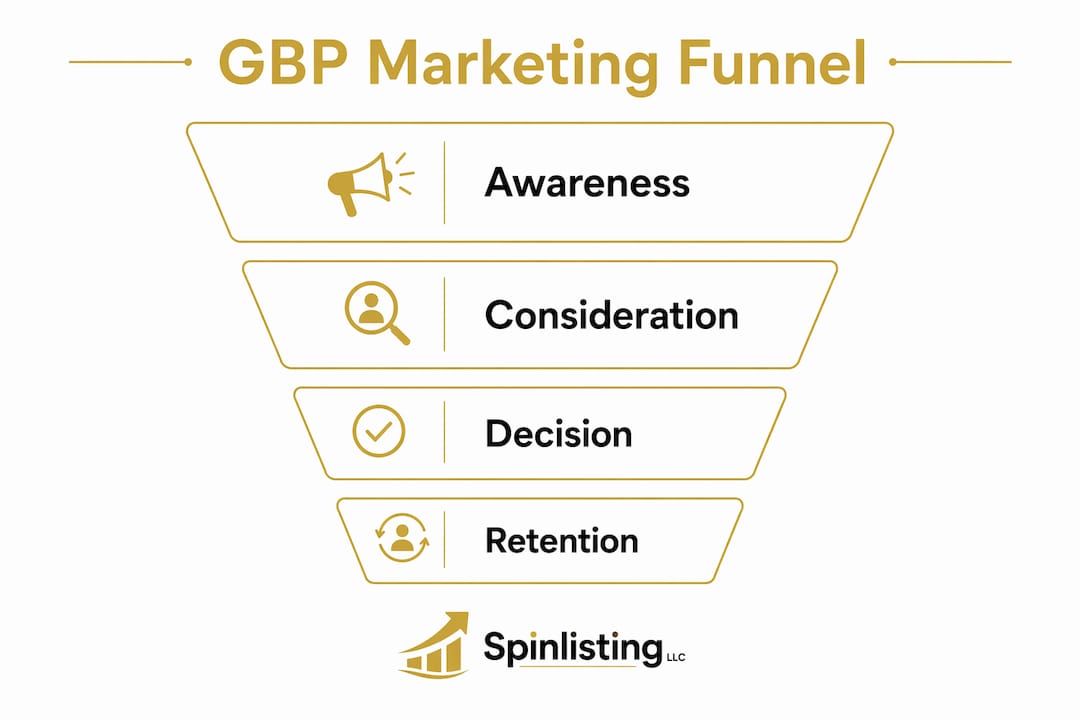
Awareness: getting found before competitors do
When a potential customer searches for a service category near them, the map pack is their first result. Your GBP photos, star rating, and business name are the entire first impression. At this stage, Google is deciding whether to show you at all, and the signals it weighs include category relevance, proximity, and profile completeness.
KPIs to watch: profile impressions, total searches (branded vs. discovery), and direction requests. A rising discovery search count means new people are finding you for category terms, not just your name.
A restaurant that adds new interior and food photos regularly typically sees a measurable lift in profile views within several weeks. The photos do not just look good; they signal activity.
Consideration: turning a view into a click
Once someone sees your listing, they start evaluating. They read reviews, scan your services, check your hours, and look at your posts. This is where review recency and velocity become decisive. A business with many recent reviews routinely outperforms one with older reviews, both in rankings and in the consumer’s mental shortlist.

KPIs: website clicks from GBP, calls initiated from the profile, message starts, and Q&A engagement. These are all trackable in GBP Insights.
Your posts matter here too. An offer post or a “what to expect” update answers the unspoken questions that would otherwise send a prospect to a competitor.
Decision: converting the ready buyer
GBP’s booking links, appointment URLs, and offer posts exist for one purpose: to remove the last bit of friction between intent and action. A searcher who has already read your reviews and scanned your services just needs a clear path to book. If your profile forces them to navigate to your homepage and hunt for a contact form, you lose many potential customers every time.
KPIs: bookings completed via GBP, calls that convert (tracked with a call-tracking number), and the ratio of profile actions to profile views. This last ratio is your profile conversion rate, and it is one of the most underused metrics in local marketing.
GBP captures a small slice of the market that is actively searching for an immediate solution. That is a small slice, but it is the highest-intent slice in your entire marketing mix.
Retention: keeping customers coming back
Most marketers treat GBP as a top-of-funnel tool and ignore its retention potential. That is a mistake. Responding to every review within a couple of days signals to past customers that you are engaged. Posting seasonal offers or loyalty promotions keeps your business visible to people who have already converted. Messaging enables direct follow-up conversations.

KPIs: repeat direction requests from known customers, return website visits from the GBP UTM source, and review cadence (how consistently new reviews arrive). For customer retention in local search, GBP is one of the few free channels that keeps working after the first sale.
Consistent updates compound into higher engagement over time. A business that posts weekly, responds to reviews, and refreshes photos monthly builds a profile that gets progressively harder for competitors to displace.
The GBP optimization playbook: what to do and when
Here is a prioritized checklist, followed by a table that maps each tactic to the funnel stage it most directly moves.
- Verify and complete your profile. NAP consistency across your website, GBP, and other directories is non-negotiable. Fill every field Google offers.
- Select your primary category carefully. Primary category selection is still the top local ranking factor. Get it right before anything else.
- Write a full business description. Use all 750 characters. Include your core services and location naturally. See Spinlisting’s guidance on business description SEO for keyword placement that actually works.
- Add 20–30 photos immediately. Interior, exterior, team, products, and completed work. Geo-tag them. Then add one new photo every week going forward.
- List all services with descriptions. Aim for 20–30 services. Each one is a keyword signal and a conversion cue for the right searcher.
- Add UTM parameters to your website link. Use
utm_source=google&utm_medium=organic&utm_campaign=google_my_business_listing. UTM-tagging your GBP link converts the profile from a black box into an attributable traffic source in GA4 and your CRM. - Set up call tracking. Use a forwarding number in your GBP so calls are logged separately from other sources.
- Enable messaging and booking links. Every friction point you remove at the decision stage improves your conversion rate.
- Post weekly. Updates, offers, events, service highlights. Schedule 4–8 posts at once if needed. Google notices active profiles; dormant ones rank lower.
- Build a review request workflow. Send a direct Google review link via SMS or email within 24 hours of a completed service. Timing is everything.
- Seed your Q&A section. Write the five questions customers ask most often and answer them yourself before anyone else does.
- Respond to every review within 48 hours. Positive and negative. This is both a trust signal for readers and a freshness signal for Google.
| Tactic | Funnel stage | Primary KPI |
|---|---|---|
| Complete NAP + categories | Awareness | Discovery search impressions |
| Photos and video cadence | Awareness → Consideration | Profile views, direction requests |
| Business description + services | Consideration | Website clicks from GBP |
| Weekly posts | Consideration → Decision | Post views, offer redemptions |
| Review request workflow | Consideration → Decision | Review count, star rating |
| Booking / appointment links | Decision | Bookings completed |
| UTM-tagged website link | Decision → all stages | Sessions, conversions in GA4 |
| Call tracking | Decision | Calls, call-to-conversion rate |
| Review responses | Retention | Review cadence, repeat visits |
| Messaging | Retention | Message starts, follow-up conversions |
Pro Tip: Treat your GBP like a live data feed, not a directory listing. Google’s AI-driven local search now pulls from freshness signals: recent photos, post dates, and review recency. A profile that has not been touched in 60 days is effectively telling Google’s systems that the business is less active than a competitor who posted yesterday.
How to measure GBP impact and attribute conversions correctly
GBP Insights gives you profile views, search queries, calls, direction requests, and website clicks natively. That is a start, but it is not enough for a real attribution picture.
Step-by-step measurement setup:
- Add UTM parameters to your GBP website link (see the playbook above). In GA4, create a channel grouping or filter for
utm_campaign=google_my_business_listingso GBP traffic is separated from organic search. - Set up a call-tracking number (services like CallRail work well for this) and use it exclusively in your GBP. Any call to that number originated from the profile.
- In GA4, create a conversion event for the actions that matter: form submissions, booking completions, and phone call clicks. Tag GBP-origin sessions so conversions are attributed correctly.
- In your CRM, add a lead source field for “GBP” and train your team to log it when a lead mentions finding you on Google Maps or when the UTM parameter is present in the session data.
- For message and booking conversions, GBP Insights tracks these natively. Export the data monthly and add it to your attribution report.
| Metric | Where to find it | What it tells you |
|---|---|---|
| Profile views | GBP Insights | Total awareness reach |
| Discovery searches | GBP Insights | New-audience reach (non-branded) |
| Direction requests | GBP Insights | High-intent local interest |
| Website clicks | GBP Insights + GA4 (UTM) | Mid-funnel engagement |
| Calls | Call tracking + GBP Insights | Decision-stage intent |
| Bookings / messages | GBP Insights | Direct conversion actions |
| GBP-origin sessions | GA4 (UTM filter) | Full-funnel attribution |
| GBP-origin conversions | GA4 Goals / Events | Revenue attribution |
Timeline expectations: Profile view lifts from photo and post activity typically appear within 4–6 weeks. Ranking improvements from category optimization and review velocity usually take 2–3 months to stabilize. Call and booking volume tied to GBP tends to move in parallel with ranking gains. For a structured approach to measuring local SEO ROI, tracking these metrics monthly against a baseline is the only way to know what is actually working.
Stat: Businesses that combine an optimized profile, regular content updates, and active follow-ups often see increased engagement and gradual ranking gains within two to three months.
For context on why Google rankings drive ROI more reliably than most other local channels, the math on intent-based traffic versus interruption-based advertising is worth understanding before you set your budget.
Common GBP mistakes that cost you rankings and risk suspension
Most GBP problems are self-inflicted. Here is what to avoid:
- Keyword stuffing in the business name. Adding “best plumber Chicago” to your business name field violates Google’s guidelines and can trigger a suspension. Your business name should match your real-world signage.
- Fake or incentivized reviews. Offering discounts for reviews, posting reviews from staff accounts, or using review farms all violate policy. Google’s systems are increasingly good at detecting these, and the penalty is profile suspension.
- Inconsistent NAP. If your address on GBP says “Suite 100” and your website says “Ste. 100,” that inconsistency is a small but real ranking drag. Audit every directory listing annually.
- Using a PO box as your address. Google requires a physical address where customers can visit. PO boxes are not allowed for service-area businesses; use a service-area setting instead.
- Wrong or too-broad primary category. A general contractor who selects “Construction Company” instead of “General Contractor” is leaving ranking potential on the table. Be specific. See local search visibility mistakes for a full breakdown of category errors.
- Inaccurate or outdated hours. A customer who shows up when you are closed will leave a one-star review. Update holiday hours every year.
- Broken website link. Check your GBP website link monthly. A 404 page kills conversions and signals a low-quality profile.
- Ignoring the Q&A section. Unanswered questions from strangers, sometimes competitors, can sit on your profile for months.
Monthly compliance checklist:
- Verify NAP matches website and major directories
- Confirm hours are current (including special hours)
- Check for unanswered Q&A entries
- Review for policy-violating content in reviews or posts
- Confirm website link resolves correctly
- Ensure no unauthorized edits have been made to your listing
If your profile is suspended, do not attempt to create a duplicate listing. Use Google’s official Business Profile support channels to file a reinstatement request with documentation of your physical location.
How a maintained GBP profile produces real funnel lifts
A local home services business came to Spinlisting with a verified but largely dormant GBP profile: no posts in several months, relatively few photos, and no review request process in place. The listing was claimed but effectively invisible outside a two-block radius.
Spinlisting’s approach covered weekly posts tied to seasonal service offers, a photo refresh with many new geo-tagged images uploaded over the first month, a structured review request workflow via SMS sent shortly after job completion, and UTM-tagged website links with call tracking installed early.
| Metric | Before | After (90 days) |
|---|---|---|
| First-place local ranking | Baseline | 83% improvement |
| Profile views | Baseline | Measurable lift |
| Calls from GBP | Baseline | Tracked via call tracking |
| Review count | Low | Steady weekly cadence |
| Website sessions from GBP | Unattributed | Fully attributed via UTM |
The attribution setup was as important as the optimization itself. Before UTM tracking, the business had no way to connect GBP activity to revenue. After 90 days, GBP-origin sessions were a clearly labeled source in GA4, and the call-tracking number had logged every inbound call from the profile.
Well-maintained GBP listings have a 5x greater value than unclaimed ones, and the compounding effect of consistent updates, review management, and photo cadence is what separates a profile that generates leads from one that merely exists.
The methodology: all ranking changes were measured using a grid-based rank tracker across the business’s service area. Attribution was based on a 30-day lookback window using UTM-tagged sessions and call-tracking logs. The review cadence improvement was measured as new reviews per week, pre- and post-workflow.
Key Takeaways
Google Business Profile is the highest-ROI local marketing channel for in-market buyers, but only when it is actively managed, properly tracked, and mapped to every funnel stage from awareness through retention.
| Point | Details |
|---|---|
| GBP spans the full funnel | Map-pack visibility drives awareness; reviews and posts move consideration; booking links close decisions; responses retain customers. |
| UTM tracking is non-negotiable | Add UTM parameters to your GBP website link on day one so every session and conversion is attributed correctly in GA4. |
| Review velocity beats review volume | Recent reviews outperform older ones for both rankings and consumer trust; build a weekly request workflow. |
| Freshness signals compound over time | Weekly posts, new photos, and review responses create a virtuous cycle that progressively improves visibility and conversions. |
| Spinlisting accelerates the process | Spinlisting’s managed GBP optimization has produced significant first-place ranking improvements for clients through structured posting, review workflows, and UTM discipline. |
Why most businesses are treating GBP like a static directory
The conventional wisdom on GBP is that you set it up once, fill in your hours, and let it run. That mindset is what keeps most local businesses stuck outside the top three map-pack positions.
What the data actually shows is that GBP behaves more like a content channel than a directory. Google’s AI-driven local search systems are pulling freshness signals: how recently you posted, how recently you uploaded a photo, how quickly you responded to the last review. A profile that has not been touched in 60 days is competing against one that was updated yesterday, and the active profile wins that comparison more often than not.
There is also a measurement gap that most businesses never close. Without UTM parameters and call tracking, GBP looks like a cost center with no measurable return. With them, it becomes one of the most attributable channels in your mix, because the intent is already there when the searcher finds you. You are not creating demand; you are capturing it. That distinction changes how you should budget for GBP management relative to paid channels that require you to interrupt people who were not looking for you.
The businesses that treat GBP as a living channel, posting weekly, requesting reviews systematically, and refreshing photos on a schedule, are the ones that compound their way into map-pack dominance over 6–12 months. The ones that set it and forget it are handing that position to whoever is willing to do the work.
Spinlisting turns your GBP profile into a measurable lead channel
Most local businesses have a GBP listing. Very few have one that is actively generating attributable leads at every funnel stage. The gap between those two outcomes is not a mystery: it is weekly posts, a photo cadence, a review workflow, UTM tracking, and the discipline to keep all of it running month after month.

Spinlisting handles exactly that. The service covers a full GBP audit, ongoing posting and photo cadence, review request management, UTM and call-tracking setup, and for multi-location businesses, API-driven profile management that removes the manual overhead entirely. Clients have seen significant improvements in first-place local rankings, and well-maintained listings consistently outperform unclaimed or dormant profiles by a large margin.
If you are ready to turn your GBP profile into a channel you can actually measure, see what Spinlisting does and get started with a profile audit. For businesses that want to understand the full competitive picture first, the breakdown of why GMB optimization beats competitors in local search is worth reading before you decide.
Useful sources and further reading
- Google Business Profiles (GMB) | The Marketing Show — Practical GBP optimization framework including the Core 30 method, UTM setup, and review velocity guidance.
- The New Google Business Profile Playbook for AI Local Search | Search Engine Journal — How AI-driven local search uses freshness signals and what that means for your posting and photo strategy.
- How to Build a Funnel That Converts Local Visibility into Real Leads | Gonukkad — Step-by-step local lead funnel structure that maps GBP actions to conversion outcomes.
- How to Optimize Google Business Profile in 2026 | Spinlisting — Spinlisting’s step-by-step guide for profile optimization, including category selection and description keywording.
- How to Measure ROI of Your Local SEO Efforts | Spinlisting — Measurement framework for attributing GBP-driven sessions and conversions in GA4 and CRM.
- Local Search Visibility Mistakes Hurting You in 2026 | Spinlisting — Common GBP errors and how to fix them, including category mistakes and NAP inconsistency.
- Marketing Funnels: 42% Better Lead Gen & SEO in 2026 | Babylove Growth — Research on funnel performance and lead-generation uplift from integrated local marketing strategies.
- Local Business Listing Essentials: Your 2026 Guide | Spinlisting — Supplier-agnostic checklist for getting every listing field right before you start optimization work.
Recommended
- Why GMB Optimization Beats Competitors in Local Search | Google my Business for SEO / ranking services SEO
- Why Google My Business Outperforms Social Media Locally | Google my Business for SEO / ranking services SEO
- GMB vs Paid Ads Benefits: Local Business Guide 2026 | Google my Business for SEO / ranking services SEO
- Local Search Marketing Explained for Business Owners | Google my Business for SEO / ranking services SEO