
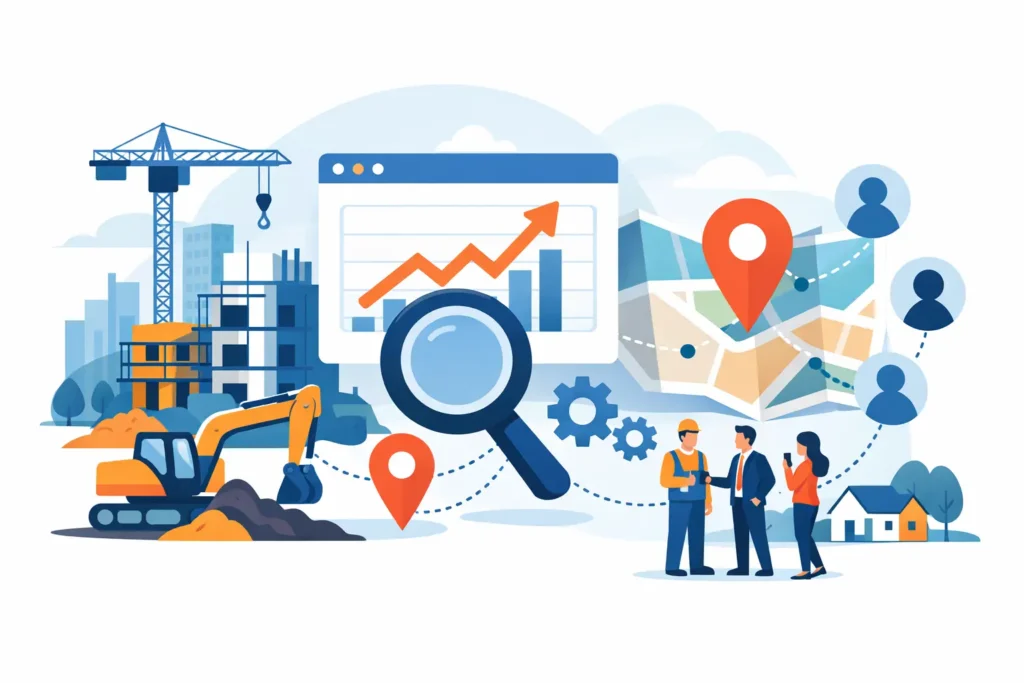
Most construction companies do not have a traffic problem. They have a visibility problem. When a property owner searches for a contractor, builder, remodeler, or excavation company, they usually pick from the businesses they see first on Google. If your company is buried in Maps and organic results, construction SEO is what closes that gap.
This is not about getting random clicks. It is about showing up when someone in your service area needs an estimate, has a project ready to price, or is comparing contractors before making a call. Good SEO for a construction business should produce qualified local traffic, stronger trust signals, and more inbound leads from the markets you actually serve.
What construction SEO actually needs to do
Construction SEO has a simple job on paper – improve rankings and bring in leads. In practice, it has to do more than that. Your website needs to rank for core services, your Google Business Profile needs to compete in the map pack, and your online presence needs to support how buyers actually choose a contractor.
That means your SEO strategy has to cover local intent, service intent, and credibility. Someone searching for “general contractor near me” is different from someone searching “commercial build-out contractor” or “kitchen remodel cost in Dallas.” One search is urgent and local. Another is research-heavy. A third may be early-stage but high value. If your site only targets broad keywords, you miss the easier wins and the stronger conversion opportunities.
For most contractors, the strongest results come from combining local SEO, on-page service targeting, technical cleanup, review growth, and a properly optimized Google Business Profile. If one of those is weak, the rest usually underperform.
Why construction companies struggle with SEO
A lot of construction websites look fine at first glance and still fail in search. The issue is usually not design. It is weak structure, thin content, or no local relevance.
Many contractors have one generic services page that tries to rank for everything. That rarely works. Google needs clear signals about what you do and where you do it. If you offer roofing, home additions, foundation work, and tenant improvements, those need distinct pages with useful content. If you serve multiple cities, those locations need to be reflected strategically, not stuffed awkwardly across the site.
The other common issue is trust. Construction is a high-ticket category. People want proof before they call. If your site has no project photos, no reviews, no service area detail, and no explanation of your process, rankings may not turn into leads even when traffic improves.
Google Maps matters more than many contractors think
For local service businesses, the map pack often gets the first call. That is especially true on mobile, where users want a nearby company, fast. If your Google Business Profile is incomplete, inactive, or inconsistent with your website, you leave easy ground to competitors.
An optimized profile should have accurate categories, current service information, fresh photos, review activity, and regular updates. It should also match the business details used across your website and local citations. This is where a lot of lead flow gets won or lost.
The core parts of a strong construction SEO campaign
A real campaign starts with keyword targeting, but it cannot stop there. Rankings come from relevance, authority, and consistency.
Your service pages need to map to the actual terms people use. That may include phrases like concrete contractor, commercial construction company, home builder, remodeling contractor, or excavation services, depending on the business. Each page should explain the service clearly, mention the types of jobs you handle, and show evidence that you do the work in the target area.
Location signals matter just as much. A contractor serving Phoenix, Mesa, Chandler, and Gilbert should not rely on one page that vaguely says “we serve the Valley.” Dedicated city pages can help, but only if they are written with substance. Thin duplicate pages tend to underperform and can weaken the whole site.
Technical SEO also matters more than many owners expect. Construction websites often have slow galleries, oversized images, broken page structures, weak internal linking, or missing metadata. These are not small details. If search engines cannot crawl the site efficiently or users bounce because pages load slowly, rankings suffer.
Then there is authority. Backlinks still matter, but quality matters more than volume. A handful of relevant local and industry mentions can outperform a pile of junk directory links. In construction, authority also comes from project depth. Strong before-and-after pages, completed job write-ups, FAQs, and detailed service content all help reinforce topical relevance.
Construction SEO and conversion have to work together
A lot of agencies chase rankings and ignore what happens after the click. That is a mistake, especially in construction.
If a user lands on your page and cannot quickly confirm your service area, licensing, project type, or next step, they leave. SEO traffic only has value if the site converts. That means clear calls to action, visible phone numbers, estimate forms that are easy to complete, and content that answers the practical questions buyers have before reaching out.
For example, a page about home additions should not just define the service. It should address project scope, timelines, permit awareness, service areas, and the kinds of additions you build. A commercial contractor page should speak differently than a residential page. Better alignment means better leads.
Reviews and project media are ranking assets
Reviews are not only about reputation. They support local visibility and conversion at the same time. Recent reviews mentioning your services and location can strengthen local relevance while helping prospects trust your company.
Photos matter too. Construction buyers want visual proof. Google Business Profile photos, geotagged jobsite images, and strong on-site project galleries support both engagement and credibility. They also make your company look active, established, and real.
What to expect from construction SEO over time
SEO is not instant, and any agency promising overnight domination is selling fantasy. That said, construction SEO can produce fast movement in the right conditions.
If your business already has some domain age, a verified Google Business Profile, and decent market demand, local improvements can show up sooner than broad organic growth. Map visibility often responds well to active optimization, review strategy, and category alignment. Organic rankings for competitive terms usually take longer, especially in larger metro areas.
It also depends on the competition. Ranking a concrete contractor in a smaller suburban market is different from ranking a general contractor in Houston or Los Angeles. The strategy, pace, and budget should reflect that reality.
This is why execution matters. The companies that win are usually the ones consistently improving service pages, adding location relevance, publishing updates, collecting reviews, and maintaining their business profile instead of touching it once and forgetting it.
What a contractor should look for in a construction SEO provider
If you are hiring help, look past broad promises. Ask what the actual deliverables are. You should know whether the provider is working on service pages, technical fixes, Google Business Profile optimization, content writing, review support, and local ranking improvements.
You should also look for industry understanding. Construction is not the same as retail, restaurants, or ecommerce. Your SEO provider needs to understand service areas, job-value differences, long sales cycles, and the importance of local intent. A company targeting design-build projects, roofing jobs, and emergency repairs needs a different structure than a business selling products online.
The best providers stay hands-on. They do not hand you a report full of impressions and call it progress. They improve the assets that affect visibility and lead flow. That is the difference between SEO that looks busy and SEO that actually produces estimates.
For contractors who rely on Google for growth, the opportunity is straightforward. If your competitors show up more often in Maps, rank above you for service searches, and present stronger trust signals, they will keep taking the calls. Construction SEO fixes that by making your business easier to find, easier to trust, and easier to contact when buyers are ready to move.