

Customer retention through local search is defined as the practice of using local SEO and digital presence to keep existing customers engaged, returning, and spending more over time. Most local business owners focus on getting found. The ones who grow consistently focus on getting found again. Local-intent traffic converts at 2–5 times higher rates than non-local intent for the same business, particularly in restaurants, healthcare, and home services. That gap exists because local searchers are already close to buying. The challenge is turning that first visit into a second, and a second into a habit.
How does local search drive higher customer retention?
Local search attracts buyers at the exact moment they have intent. A person searching “dentist near me” or “best pizza in [city]” is not browsing. They are deciding. That purchase-ready mindset makes local search traffic fundamentally different from social media or display advertising.
Three mechanisms explain why local search supports retention specifically:
- Convenience signals. Click-to-call, map directions, and business hours visible in a Google Business Profile reduce friction at every step. Customers who can reach you without effort are more likely to return.
- Social proof at the point of discovery. Star ratings and reviews appear before a customer ever visits. A business with 200 recent reviews builds trust before the first transaction, which sets a higher baseline for loyalty.
- Repeat touchpoints. Every time a customer searches your category, your optimized listing appears. That repeated visibility reinforces brand recall without paid advertising.
Local search market share data confirms that physical service businesses see the largest conversion lift from local optimization. The reason is simple: these businesses depend on in-person visits, and local search is the primary channel that drives those visits. Retention, then, is not a separate strategy from local SEO. It is the downstream result of doing local SEO well.
Pro Tip: Ask every new customer how they found you. If the answer is Google, that is your signal to invest more in your Google Business Profile, not less.

What are the critical timeframes for turning local customers into loyal buyers?
The first 48 hours after a first purchase are the highest-leverage window in the entire customer relationship. Triggered communications via SMS or email sent within that window increase second-visit likelihood far more than any later generic marketing effort. A simple thank-you text, a feedback request, or a loyalty program invitation sent the next morning costs almost nothing and signals that your business values the relationship.
The 90-day mark is the next major milestone. Customers who reach 90 days with consistent engagement are 3–5 times more likely to become loyal long-term regulars. Target metrics for that window are a 40–50% second-visit conversion rate and a 30–40% retention rate at 90 days. Those numbers give you a concrete benchmark to measure against.
A practical 90-day retention sequence looks like this:
- Day 1: Send an automated thank-you message with a soft invitation to leave a review.
- Day 7: Follow up with a personalized offer tied to what the customer purchased.
- Day 30: Send a loyalty program update or a community-focused reward.
- Day 60: Trigger a reactivation message if the customer has not returned.
- Day 90: Evaluate whether the customer has crossed into “loyal regular” status and adjust outreach accordingly.
Automated retention systems that integrate POS data and personalized messaging handle all of this without manual effort. That matters because manual approaches consistently miss the critical timing windows. A business owner managing 50 customers a week cannot track individual follow-up dates by hand. Automation removes that constraint entirely.
Pro Tip: Tracking retention cohorts by month reveals exactly where customers drop off. If most churn happens between day 7 and day 30, your week-one follow-up needs work, not your loyalty program.
How is AI-powered local search reshaping customer retention in 2026?
AI search engines like ChatGPT synthesize local information differently than Google Maps rankings do. A well-optimized Google Business Profile gets you into the local pack. It does not guarantee you appear when someone asks an AI assistant for a recommendation in your city. Google Maps rankings do not guarantee AI-powered local search visibility. AI tools prioritize mentions in local blogs, community forums, third-party review sites, and rich editorial content.
That shift has direct consequences for retention. If a returning customer asks an AI assistant to recommend a plumber or a salon in their neighborhood, and your business does not appear, you lose a repeat visit to a competitor who has better AI visibility. Discovery and retention are now linked across two separate systems.
“Being absent from AI recommendations can reduce discovery and repeat business even when your Google Maps ranking is strong. Businesses that build diverse local citations and earn mentions in community content will hold an advantage in AI-driven search that pure profile optimization cannot replicate.”
The practical response involves several parallel actions:
- Consistent NAP data. Name, address, and phone number must match exactly across every directory, citation site, and social profile. AI tools use this consistency as a trust signal.
- Local content beyond your profile. Sponsor a neighborhood event and get mentioned in a local blog. Answer questions in community forums. These citations feed AI visibility in ways that a single Google profile cannot.
- ChatGPT city tracking. Search your business category in your city using ChatGPT or Perplexity regularly. If you do not appear, identify which local sources are being cited and pursue mentions there.
AI local search rankings rely on diverse citations across multiple platforms. Businesses that treat local SEO as a single-channel effort will lose ground to those managing a broader digital footprint.
What practical strategies improve retention via local search?
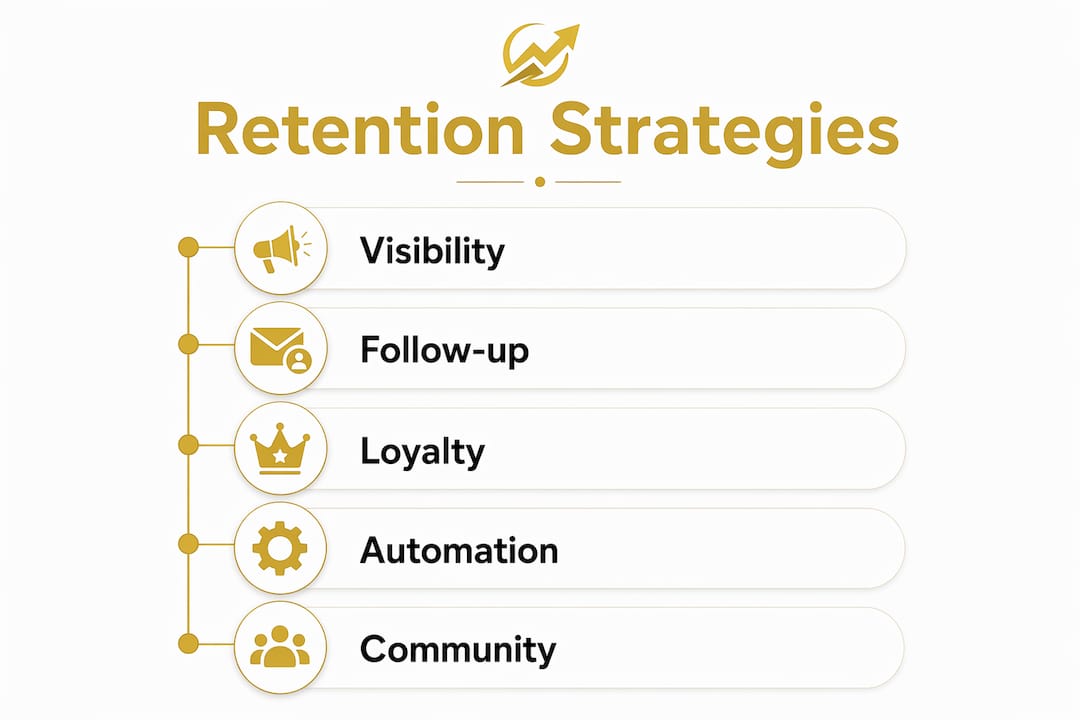
Retention via local search requires three parallel tracks: visibility, follow-up, and loyalty. Each track reinforces the others.
Optimize your Google Business Profile and local citations
An optimized Google Business Profile is the foundation of local search marketing. Post updates weekly, respond to every review, and keep your hours accurate. Spinlisting reports that well-maintained listings deliver 5x greater value than unclaimed ones, and clients see up to 83% increases in first-place rankings after consistent optimization. Accurate local business listings across directories like Yelp, Apple Maps, and Bing Places reinforce your NAP consistency for both Google and AI search tools.
Use automation to trigger personalized follow-ups
Retention automation does not require enterprise software. Entry-level tools can connect to your POS system and send personalized messages based on purchase history. The key is behavior-triggered timing, not batch-and-blast email campaigns. Increase repeat business locally by building sequences that respond to what a customer actually did, not just when they last visited.
Build loyalty programs around community values
Value signals like local community donations in loyalty programs create stronger, more durable retention than simple discounts. A coffee shop that donates a meal to a local food bank for every tenth purchase builds an emotional connection that a 10% discount cannot replicate. Programs that reflect local identity consistently outperform financial incentives in long-term loyalty.
| Retention tactic | Best for | Key metric to track |
|---|---|---|
| Automated SMS follow-up | All local businesses | Second-visit rate within 30 days |
| Google Business Profile updates | Discovery and repeat search | Profile views and direction requests |
| Community-tied loyalty program | Neighborhood businesses | 90-day retention rate |
| Local citation building | AI and map visibility | Citation consistency score |
| Cohort retention tracking | Identifying churn points | Monthly retention by signup cohort |
Retention requires a shift from transactional to relational marketing. The businesses that grow their local customer base year over year are not running more promotions. They are building systems that make customers feel recognized and valued every time they interact.
Key Takeaways
Local search retention works because it captures high-intent buyers and then uses automation, consistent visibility, and community-focused loyalty to convert one-time visits into long-term relationships.
| Point | Details |
|---|---|
| Local intent converts higher | Local-intent traffic converts at 2–5 times the rate of non-local traffic, giving retention efforts a stronger starting point. |
| 48-hour follow-up is critical | Triggered SMS or email within 48 hours of a first purchase dramatically increases second-visit likelihood. |
| 90-day benchmark matters | Customers who stay engaged through 90 days are 3–5 times more likely to become loyal regulars. |
| AI visibility requires diverse citations | Google Maps rankings alone do not guarantee AI search visibility; consistent NAP data and community mentions are required. |
| Community loyalty outperforms discounts | Loyalty programs tied to local values build more durable retention than financial incentives alone. |
What I’ve learned about local retention that most guides skip
Most articles on local customer loyalty strategies treat retention as a marketing problem. It is actually a timing and systems problem. The businesses I have seen fail at retention are not failing because they lack a loyalty program. They are failing because they have no system that fires within 48 hours of a first visit. By the time they send a follow-up, the customer has already gone back to whoever was most convenient.
The AI shift in local search is the part that concerns me most right now. Business owners who built their entire presence around a single Google Business Profile are exposed. If an AI assistant does not surface your name when someone asks for a recommendation in your neighborhood, you are invisible to a growing segment of repeat buyers. Diversifying your citations, earning mentions in local content, and tracking your AI visibility are not optional extras in 2026. They are table stakes.
The other thing I would push back on is the obsession with discounts. Tracking retention cohorts consistently shows that customers who joined because of a deal churn faster than customers who joined because of a genuine experience. Build your loyalty program around what your community cares about, not what is cheapest to offer. That is the difference between a customer who returns once for the reward and one who returns because your business feels like part of their neighborhood.
— Against
How Spinlisting helps local businesses retain more customers
Local businesses that want consistent repeat business need two things working together: a visible, optimized local presence and a follow-up system that engages customers at the right moment.

Spinlisting builds and maintains Google Business Profiles that rank, with proven results including 83% increases in first-place rankings and measurable lifts in organic traffic. Beyond visibility, Spinlisting’s approach covers local SEO strategy and the citation consistency that AI-powered search now requires. If your business is ready to turn local search traffic into loyal repeat customers, Spinlisting provides the profile optimization and local SEO foundation that makes retention systems actually work.
FAQ
What is customer retention in local search?
Customer retention in local search is the practice of using local SEO, Google Business Profile optimization, and digital follow-up systems to keep existing customers returning after their first visit.
How does local search improve repeat business?
Local search captures buyers with high purchase intent, and an optimized profile with reviews and accurate information reduces friction for repeat visits. Local-intent traffic converts at 2–5 times the rate of non-local traffic.
Why do the first 48 hours matter for retention?
Triggered messages sent within 48 hours of a first purchase outperform all later generic marketing for driving a second visit. That window is when the customer’s experience is freshest and a follow-up feels personal rather than promotional.
Does AI search affect local customer retention?
Yes. AI tools like ChatGPT surface local recommendations based on citations across blogs, forums, and directories, not just Google Maps rankings. Businesses absent from those sources lose repeat discovery to competitors with broader digital footprints.
What is the 90-day retention benchmark for local businesses?
The 90-day benchmark targets a 40–50% second-visit conversion rate and a 30–40% overall retention rate. Customers who reach 90 days with consistent engagement are 3–5 times more likely to become long-term regulars.
Recommended
- Local Search Market Share: What Businesses Must Know | Google my Business for SEO / ranking services SEO
- Local SEO vs Paid Ads Explained for Business Owners | Google my Business for SEO / ranking services SEO
- Local Business Listing Essentials: Your 2026 Guide | Google my Business for SEO / ranking services SEO
- Local Online Marketing Budget Tips for Small Businesses | Google my Business for SEO / ranking services SEO