
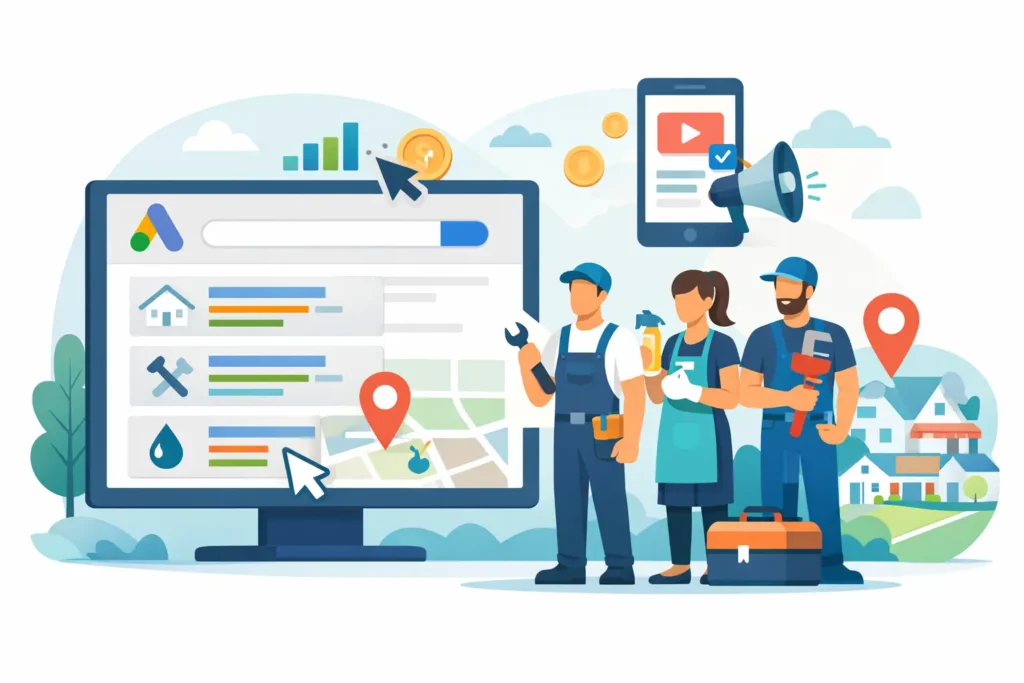
Most local service companies do not have a lead problem. They have a visibility problem. When homeowners need a roofer, cleaner, electrician, mover, or HVAC company, they usually go to Google with high intent and make a decision fast. That is exactly why google ads for local service businesses can work so well – but only when the campaign is built for calls, booked jobs, and service-area targeting instead of vanity clicks.
A lot of agencies and freelancers make Google Ads look simple. Pick a few keywords, set a budget, and wait for leads. That is how local businesses burn money. Paid search for service companies is not about traffic volume. It is about showing up in the right zip codes, matching the right search intent, filtering out junk leads, and turning ad spend into profitable jobs.
Why google ads for local service businesses works
Local service searches are usually urgent, specific, and close to a buying decision. Someone searching “emergency plumber near me” or “roof repair company” is not browsing for entertainment. They need help. That makes Google Ads one of the fastest ways to get in front of buyers who are already looking.
The advantage is speed. SEO and Google Business Profile optimization are critical for long-term visibility, but they take time. Google Ads can put a business at the top of search results much faster. For a company entering a new market, trying to fill schedule gaps, or competing in a crowded metro area, that speed matters.
The trade-off is just as important. Google Ads is not forgiving. If your campaign structure is weak, your targeting is broad, or your landing page is generic, you can spend a lot without seeing much return. Local service businesses need campaigns built around real buying behavior, not generic best practices copied from ecommerce accounts.
What separates profitable campaigns from wasted spend
The first difference is keyword intent. A profitable local campaign focuses on terms that suggest someone wants to hire now or soon. “Water heater repair,” “same day junk removal,” and “landscaping company near me” are all stronger than broad informational searches. If the account targets too many research-based keywords, lead quality drops fast.
The second difference is geography. Service businesses do not need clicks from everywhere. They need the right neighborhoods, cities, counties, or radius targets based on where they actually operate and where the economics make sense. If a cleaning company gets leads 45 minutes outside its profitable service range, those clicks are not helping. Tight location control protects budget.
The third difference is conversion tracking. A lot of business owners think their ads are working because the phone rings. That is not enough. You need to know which campaigns, ad groups, keywords, and locations produced calls, form fills, and actual booked work. Without tracking, optimization turns into guessing.
Then there is the landing page. Sending paid traffic to a weak homepage is one of the most common mistakes in local advertising. A strong landing page should match the ad, reinforce trust, show the service area, and make it easy to call or request a quote. People clicking a paid ad are not looking for a scavenger hunt.
The best campaign types for local service businesses
For most service companies, search campaigns are the core play. They capture active demand from people searching for exactly what you do. If you are an HVAC company, lawyer, pest control provider, or mover, search is often where the highest-intent traffic lives.
Local Services Ads may also belong in the mix for eligible categories, but they are not a replacement for Google Ads. They can generate leads, but they do not give the same level of control over messaging, keyword strategy, and landing page experience. In some markets they perform well. In others, lead quality is mixed. It depends on category, competition, and how well the account is managed.
Performance Max can sometimes support local campaigns, especially when paired with strong first-party data and clean conversion tracking. But for many local service businesses, it can become too opaque too quickly. If you cannot see where spend is going or what search intent is driving results, it becomes harder to control quality. For that reason, many local accounts still perform best when search stays at the center.
How to build google ads for local service businesses the right way
Start with services, not with one giant campaign. If a company offers roof repair, roof replacement, gutters, and siding, those should usually be separated based on demand, value, and messaging. Different services carry different margins and different urgency levels. If they are all bundled together, budget allocation gets messy.
Next, organize by service area logic. A business serving three cities should not always advertise the same way in each one. One city may be highly competitive, one may convert better, and one may only be worth targeting for higher-ticket jobs. Smart segmentation gives you control over bids, budgets, and ad copy.
Ad copy should be specific and local. Generic ads get ignored. If you serve Phoenix, say Phoenix. If you offer same-day service, licensed technicians, free estimates, financing, or 24/7 response, put that in the ad. Local buyers respond to clear proof points, not vague claims.
Negative keywords matter more than most owners realize. They stop your ads from showing for searches that waste money. A commercial electrician may want to block residential terms. A premium landscaping company may want to exclude job seekers, DIY searches, and low-intent education queries. Cleaning up search traffic is one of the fastest ways to improve lead quality.
Scheduling also matters. Some businesses should run ads all day. Others should focus spend during the hours when office staff can answer calls and convert leads. If missed calls are common after hours, a 24-hour campaign can create more waste than opportunity. The right setup depends on staffing, response time, and how urgent the service is.
Budget, bidding, and lead quality
A small budget does not automatically mean a bad campaign, but it does require discipline. If the market is competitive, spreading a limited budget across too many services and locations usually underperforms. It is often better to dominate a few profitable service lines in the best areas than to appear weakly everywhere.
Bidding strategy should match account maturity. New accounts often need cleaner data before automated bidding can really work. If tracking is broken or conversion volume is low, automation can optimize toward the wrong outcome. Once the account has reliable signals, smart bidding can become more useful.
Lead quality is where many campaigns break down. Cheap leads are not the goal. Qualified leads are. A junk removal company may get a flood of low-value calls from broad targeting, while a tighter campaign brings fewer but better jobs. Cost per lead only tells part of the story. Cost per booked job and return on ad spend matter more.
Where Google Ads fits with local SEO and Google Business Profile
Paid ads should not operate in isolation. The strongest local acquisition systems combine Google Ads with Google Business Profile optimization, map pack visibility, review management, and service-page SEO. When a prospect sees your ad, then sees a strong business profile with solid reviews, trust goes up. That helps conversion.
This is where many local businesses miss the bigger picture. They treat paid search and local SEO like separate channels with separate goals. In reality, they support each other. Ads create immediate demand capture. Organic rankings and Maps visibility build long-term market presence. Together, they make it harder for competitors to take the click and the call.
For service businesses in crowded local markets, that full-funnel approach is usually the smarter move. A paid click might generate the first touch, but your reviews, business profile, and local landing pages often help close the lead.
Common mistakes that kill performance
The biggest mistake is weak account structure. If every service, city, and audience is thrown into one campaign, optimization gets sloppy fast. Another major issue is sending traffic to pages that do not match the search. When someone clicks an ad for drain cleaning and lands on a generic plumbing page, conversion rates usually suffer.
Poor follow-up is another hidden problem. You can have a well-built campaign and still lose money if calls go unanswered, forms sit untouched, or estimates take too long. Google Ads can generate demand, but your team still has to close it.
Many businesses also ignore search term reviews. That is where wasted spend often hides. If you are not regularly checking what people actually typed before clicking, you are probably funding irrelevant traffic.
What local business owners should expect
A good campaign should produce more than impressions and click reports. It should create measurable lead flow, show which services and locations are performing, and get sharper over time as data comes in. That means ongoing management, not a set-it-and-forget-it setup.
Some industries convert fast. Others need more testing, stronger landing pages, or tighter qualification filters. Legal, home services, and high-ticket trades can all perform well, but the cost per click and competition level vary by market. There is no honest one-size-fits-all benchmark.
What does stay consistent is the principle: local paid search works best when it is built around service intent, geography, conversion tracking, and operational follow-through. That is the difference between buying clicks and buying growth.
If your ads are already running but the lead quality is weak, or if you have been relying only on organic visibility, now is a good time to tighten the system. Google rewards relevance, speed, and trust – and local service businesses that build around those three factors usually win more calls than the ones just increasing budget.