
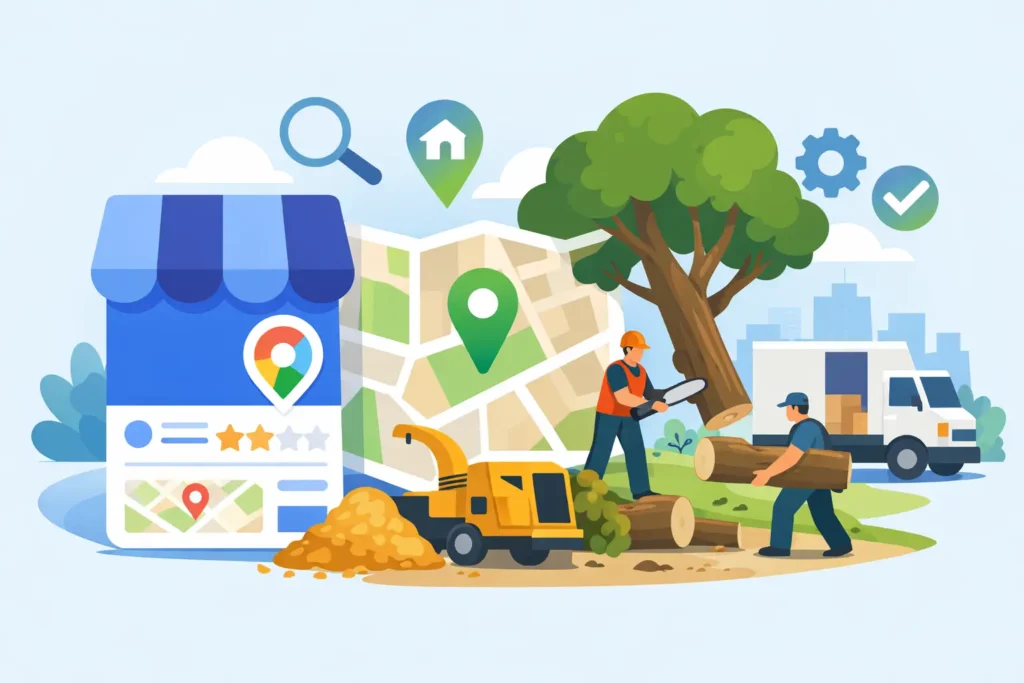
When a customer needs a mover after a lease falls apart or a tree removed before it crashes into the roof, they do not browse for an hour. They search, scan the map, compare reviews, and call one of the top few businesses they trust. That is exactly why google my business for movers tree removal matters. If your company is not visible in Google Maps when urgency is high, a competitor gets the call.
For movers and tree service companies, Google Business Profile is not just a directory listing. It is a lead generation asset. It influences whether you show up in the local pack, whether prospects trust you fast, and whether Google understands what you do and where you do it. A weak profile leaves money on the table. A properly managed one can drive calls every week without relying only on paid ads.
Why google my business for movers tree removal is different
These two industries share something most service businesses understand well – local intent is strong, but customer behavior is different from category to category. Movers often compete on timing, service area, and reputation. Tree removal companies compete on urgency, safety, equipment, and trust. In both cases, your profile has to send the right signals quickly.
That means a generic setup is not enough. If you are a mover, your listing should reinforce residential moves, commercial moves, long-distance moves if relevant, packing help, and local service coverage. If you run a tree removal company, your profile should reflect tree removal, emergency storm cleanup, stump grinding, trimming, and debris hauling where applicable. Google looks at relevance, distance, and prominence. Customers look at proof. Your profile has to satisfy both.
A lot of owners make the same mistake. They verify the listing, add a phone number, upload a logo, and assume the job is done. It is not. Google Business Profile performance usually comes from ongoing optimization – category selection, service alignment, review management, fresh photos, posts, Q&A monitoring, and consistency with your website and citations.
What actually moves rankings and calls
The profile fields matter, but not all of them matter equally. Your primary category is one of the strongest signals. A moving company should not dilute the listing with unrelated categories just because they sound close. A tree company should not choose a broad label when a tighter, more relevant category exists. The wrong category can weaken relevance and hurt visibility for your best searches.
Your business description also matters, but this is where many companies waste space. Do not write a vague paragraph about customer service and professionalism alone. Those are baseline expectations. Use the description to reinforce services, local coverage, and what makes the operation credible. If you have cranes, bucket trucks, same-day availability, piano moving experience, or insured crews, say it clearly.
Reviews often make the biggest practical difference because they impact both ranking strength and conversion rate. A company with 12 reviews and a decent profile can lose to a competitor with 140 reviews and stronger recency. But volume alone is not the whole story. Review content matters. If customers mention moving help, careful packing, emergency tree removal, storm cleanup, or stump grinding, that helps Google connect your listing to those services. It also helps prospects trust that you actually do the work well.
Photos are another underused ranking and conversion lever. Movers should show trucks, crews, packing materials, loading jobs, commercial moves, and branded equipment. Tree service companies should show before-and-after jobs, crew safety gear, machinery, stump work, and cleanup results. These are not vanity uploads. They help customers validate legitimacy in seconds.
Google Business Profile setup for movers and tree services
If you want better results from Google My Business for movers tree removal, start with the foundation. The business name, address, phone number, website, hours, service areas, and core categories need to be accurate and consistent. If you are a service-area business, setup has to reflect how you actually operate. Trying to game location signals with fake offices usually creates more problems than gains.
Services should be built out with intent in mind. A mover should not stop at “moving company.” Add the actual services people search for, as long as you truly offer them. The same goes for tree companies. Tree trimming, emergency removal, lot clearing, and stump removal can all support relevance if they match real-world operations.
The appointment or estimate path matters too. If a customer lands on your profile and cannot quickly figure out how to contact you, request a quote, or confirm operating hours, your visibility is less valuable. Profiles need clean conversion paths. Calls, direction requests, messaging where appropriate, and website visits should all feel frictionless.
Common mistakes that keep service businesses buried
One of the biggest issues is category confusion. Movers sometimes load a profile with hauling, storage, junk removal, and labor categories even when moving is the main service. Tree companies do something similar by mixing landscaping terms too aggressively. Some overlap is fine if the services are real, but overloading categories can muddy the profile.
Another issue is review neglect. Owners either never ask, ask inconsistently, or ask without guiding customers on what to mention. You cannot script reviews, but you can request them at the right moment and encourage honest detail about the service performed. That creates stronger trust signals and more useful keyword context over time.
Then there is content decay. A profile that has not had new photos, updates, or customer interaction in months often looks stale. That does not automatically kill rankings, but it weakens engagement and sends the wrong message. Customers notice inactive profiles. So does Google.
Website misalignment is another hidden problem. If your profile says tree removal, stump grinding, and emergency cleanup, but your website barely mentions those services or locations, your local signals are weaker than they should be. The profile and website should reinforce each other. Local SEO works better when those assets are coordinated, not managed in silos.
How movers and tree removal companies should use posts and updates
Most business owners either ignore GBP posts or treat them like social content. That is the wrong approach. Posts should support visibility and conversion. For movers, that can mean highlighting local moves, packing services, office relocation work, seasonal demand, or service area expansions. For tree companies, good posts often feature storm response, dangerous limb removal, recent cleanup projects, or reminders before peak weather seasons.
These updates do not need to be flashy. They need to be relevant, current, and aligned with real services. The goal is to keep the profile active and useful. Freshness helps with trust, and in some cases it supports better engagement signals.
Q&A is also worth managing. If customers repeatedly ask whether you handle same-day moves, apartment stairs, insurance claims, crane work, or emergency jobs, those answers belong on the profile. Done right, this reduces friction before the call and helps pre-qualify leads.
When optimization becomes management, not setup
This is where many businesses stall. Initial setup is easy. Ongoing execution is what creates separation in competitive markets. If you are serious about ranking in Google Maps, profile management has to be recurring. Reviews need to be requested and answered. Photos need to be added. Services need to stay accurate. Competitor movement needs to be monitored. Spam listings need to be watched. Performance trends need to be checked.
That is why hands-on local SEO usually outperforms one-time profile cleanup. In dense metro markets, especially for movers and tree removal, competitors are not standing still. They are collecting reviews, updating profiles, improving websites, and investing in local visibility. If you are passive, rankings slip.
A tactical agency that understands service-area business ranking mechanics can speed this up, especially when profile work is paired with local landing pages, technical SEO, and ad support. That matters if you want more than vanity visibility. It matters if the goal is booked jobs. Spinlisting focuses on that execution layer because local rankings do not improve from theory. They improve from repeated, category-specific work.
What good performance looks like
A strong profile does not just rank for your business name. It shows up for service searches in the areas you actually want. It generates calls from high-intent prospects. It earns reviews regularly. It displays real job photos. It reflects the service mix accurately. And it supports your broader local SEO efforts instead of operating as a disconnected listing.
For movers, that often means more map visibility for city-level and near-me searches, stronger trust for quote requests, and better conversion from mobile users. For tree removal companies, it usually means more emergency job calls, more high-value estimates, and better positioning against larger local competitors.
If your listing is incomplete, outdated, or barely managed, the fix is not complicated – but it does require consistency. Google My Business for movers tree removal works when the profile is treated like a live sales asset, not a set-it-and-forget-it page. The companies that win in local search are usually the ones that keep showing Google and customers the same thing: we do the work, we do it locally, and we can prove it.