
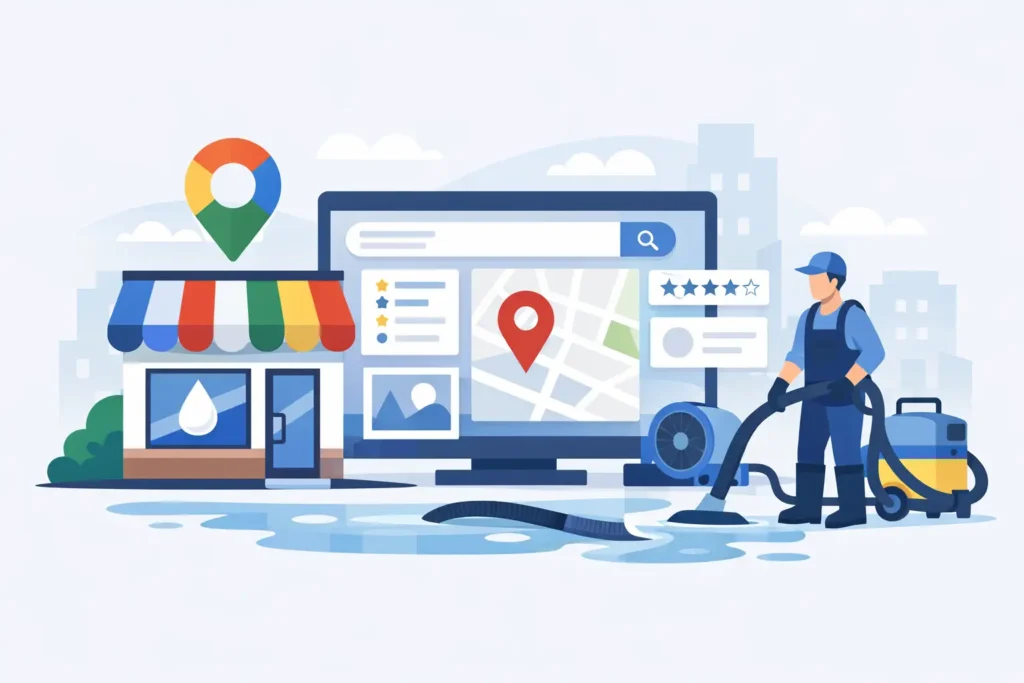
A burst pipe at 2:00 a.m. does not create a shopper. It creates a panic search, a tap on the map pack, and a phone call to the company that looks closest, fastest, and most credible. That is why Google My Business for water removal is not a side task for restoration companies. It is one of the main drivers of emergency lead flow.
If your business handles water extraction, flood cleanup, dry-out services, or restoration work, your Google Business Profile often decides whether you get the call or your competitor does. In this category, visibility matters, but trust signals matter just as much. People are inviting you into a stressful situation, often while standing in inches of water. They are not reading ten pages of marketing copy. They are looking for proof that you are real, nearby, responsive, and qualified to solve the problem now.
Why Google My Business for water removal matters more than most niches
Water damage is a high-intent local search. The person searching usually needs help immediately, and Google knows that. That is why the local map pack dominates results for terms like water removal, flood cleanup, and emergency water extraction. If your profile is weak, incomplete, or inactive, you are giving away the easiest calls in your market.
This niche also has a trust barrier that many service businesses do not face at the same level. Homeowners and property managers want speed, but they also want confidence that the crew arriving knows how to assess damage, prevent mold, document the issue, and handle insurance-related communication if needed. A solid profile helps bridge that gap fast.
There is also a category problem. Many restoration companies try to rank broadly for every service, from fire damage to mold remediation to sewage cleanup. That can work, but only if your profile clearly supports water removal as a core service. If it does not, Google may not connect your listing strongly enough to the searches that actually convert.
What a strong water removal profile needs
A high-performing Google Business Profile starts with the basics, but basics alone will not move a competitive market. Your business name, primary category, service areas, phone number, hours, website, and business description all need to be accurate and aligned. Any mismatch creates friction for both Google and the customer.
For water removal companies, category selection matters more than owners think. Your primary category should reflect your main revenue driver, and your secondary categories should support related restoration services without muddying the profile. If your category stack is too broad or poorly chosen, your relevance for water damage searches can weaken.
Your services section should not be left thin. Add water removal, emergency water extraction, flood damage cleanup, structural drying, basement water removal, and related jobs that reflect how customers actually search. This gives Google more context and helps reinforce topical relevance.
Photos matter too, but not random office shots. Google wants evidence that your business is active and real. Customers want evidence that your team can handle the work. Before-and-after project photos, drying equipment in use, moisture checks, extraction jobs, and on-site crew photos all support credibility. The more localized and service-specific those images are, the better.
Reviews are not optional in water removal
In emergency services, reviews do two jobs at once. They improve conversion rate and they support ranking strength. A profile with recent, detailed reviews usually outperforms a stale listing, especially when those reviews mention water damage, flooding, fast response time, professionalism, and cleanup quality.
The details inside the review matter. A five-star review that says great company is better than nothing, but it is not doing much heavy lifting. A five-star review that says the team arrived within an hour after a pipe burst, removed standing water, set up drying equipment, and helped document the loss tells Google and future customers exactly what you do.
Replying to reviews matters as well. It shows activity, reinforces service terms naturally, and gives potential customers another layer of confidence. Keep replies professional and specific. You are not writing for vanity. You are building trust at the point of search.
Google posts, photos, and activity signals
Most water removal companies claim their profile and stop there. That is where momentum dies. Google favors active profiles, and customers notice them too. If your last update was eight months ago, your listing looks neglected.
Weekly posts can help reinforce service focus, highlight recent jobs, and keep the profile fresh. A short post about emergency water extraction after storm damage or a recent commercial dry-out project can support visibility while also showing operational activity. The same goes for regularly uploaded photos tied to real jobs.
This is where consistent execution beats one-time setup. A profile that gets ongoing posts, new images, review responses, and service updates sends stronger quality signals than a profile built once and ignored. For water removal, where urgency and trust are everything, that consistency can turn into more calls.
How to improve Google My Business for water removal rankings
Ranking better in Google Maps is not one move. It is a stack of signals working together. Relevance, distance, and prominence are still the core factors, but prominence is where most companies can actually make gains.
Start with your profile itself. Make sure every section is complete, your categories are right, and your services are filled out with real search intent in mind. Then look at your website. Your Google Business Profile does not operate in a vacuum. If your site has weak service pages, thin location content, poor technical SEO, or no clear water damage focus, your listing has less support behind it.
Local landing pages can help if they are built correctly. If you serve multiple cities, do not just clone pages and swap city names. Create useful, location-specific pages that speak to response area, service type, and the concerns of customers in that market. Google is better at spotting lazy local SEO than many business owners realize.
Citations still matter, but accuracy matters more than volume. Your business information should be consistent across major directories and industry listings. If your name, address, or phone number is inconsistent, that can dilute local trust signals.
Backlinks also play a role, especially for competitive metro areas. A water removal company with strong local relevance, active reviews, optimized profile content, and a site that actually earns authority has a much better shot at map pack visibility.
Common mistakes water damage companies make
The biggest mistake is treating the profile like a digital business card instead of a lead generation asset. That mindset leaves money on the table.
Another common issue is using the wrong primary category because it sounds broader or more impressive. Broad is not always better. If the profile does not clearly match water removal intent, rankings can slip for the exact searches you want.
Some companies also overload the business description with sales language and miss the point. Your description should be clear, service-focused, and helpful. It is not a place to stuff every keyword variation you can think of.
Then there is photo quality. Uploading logos, stock images, or generic trucks does not do much. Real job photos outperform generic visuals because they prove capability. The same principle applies to reviews. A profile with dozens of vague reviews can still lose to a competitor with fewer but more specific and recent reviews.
Finally, many owners expect fast ranking jumps from setup alone. Sometimes that happens in weak markets. In competitive areas, it usually takes ongoing profile work, site support, review growth, and local SEO alignment to move the needle.
Why ongoing optimization beats one-time setup
Water removal is not a static market. Storms hit. Competitors improve. Search behavior changes by season and by event. If your profile is not being managed, it will eventually lose ground.
Ongoing optimization means tracking calls, refining categories and services, publishing updates, adding new jobsite photos, generating reviews, and supporting the profile with local SEO on the website. It also means paying attention to what is actually converting, not just what looks good on the surface.
That is where execution separates serious operators from everyone else. A cleaned-up listing is useful. A managed listing tied to local SEO, review strategy, photo uploads, and map pack growth is what drives sustained lead flow. For restoration companies that depend on inbound calls, that difference is not minor. It is measurable.
If your water removal company is getting buried in the map pack, the fix is rarely one trick. It is a better profile, better signals, and better follow-through. When the next emergency search happens in your service area, your listing should look like the obvious call to make.