

Adding local SEO keywords to your Google Business Profile listing is the single most direct way to appear in front of nearby customers who are ready to buy. Local SEO keywords are search terms that combine a service or product with a geographic signal, such as “plumber Boston” or “coffee shop near me.” Google uses these signals to decide which businesses appear in the local 3-pack and Google Maps results. Businesses that treat their Google Business Profile as a living, keyword-rich document consistently outrank those that set it up once and forget it. This guide gives you a complete local SEO keyword strategy, from research through execution, built specifically for local business owners.
What are the four local SEO keyword patterns?
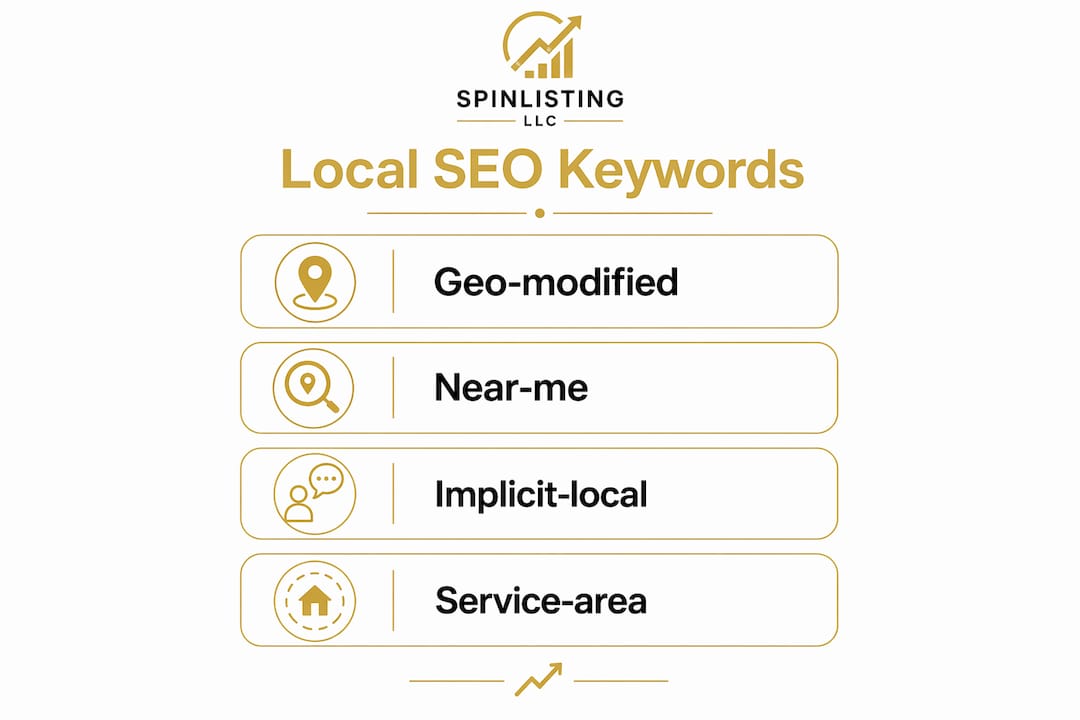
Local SEO keyword strategy requires managing four distinct query patterns, each of which maps to a different search result layout and a different type of customer intent. Treating all local keywords the same is the most common mistake local business owners make. Each pattern needs its own approach.
- Geo-modified queries include the city or region directly: “plumber Boston,” “dentist Austin TX.” These are high-intent searches from people who know where they want service.
- Near-me queries use proximity signals: “plumber near me,” “pizza delivery near me.” Google resolves these using the searcher’s device location, so your Google Business Profile address accuracy is critical.
- Implicit-local queries have no location word but Google treats them as local: “emergency plumber,” “urgent care.” Google infers local intent from the search context and shows map results automatically.
- Service-area queries combine a service with a specific neighborhood or ZIP code: “plumber Cambridge MA 02139.” These are lower-volume but extremely high-conversion because the searcher is very specific.
Each local keyword pattern matches a different SERP layout and a different competitor set. A page that ranks for “plumber Boston” will not automatically rank for “plumber near me.” Each pattern needs its own dedicated landing page or content section to avoid cannibalizing your own rankings.
Pro Tip: Map each of your core services to all four query patterns before you write a single word of listing content. A plumber in Boston should have content targeting “plumber Boston,” “plumber near me,” “emergency plumber,” and “plumber Cambridge MA” as separate, distinct keyword targets.
How do you research local SEO keywords for your business?
Effective local keyword research starts with your Google Business Profile categories. Your primary category is your seed keyword. A business listed as “Italian Restaurant” starts with “Italian restaurant” and builds from there.
Follow these steps to build a complete local keyword list:
- Pull seed keywords from your GBP categories. Your primary and secondary Google Business Profile categories tell you exactly how Google classifies your business. Use those category names as your starting seed terms.
- Geo-modify every seed keyword. Add your city, neighborhood, and ZIP code to each seed term. “Italian restaurant” becomes “Italian restaurant downtown Chicago,” “Italian restaurant River North,” and “Italian restaurant 60654.”
- Find near-me and implicit-local variants. Type your seed keyword into Google and check the “People Also Ask” box. Seed keywords expand through geo-modification and Google’s People Also Ask box, which surfaces the exact phrasing real customers use.
- Check search volume with location filters. Use Google Keyword Planner with your city set as the target location. Local SEO tools show national search volumes, but local volumes vary significantly by geography, so always filter by your specific market.
- Prioritize by intent, not just volume. A keyword with 50 monthly local searches and clear buying intent beats a 5,000-volume keyword where the searcher is just browsing.
| Keyword type | Example | Best placement |
|---|---|---|
| Geo-modified | “plumber Boston” | Business description, website title tag |
| Near-me | “plumber near me” | GBP posts, FAQ section |
| Implicit-local | “emergency plumber” | Services field, website headers |
| Service-area | “plumber Cambridge MA” | Dedicated location page, GBP description |
For AI-driven keyword discovery that goes beyond standard tools, AI-powered local SEO approaches can surface query patterns that traditional keyword planners miss, particularly for implicit-local and near-me variants.
How do you add local keywords to your Google Business Profile?
Knowing which keywords to target is half the work. Placing them correctly inside your listing and website is what actually moves your ranking. Here is where each keyword type belongs.
Business description. Write 750 characters that describe your services and location naturally. Place your top geo-modified keyword in the first sentence. “Boston’s trusted family plumber serving Back Bay, South End, and Cambridge since 2008” does more work than a generic description with no location signals.
Services and products fields. Google reads the text in your services section as keyword content. Name each service specifically: “Emergency Pipe Repair Boston” rather than just “Pipe Repair.” Add a short description to each service entry and include a neighborhood or city name where it reads naturally.

GBP posts and updates. Post at least once per week. Each post is an indexed piece of content. Use near-me and implicit-local keywords in post text because Google associates that language with your profile over time.
Reviews and their language. Consistent review volume significantly affects how search engines associate a business with local search terms. When customers mention your service and city in a review, “best plumber in Boston, fixed our burst pipe fast,” Google reads that as a keyword signal. Encourage specific language by asking customers to mention the service they received and where they are located.
Pro Tip: Place a QR code at your checkout counter or service vehicle that links directly to your Google review page. Industry experts recommend physical review prompts to reduce friction and increase review volume, which directly strengthens your keyword associations.
Website elements tied to your GBP. Your Google Business Profile links to your website, and Google reads both together. Apply these placements on your site:
- Title tags: “Emergency Plumber Boston | [Your Business Name]”
- H1 headers: match the page’s primary local keyword
- URL slugs: /plumber-boston or /emergency-plumber-cambridge-ma
- Image alt text: “licensed plumber fixing pipe in Boston kitchen”
- NAP consistency: your Name, Address, and Phone number must appear identically on your website, GBP, and every directory listing
Ranking in the local 3-pack requires a fully optimized Google Business Profile, steady recent reviews using local language, consistent NAP citations, and local backlinks. All four elements work together. Fixing only one rarely moves the needle.
For a deeper look at how listing completeness affects your ranking position, the local business listing essentials guide covers every field in your Google Business Profile and what to put in each one.
What mistakes hurt your local SEO keyword efforts?
Most local SEO keyword problems fall into a small number of repeatable errors. Knowing them in advance saves months of wasted effort.
- Keyword stuffing. Overusing keywords or stuffing them harms SEO and appears spammy to customers. A business description that reads “Boston plumber, best plumber Boston, plumber Boston MA, emergency plumber Boston” will trigger Google’s spam filters and drive customers away. Write for people first.
- Ignoring keyword segmentation. Targeting only geo-modified keywords and skipping near-me and implicit-local variants leaves a large portion of local search traffic uncaptured. Each pattern needs its own content.
- Setting and forgetting. Search behavior changes. New neighborhoods grow, new services become popular, and competitor listings evolve. Review your keyword targets every quarter and update your GBP content accordingly.
- Mismatched categories and keywords. If your GBP primary category is “General Contractor” but your keywords target “kitchen remodeling Boston,” Google sees a mismatch. Align your categories with your highest-priority keyword targets.
- Skipping local backlinks. GBP completeness, review volume, and local backlinks are key local SEO ranking factors. A link from a local chamber of commerce, neighborhood blog, or city news site carries far more local ranking weight than a generic directory link.
“The businesses that win local search are not the ones with the most keywords. They are the ones with the most consistent signals: accurate listings, steady reviews, and content that matches exactly what their neighborhood is searching for.”
Monitor your keyword performance monthly using Google Business Profile Insights. Track which search queries drive profile views and calls, then double down on the terms already bringing traffic. The 2026 local search ranking strategy covers how to read these signals and act on them systematically.
Key Takeaways
Integrating local SEO keywords into your Google Business Profile requires segmenting by query type, placing keywords in every available profile field, and reinforcing them with consistent reviews and local backlinks.
| Point | Details |
|---|---|
| Segment by query pattern | Target geo-modified, near-me, implicit-local, and service-area keywords separately for maximum coverage. |
| Start with GBP categories | Use your primary and secondary Google Business Profile categories as seed keywords before expanding. |
| Place keywords in every field | Business description, services, posts, and reviews all carry keyword weight with Google. |
| Reviews reinforce keywords | Customers who mention your service and city in reviews strengthen your local keyword associations. |
| Avoid keyword stuffing | Natural integration outperforms forced repetition and protects your listing from spam filters. |
Why keyword segmentation is the edge most local businesses miss
I have reviewed hundreds of Google Business Profiles for local businesses, and the pattern is almost always the same. Owners write one solid business description, add a handful of services, and call it done. They target “plumber Boston” and wonder why they are invisible for “emergency plumber” searches at 11 PM on a Sunday.
The real competitive edge in local SEO is not finding a secret keyword. It is doing the unglamorous work of segmenting your keyword targets by query type and then placing them consistently across every available surface: your GBP description, your services, your posts, your website headers, and your review responses. Most businesses skip two or three of those surfaces entirely.
AI is changing local search faster than most business owners realize. Google’s AI Overviews and tools like ChatGPT are increasingly pulling local business information from well-structured, keyword-rich profiles. Businesses that treat their GBP as a content asset, not just a contact card, will be the ones that appear in AI-generated local recommendations. That shift is already happening, and the businesses building keyword depth now will have a significant head start.
The other thing I have seen consistently: review language matters more than most people expect. When ten customers mention “emergency plumber Cambridge” in their reviews, Google starts associating your profile with that exact phrase. Asking for reviews is not just about social proof. It is a keyword strategy.
— Against
Spinlisting’s approach to local keyword optimization
Getting your Google Business Profile to rank in the local 3-pack takes more than filling in a few fields. Spinlisting builds tailored local SEO keyword strategies for each client’s specific location, services, and competitive market.
Spinlisting’s GMB optimization service covers every ranking factor: keyword-rich profile content, category alignment, post scheduling, and review strategy. Clients have seen first-place ranking increases of 83% after a full profile optimization. If you want a profile that works as hard as you do, Spinlisting’s Google Business Profile optimization service gives you a clear path from invisible to top of the local map pack.
FAQ
What does “add local SEO keywords to a listing” mean?
Adding local SEO keywords to a listing means placing location-specific search terms in your Google Business Profile fields, including your description, services, and posts, so Google connects your business to nearby searches.
How many local keywords should I target in my GBP?
Focus on 5–10 core keyword targets across all four query patterns: geo-modified, near-me, implicit-local, and service-area. Quality and placement matter more than volume.
Do reviews help with local keyword rankings?
Yes. Review volume and the language customers use in reviews directly influence how Google associates your profile with local search terms. Encourage customers to mention the specific service and location in their review.
How often should I update my local SEO keywords?
Review your keyword targets every quarter. Search behavior shifts with seasons, local events, and changes in your service area, so your GBP content should reflect current demand.
Can I use the same keywords on my website and my GBP?
Yes, and you should. Google reads your website and your Google Business Profile together. Consistent keyword use across both reinforces your relevance for local searches and strengthens your overall local ranking signals.
Recommended
- Improve Local Search Ranking: 2026 Strategy Guide | Google my Business for SEO / ranking services SEO
- Local Business Listing Essentials: Your 2026 Guide | Google my Business for SEO / ranking services SEO
- How to Measure ROI of Your Local SEO Efforts | Google my Business for SEO / ranking services SEO
- Local SEO vs Paid Ads Explained for Business Owners | Google my Business for SEO / ranking services SEO