

Local search ranking is defined as how high your business appears in Google’s results when nearby customers search for services you offer. 84% of consumers search for local businesses online daily, and 87% check reviews before visiting. Those numbers make local visibility a direct revenue driver, not a marketing luxury. Google’s local search algorithm ranks results on three core factors: relevance, proximity, and prominence. Your Google Business Profile, local citations, and review signals are the primary levers you control. This guide shows you exactly how to improve local search ranking across every one of them.
How to improve local search ranking with your Google Business Profile
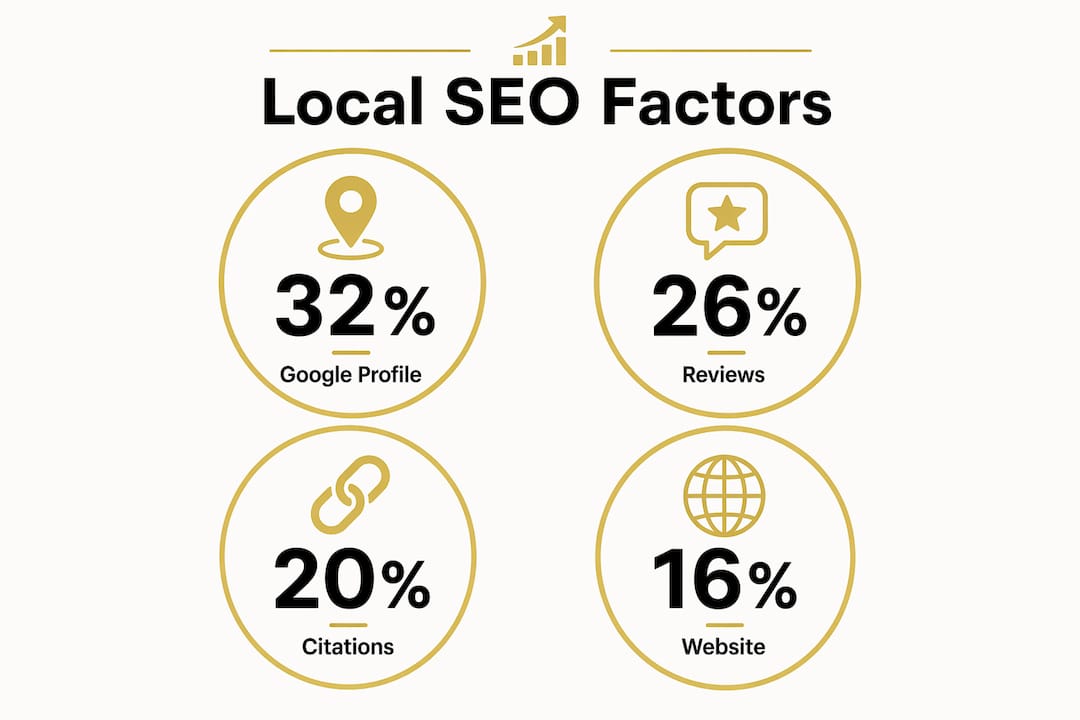
Google Business Profile signals account for 32% of total local ranking weight. No other single asset comes close. A fully optimized profile tells Google what you do, where you do it, and why customers trust you. That clarity is what the algorithm rewards.
Follow these steps to get the most from your profile:
- Claim and verify your listing. An unverified profile cannot rank competitively. Complete verification through Google’s postcard, phone, or video process before doing anything else.
- Fill in every field accurately. Your business name, address, and phone number (NAP) must match exactly what appears on your website and in every directory. Even small differences in formatting hurt your ranking.
- Choose precise categories. Your primary category carries the most weight. Pick the one that most specifically describes your core service. Add secondary categories for related offerings, but do not add categories that do not apply.
- Upload geotagged photos regularly. Photos with location data embedded signal your service area to Google. Add images of your work, your team, and your location at least twice a month.
- Post updates consistently. Google Posts keep your profile active and give you space to highlight offers, events, or seasonal services. Treat them like short social media updates tied to your business.
- Respond to every review. Replies show Google and customers that your business is engaged. A response to a negative review often matters more than the review itself.
- Keep hours and service areas current. Outdated hours cause customer frustration and signal neglect to Google. Update them for holidays and any operational changes.
Pro Tip: Use the Q&A section of your profile proactively. Add your own questions and answers covering common customer concerns. This content feeds directly into local search results and builds relevance for specific service queries.
What is local keyword research and how does it work?
Local keyword research is the process of identifying the specific phrases customers type when searching for your services in your area. It differs from general SEO keyword research because location modifiers, neighborhood names, and “near me” phrases carry most of the ranking value. A plumber in Austin does not compete for “plumbing tips.” They compete for “emergency plumber South Austin” or “water heater repair near me.”
Use this process to build your keyword list:
- List every service you offer, written the way a customer would describe it.
- List every suburb, city, and neighborhood you serve.
- Combine each service with each location to create targeted phrases.
- Type your top combinations into Google and study the Autocomplete suggestions and the “People Also Ask” box. These show you exactly what real customers are searching.
- Prioritize suburb-level keywords over broad city terms. Specific phrases have less competition and attract customers who are closer to buying.
Duplicating nearly identical location pages for different suburbs risks thin content penalties from Google. Each location page needs unique content. That means area-specific customer problems, local photos, neighborhood references, and testimonials from customers in that area.
Strong location pages also include:
- A unique headline mentioning the specific suburb or neighborhood
- A paragraph describing common local challenges your service solves
- At least one photo taken in or near that location
- A customer testimonial from someone in that area
- A clear call to action with your local phone number
Pro Tip: Search your top service plus city name in Google’s image search. The photo captions and alt text you see on ranking pages reveal the exact language local customers use. Mirror that language in your own content.
How do citations and local links build your prominence?

Google ranks local results based on relevance, distance, and prominence. Prominence is the factor most influenced by your presence across the wider web. Citations and backlinks are the two main drivers of prominence.
A citation is any online mention of your business name, address, and phone number. It does not need a link to count. Directories like Yelp, Apple Maps, Bing Places, and industry-specific platforms all send prominence signals to Google. Consistent NAP information across these directories strengthens your ranking signal. Inconsistent data does the opposite.
| Citation type | Example sources | Ranking impact |
|---|---|---|
| General directories | Yelp, Bing Places, Apple Maps | High |
| Industry directories | Houzz, Healthgrades, Avvo | Medium to high |
| Local community sites | Chamber of commerce, local news | High |
| Unstructured mentions | Blog posts, news articles | Growing |
Best practices for citation management:
- Create one internal document with your exact NAP details and use it as the single source of truth for every submission
- Audit existing citations with a manual search of your business name to find inconsistencies
- Correct outdated listings before adding new ones
- Submit to the four major data aggregators: Data Axle, Neustar Localeze, Foursquare, and Factual
Local backlinks carry more weight than generic directory links. Reach out to your local chamber of commerce, sponsor a community event, or contribute a guest article to a local news site. These links signal that your business is genuinely embedded in the community.
Pro Tip: Set a Google Alert for your business name. Every unlinked mention is a citation opportunity. Contact the site owner and ask them to add your website link. Most will do it without hesitation.
Why do online reviews directly affect local rankings?
Review quantity, rating, and frequency contribute 16% to local ranking weighting. That makes review management one of the highest-return activities in local SEO. Recency matters as much as volume. A business with 200 old reviews ranks below a competitor with 50 recent ones in many cases.
Tactics that generate reviews consistently:
- Ask at the moment of highest satisfaction, which is immediately after a job is completed or a service is delivered
- Send a follow-up text or email with a direct link to your Google review page
- Train every customer-facing team member to mention reviews as a natural part of the closing conversation
- Add a review request card to invoices or receipts
87% of consumers read reviews before visiting a local business. That means your review profile influences both your ranking and your conversion rate at the same time.
Avoid these common mistakes:
- Never offer discounts, gifts, or incentives in exchange for reviews. Google’s policies prohibit it and the risk of suspension is real.
- Never post fake reviews from staff accounts or third-party services.
- Do not ignore negative reviews. A professional, specific response shows future customers that you take quality seriously.
Pro Tip: When responding to positive reviews, mention the specific service the customer received. “Thank you for trusting us with your roof repair in Cedar Park” reinforces your service and location keywords naturally within the review thread.
How does your website support local search rankings?
Your website acts as a confirmation layer for everything your Google Business Profile claims. Google rewards businesses that make it easy to understand what they do, where they do it, and why customers should trust them. Your website needs to deliver that clarity on every relevant page.
Key website elements for local ranking:
- NAP consistency. Your name, address, and phone number on your website must match your Google Business Profile exactly, including punctuation and abbreviations.
- LocalBusiness schema markup. This structured data tells Google’s crawlers your business type, location, hours, and services in a format they can parse instantly. Use Google’s Rich Results Test to verify it works.
- Unique service pages. Create a separate page for each core service. A plumber should have individual pages for drain cleaning, water heater installation, and pipe repair rather than one generic “services” page.
- Location-specific pages. Each area you serve deserves its own page with unique content, not a copy-paste template with the suburb name swapped out.
- FAQ sections. Answer the questions your customers actually ask. These feed directly into Google’s featured snippets and People Also Ask results.
Mobile-first indexing means a responsive, fast, mobile-friendly website is a baseline requirement for local ranking. Google indexes the mobile version of your site first. A slow or broken mobile experience suppresses your rankings regardless of how strong your profile or citations are.
Use Google’s PageSpeed Insights to check your load time. Aim for a score above 70 on mobile. Compress images, remove unused plugins, and use a content delivery network if your host supports it.
Key Takeaways
Improving local search ranking requires consistent, accurate signals across your Google Business Profile, citations, reviews, and website.
| Point | Details |
|---|---|
| Google Business Profile is the top priority | GBP signals account for 32% of local ranking weight; complete every field and post regularly. |
| NAP consistency is non-negotiable | Mismatched name, address, or phone number across directories actively hurts your ranking. |
| Reviews drive both ranking and conversions | Review frequency and recency contribute 16% to ranking; ask at the moment of highest satisfaction. |
| Location pages need unique content | Duplicate suburb pages risk thin content penalties; add local photos, testimonials, and area-specific details. |
| Your website confirms your profile’s claims | LocalBusiness schema, fast mobile load times, and unique service pages all reinforce local relevance. |
The part most local businesses get wrong
Local SEO advice tends to focus on volume: more citations, more reviews, more pages. That instinct is understandable but often counterproductive. I have seen businesses with 400 directory listings rank below competitors with 40, simply because the 400 were inconsistent and the 40 were clean.
The same logic applies to location pages. Businesses that create 30 suburb pages with near-identical content do not dominate 30 suburbs. They get filtered out of most of them. Focusing on core service areas with genuinely unique, detailed content consistently outperforms the spray-and-pray approach.
Reviews are where I see the biggest gap between effort and result. Most businesses ask for reviews inconsistently, then wonder why their rating stagnates. The businesses that rank well in competitive local markets treat review generation like a daily habit, not a quarterly campaign. They ask every customer, every time, through a frictionless process.
Distance is a structural factor that no amount of optimization can fully overcome. A business two miles from the searcher will beat a better-optimized business ten miles away in most cases. That reality should focus your efforts. Build deep authority in the areas where you physically operate rather than chasing rankings in suburbs you rarely serve. Depth beats breadth every time in local search.
— Against
How Spinlisting helps local businesses rank higher

Spinlisting specializes in Google Business Profile optimization for local businesses that want consistent, measurable ranking growth. The team handles everything from profile setup and category selection to review generation systems and citation audits. Spinlisting’s clients have seen first-place ranking increases of 83%, along with steady gains in organic traffic and customer calls. If you want expert support managing your local presence without spending hours on it yourself, Spinlisting offers personalized local SEO services built around your specific service area and business goals. You can also review local marketing budget guidance to understand how to allocate your resources for the best return.
FAQ
What is the local search algorithm?
The local search algorithm is Google’s system for ranking nearby businesses based on relevance, proximity, and prominence. It weighs signals from your Google Business Profile, citations, reviews, and website to determine where you appear in local results.
How long does it take to improve local search ranking?
Most businesses see measurable movement in local rankings within 60 to 90 days of consistent optimization. Competitive markets or heavily neglected profiles may take longer to show significant gains.
What are the most important local ranking factors?
Google Business Profile signals (32% of ranking weight), review signals (16%), and NAP citation consistency are the top three factors. A fast, mobile-friendly website with LocalBusiness schema markup supports all of them.
How do I do local keyword research effectively?
Combine every service you offer with every location you serve to create targeted phrases. Use Google Autocomplete and the People Also Ask section to find real customer search variations, then prioritize suburb-level terms over broad city keywords.
Does NAP consistency really affect rankings?
Yes. Inconsistent name, address, or phone number data across directories sends conflicting signals to Google and reduces your prominence score. Audit all existing listings and correct discrepancies before adding new citations.
Recommended
- Local Search Market Share: What Businesses Must Know | Google my Business for SEO / ranking services SEO
- How to Optimize Google Business Profile in 2026 | Google my Business for SEO / ranking services SEO
- Local Online Marketing Budget Tips for Small Businesses | Google my Business for SEO / ranking services SEO
- Local SEO vs Paid Ads Explained for Business Owners | Google my Business for SEO / ranking services SEO