
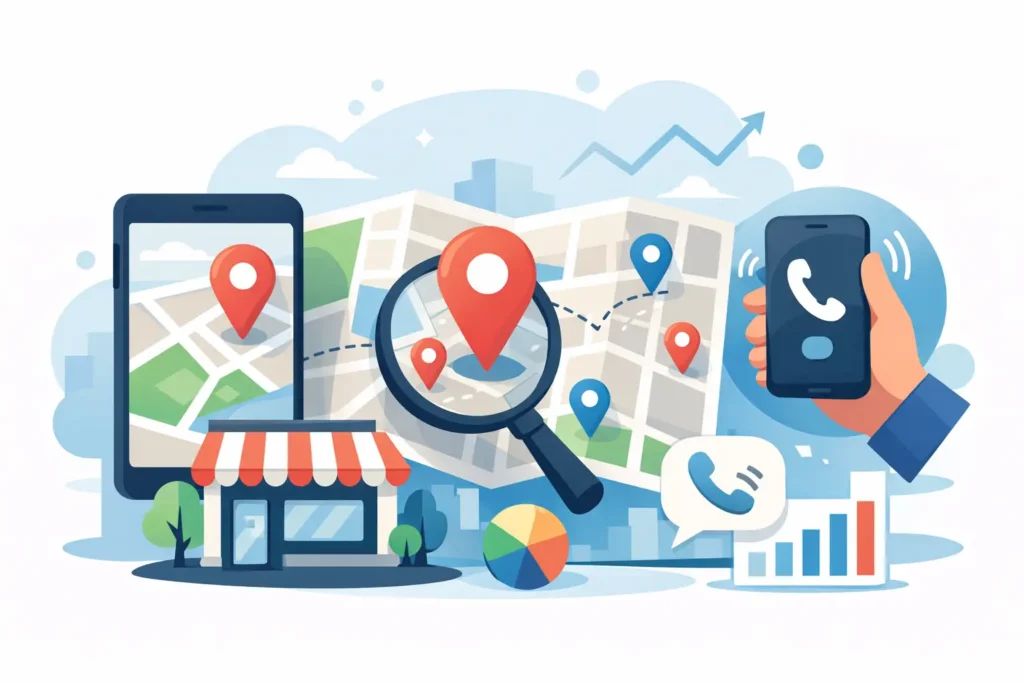
If your phone is not ringing from Google Maps, you do not have a traffic problem. You have a visibility problem. Local maps SEO is what puts your business in front of nearby customers when they search for terms like plumber near me, roof repair, or house cleaning in their city. For service businesses, that placement is not a vanity metric. It is where leads, calls, and booked jobs start.
Most owners assume Maps rankings come down to proximity alone. That is only part of the picture. Google also looks at relevance, trust signals, profile activity, website support, reviews, and how clearly your business matches local search intent. If a competitor with a weaker company is outranking you, there is usually a reason, and it is usually fixable.
What local maps SEO actually means
Local maps SEO is the work involved in improving your visibility inside Google Maps and the local pack, which is the group of map listings that appears above standard organic results for many local searches. It centers on your Google Business Profile, but it does not stop there. Strong Maps performance usually comes from a connected system that includes your listing, your website, your reviews, your local content, and the trust signals Google can verify across the web.
For a roofer, HVAC company, mover, attorney, or cleaner, that means your listing needs to be complete, active, accurate, and backed by a site that supports the same services and service areas. A half-filled profile with outdated hours and five blurry photos will not compete for long, even in smaller markets.
Why local Maps SEO matters more than standard rankings
A lot of business owners focus on traditional SEO first because they want page one rankings. Fair enough. But local Maps traffic often converts faster because the searcher is usually closer to a buying decision. They are not browsing. They are comparing, calling, and hiring.
That is why local Maps visibility matters so much for service businesses. A person searching emergency electrician or AC repair near me is often ready now. If your listing appears in the map pack with strong reviews, clear categories, recent photos, and a dial-ready phone number, you are in the game immediately.
Organic rankings still matter because they reinforce Maps performance. But if your local presence is weak, you can miss high-intent leads even when your website is decent.
The core factors behind Google Maps rankings
Google has never handed out a full playbook, but the patterns are clear. Strong local maps SEO usually comes down to relevance, distance, and prominence, with several practical ranking signals inside each one.
Relevance starts with your profile setup
Your primary category carries weight. If you are an HVAC contractor but your profile leans too heavily into general contractor terms, you are sending mixed signals. The same applies to your services, business description, service areas, and supporting content. Your listing should clearly reflect what you do and where you do it.
This is where a lot of businesses go wrong. They either overstuff the profile with keywords or leave useful fields blank. Neither approach helps. Google wants clarity, not chaos.
Distance matters, but it is not the whole story
Yes, proximity affects rankings. You will usually rank better closer to your business address or service-area relevance. But distance is not a free pass for your competitors. A better optimized listing with stronger signals can outrank a closer but weaker business in many cases, especially across broader city searches.
That is why service-area businesses should not assume they are stuck. You may not dominate every zip code, but you can absolutely improve coverage and visibility with the right setup.
Prominence is where real competition happens
Prominence is built through reviews, citations, website authority, listing activity, local backlinks, branded searches, and overall trust. If two businesses are equally relevant and similarly located, prominence often decides the winner.
This is also why local maps SEO is never just one task. You do not fix Maps by changing a category and hoping for the best. Ranking gains usually come from consistent work across multiple signals.
What a well-optimized Google Business Profile looks like
A strong profile is complete, active, and built to convert. That means the basics are accurate, but it also means the listing is managed with intent.
Start with the foundation. Your business name, address, phone number, hours, categories, service areas, and services should be correct and aligned with your website. Your description should explain what you do in plain language and support your main service keywords naturally.
Then look at the assets that separate active listings from neglected ones. Recent photos matter. Quality matters more. Review volume matters, but response quality matters too. Regular posting can help reinforce activity and service relevance. Q&A monitoring helps control misinformation. Booking, messaging, and call tracking setups should support lead generation without creating data inconsistency.
A profile that is merely claimed is not optimized. It is just owned.
Reviews are not just trust signals
Reviews influence click-through rate, lead quality, and ranking strength. They also shape buyer behavior fast. People scan your star rating, but they also read details. They want to know whether you show up on time, communicate well, solve the problem, and stand behind the work.
For local maps SEO, review strategy should be intentional. You want steady review growth, not random bursts. You want service-related language to appear naturally in customer feedback. You want responses that sound real, not copied and pasted. And you want review generation built into operations so it keeps happening.
There is a trade-off here. Aggressive review asks can backfire if your service experience is inconsistent. Fix operations first if needed. More visibility only helps if your reputation can support it.
Your website still affects Maps performance
A surprising number of business owners treat their Google Business Profile like a standalone lead source. It is not. Your website helps validate your authority, location relevance, and service depth.
If you want stronger map rankings, your site should support the same categories and areas you are targeting. That means having clear service pages, useful city or area pages where appropriate, proper title tags, indexable content, mobile usability, and fast load times. Technical SEO matters because weak crawlability and poor page experience can limit the support your site gives your listing.
This is especially true in competitive markets. The businesses winning Maps often have stronger websites behind the profile, not just more photos on the listing.
Common mistakes that hold back local Maps SEO
The biggest problem is inconsistency. Different phone numbers, outdated addresses, mismatched service descriptions, and weak location signals make it harder for Google to trust your business data.
Another common issue is category confusion. Businesses choose broad categories because they think it gives them more reach. Usually it does the opposite. Precision tends to perform better.
Then there is inactivity. No new photos, no posts, no review responses, no profile updates, and no attention to user questions create a stale listing. Google does not need daily busywork, but it does reward businesses that look active and credible.
The last major mistake is expecting instant results. Some changes can move rankings quickly, but local maps SEO is usually cumulative. If your competitors have years of review history and stronger local authority, you are not going to leapfrog them overnight.
How local Maps SEO should be approached for service businesses
Service businesses need a practical strategy, not a generic checklist. A roofer competing across suburbs has different map challenges than a law firm downtown. A cleaner with a home-based setup needs a different service-area approach than a contractor with a storefront.
That is why execution matters. The right approach usually includes GBP optimization, review generation, posting, image updates, citation cleanup, on-page local SEO, technical fixes, and local landing page support. In many cases, paid search can also complement Maps by covering gaps while organic visibility improves.
This is where a specialized agency can speed things up. Spinlisting focuses on this kind of hands-on work because rankings usually improve when the listing and website are managed together, not in separate silos.
How to tell if your local maps SEO is working
Do not judge performance by rankings alone. Rankings vary by location, device, and search history. What matters is whether visibility turns into business.
Track calls, direction requests, website visits, form fills, booked jobs, and lead quality. Watch how often you appear for your core service terms in your target areas. Look at review growth, profile engagement, and whether your service pages are picking up local organic traffic.
If impressions are rising but calls are flat, your listing may need better conversion elements. If your profile looks strong but rankings stall, your website or local authority may be the weak point. The data usually tells the story if you are looking at the right metrics.
Local maps SEO is not magic, and it is not guesswork either. It is a ranking channel with clear inputs, measurable outputs, and real revenue upside when it is managed properly. If your business depends on local leads, the question is not whether Google Maps matters. It is whether your current setup is doing enough to win the searches that are already happening in your market.