

A local search visibility score is a weighted percentage that quantifies how often and how prominently your business appears across local search results within your service area. Unlike a single rank position, this composite metric aggregates your rankings across dozens of geographic points, giving you a true picture of your local market share. Spinlisting clients who understand this score consistently make better decisions about where to invest their local SEO budget. The score correlates directly with calls, leads, and foot traffic, making it one of the most revenue-aligned numbers a local business owner can track.
What is a local search visibility score and how is it calculated?
A local search visibility score is expressed on a 0–100 scale and reflects the share of local search attention your business captures across a defined geographic area. The industry standard term for this concept is the Local Search Visibility Score, and it sits alongside related metrics like Share of Local Voice (SoLV) and Average Rank Position (ARP). Together, these numbers replace the misleading simplicity of a single rank check.
The calculation works by overlaying a grid of geographic points across your service area, then recording your ranking at each point. A common setup uses a 7×7 grid, which produces 49 data points across your target zone. Your score rises when you rank in the top 3 at more of those points, because clicks cluster heavily in positions 1 through 3 of the local pack.

Here is how the core metrics relate to each other:
| Metric | What it measures | Why it matters |
|---|---|---|
| Visibility Score | Overall prominence across the grid | Shows total market coverage |
| SoLV (Share of Local Voice) | % of grid points where you rank top 3 | Directly tied to lead volume |
| ARP (Average Rank Position) | Mean rank across all grid points | Tracks general trend over time |
| ATRP (Average True Rank Position) | Mean rank including non-appearances | Reveals dead zones in coverage |
Single-point rank checking fails because a business may rank #2 at its storefront and #8 just a few miles away. That gap is invisible in a traditional rank report. The grid approach exposes it.
Pro Tip: Run your grid at least once a week. A single snapshot tells you where you stand today. Weekly data tells you whether your efforts are actually moving the needle.
What factors influence your local search visibility score?
Google’s local algorithm centers on three pillars: relevance, distance, and prominence. Strength in one pillar does not substitute for weakness in another. All three must be balanced for your visibility score to climb.
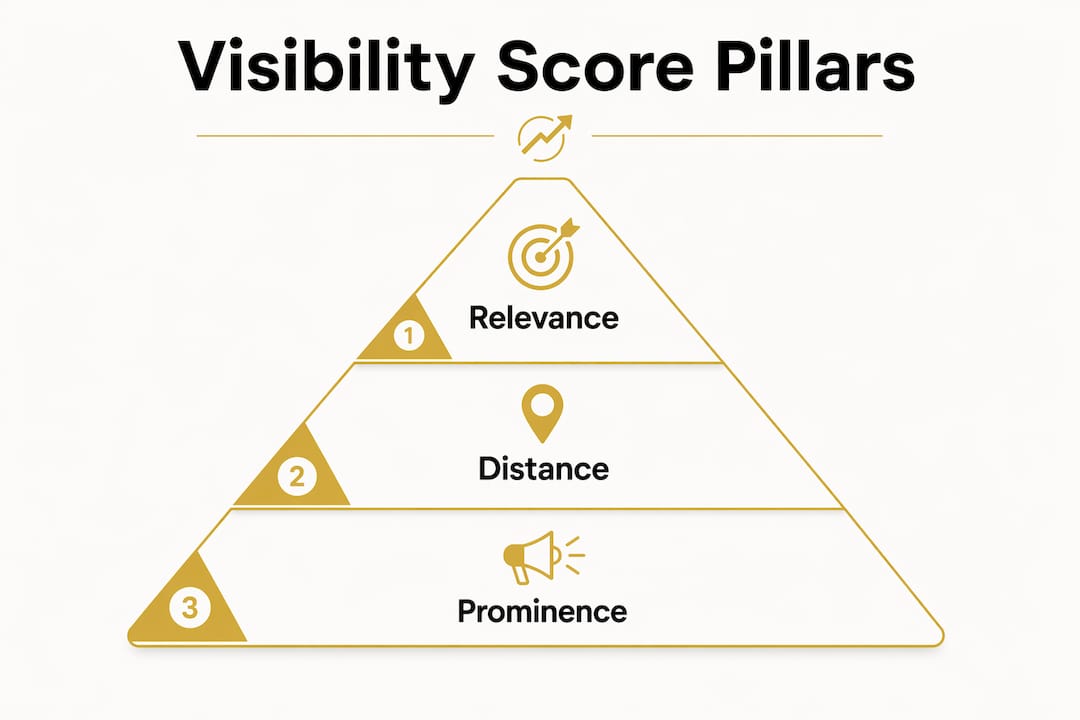
Relevance
Relevance measures how well your Google Business Profile matches what a searcher is looking for. A complete and accurate profile, with the right primary category, secondary categories, business description, and service list, feeds this signal directly. Profile completeness drives local pack rankings and map results in a measurable way.
Distance
Distance is a continuous decay factor. A listing may rank #1 near its verified pin, drop to #5 ten miles out, and disappear entirely at twenty miles. This is why businesses with a single location often have strong scores near their address and weak scores at the edges of their service area.
Prominence
Prominence is the broadest pillar and the hardest to build quickly. The key drivers include:
- Customer reviews: Volume, recency, average rating, and your response rate all feed this signal. Higher volume and positive, recent reviews correlate with higher rankings.
- Citations: Consistent name, address, and phone number (NAP) data across directories like Yelp, Apple Maps, and industry-specific sites reinforces trust.
- Website authority: Backlinks, local content, and structured data (schema markup) contribute indirectly to prominence by signaling credibility to Google.
- Photo and post activity: Regular updates to your Google Business Profile signal an active, trustworthy business.
Pro Tip: Respond to every review, including negative ones. Google treats response activity as a prominence signal, and potential customers read your replies before they call.
How do you interpret your visibility score alongside other metrics?
A visibility score alone can mislead you. Visibility scores and grid ranks must be used together: scores give breadth, while grid ranks give location-specific detail. A business with a score of 60% might look healthy until you map the grid and find that all its top-3 rankings cluster within one mile of its front door.
The SoLV metric sharpens this picture. A SoLV of 70% means your business ranks in the top 3 for 70% of searches across your service area. Improving SoLV often produces measurable increases in lead volume. That connection to revenue is what makes it more useful than a raw rank number.
ATRP adds another layer. High visibility scores can mask dead zones where your business has zero presence. ATRP penalizes non-appearances more heavily than ARP does, which forces those gaps into view. If your ATRP is significantly worse than your ARP, you have geographic blind spots that need attention.
Benchmarking against local competitors is the final piece. Your score only matters relative to the businesses competing for the same customers. A score of 45% in a market where your nearest competitor sits at 30% is a strong position. The same score in a market where competitors average 65% signals urgent work ahead. Understanding local search market share in your specific area gives that context.
Pro Tip: Track your score bi-weekly rather than monthly. Regular weekly or bi-weekly monitoring produces reliable trend data. Monthly checks miss short-term drops caused by competitor activity or algorithm updates.
How to improve your local search visibility score
Improving your score requires work across several fronts simultaneously. No single tactic moves the needle on its own.
Complete your Google Business Profile fully
Every empty field on your profile is a missed relevance signal. Fill in your primary category, all applicable secondary categories, business hours (including holiday hours), service list, product catalog if relevant, and a keyword-rich business description. Add at least ten photos and refresh them regularly. A profile with accurate NAP data and rich content consistently outperforms a sparse one.
Build and manage customer reviews actively
Ask every satisfied customer for a review. Make it easy by sending a direct link to your Google review page. Respond to every review within 48 hours. Positive responses reinforce trust; professional responses to negative reviews demonstrate accountability. Review velocity matters as much as total count, so a steady stream of new reviews beats a burst followed by silence.
Audit and fix your citations
Run a citation audit to find inconsistencies in your business name, address, and phone number across directories. Errors on high-authority sites like Yelp, Facebook, and Bing Places dilute your prominence signal. Correct them and then build new citations on relevant industry directories. Consistency is the goal, not volume alone.
Create hyper-localized content
If you serve multiple neighborhoods or cities, build a dedicated landing page for each area. Each page should reference local landmarks, use area-specific keywords, and include schema markup with your address and service area. Ranking decay with distance is gradual, not binary, and hyper-localized content helps you hold rankings further from your pin.
Consider verified locations strategically
Businesses that serve a wide geographic area often hit a ceiling with a single verified location. A second verified address in a high-value service area can anchor rankings in that zone. This is a longer-term play, but it directly addresses the distance decay problem that limits most single-location businesses.
Monitor your grid and adjust
Use a geo-grid rank tracking tool to run regular scans. Map the results visually to identify which zones are strong and which are weak. Prioritize content and citation work in the weak zones. A local SEO audit checklist keeps this process systematic and prevents you from overlooking easy wins.
Pro Tip: Visibility score improvements from profile and review work typically appear within 4–8 weeks. Citation corrections take longer, often 8–12 weeks, because directories update on their own schedules.
Key Takeaways
A local search visibility score measures your geographic market share across a grid of search points, and improving it requires balancing Google’s three pillars of relevance, distance, and prominence simultaneously.
| Point | Details |
|---|---|
| Score measures market share | A visibility score reflects the percentage of local searches where your business appears prominently, not just a single rank. |
| Grid tracking beats single-point checks | A 7×7 geo-grid reveals ranking gaps across your service area that traditional rank reports hide entirely. |
| SoLV connects to revenue | Share of Local Voice measures top-3 coverage and correlates directly with call volume and lead generation. |
| ATRP exposes dead zones | Average True Rank Position penalizes non-appearances, revealing geographic gaps a standard visibility score can mask. |
| All three pillars must be balanced | Relevance, distance, and prominence each affect your score; weakness in any one limits the others. |
The metric most business owners underestimate
Most local business owners I talk to are fixated on ranking #1 for one keyword in one location. That instinct is understandable, but it misses the point entirely. Your customers search from their homes, their offices, and their cars. They are spread across your service area, not standing at your front door. A business that ranks #1 at its address but disappears three miles out is losing a large portion of its potential market every single day.
The visibility score is the first metric I point to when a business owner tells me their local SEO “isn’t working.” Nine times out of ten, they have been tracking a single rank position that looks fine while their actual geographic coverage is thin. When they see the grid map for the first time, the problem becomes obvious immediately.
The other mistake I see constantly is treating the score as a vanity metric rather than a business number. Visibility scores provide revenue-aligned data that business owners actually understand. Telling a client they rank #4 on average means little. Telling them they capture 45% of local searches in their area, and that a competitor captures 62%, creates urgency and direction. That framing changes how business owners prioritize their marketing spend.
The local search ranking factors that drive visibility scores are not mysterious. They are documented, measurable, and improvable. The businesses that win local search in 2026 are the ones that treat their visibility score the same way they treat their revenue numbers: tracked weekly, analyzed seriously, and acted on consistently.
— Against
How Spinlisting helps you improve your local visibility score
Spinlisting specializes in Google Business Profile optimization, geo-grid rank tracking, and review management for local businesses. Every service connects directly to the factors that move your visibility score: profile completeness, citation consistency, review velocity, and localized content.

Spinlisting’s approach starts with a full audit of your current profile and grid performance, then builds a prioritized plan based on where your score has the most room to grow. Businesses that work with Spinlisting have seen first-place ranking increases of 83% through consistent, targeted optimization. If you want to see where your score stands and what it would take to close the gap on local competitors, the 2026 local SEO strategy guide is the right starting point. You can also explore Spinlisting’s full range of local SEO services to find the right fit for your business.
FAQ
What is a local search visibility score?
A local search visibility score is a composite metric on a 0–100 scale that aggregates your business’s rankings across a geographic grid of search points. It reflects your share of local search attention across your entire service area, not just at your address.
How is the visibility score different from a rank position?
A rank position tells you where you appear for one search at one location. A visibility score aggregates rankings across dozens of geographic points, giving you a true measure of market coverage rather than a single snapshot.
What is Share of Local Voice (SoLV)?
SoLV measures the percentage of grid points where your business ranks in the top 3. A SoLV of 70% means you have top-3 visibility for 70% of searches across your service area, and it correlates directly with lead volume.
How often should I check my local search visibility score?
Weekly or bi-weekly monitoring produces the most reliable trend data. Monthly checks miss short-term drops caused by competitor activity or algorithm updates, making it harder to respond quickly.
What is the fastest way to improve my visibility score?
Completing your Google Business Profile fully and actively building customer reviews produces the fastest results, typically within 4–8 weeks. Citation corrections and localized content take longer but extend your geographic coverage significantly.
Recommended
- Local Search Market Share: What Businesses Must Know | Google my Business for SEO / ranking services SEO
- How to Measure ROI of Your Local SEO Efforts | Google my Business for SEO / ranking services SEO
- Local SEO vs Paid Ads Explained for Business Owners | Google my Business for SEO / ranking services SEO
- Why Mobile Search Drives Local Traffic to Your Business | Google my Business for SEO / ranking services SEO