

Customer reviews are the single most important factor in local SEO success in 2026. Not backlinks. Not keyword density. Reviews. Google uses them to judge whether your business is active, credible, and worth showing to searchers, and the bar has moved higher than most local owners realize.
Here is what the algorithm actually rewards:
- Rating threshold: A high star average is now the baseline to compete in top local results. You need a 4.8-star rating or higher to compete for top local search rankings in 2026, as most small businesses with 4.2 to 4.6 stars no longer qualify.
- Review freshness: Google prioritizes recent activity. A strong overall rating built on old reviews loses influence fast.
- Review volume and consistency: A steady flow of new reviews signals that your business is active and relevant, not just historically popular.
- Review content: The words customers use in reviews feed Google’s algorithms, including its AI systems, helping search engines understand exactly what you do and who you serve.
Think of reviews as fuel, not trophies. Every new review shapes how Google interprets your business and how confidently it places you in front of searchers.
Table of Contents
- How customer reviews build trust and authority with search engines
- How reviews directly affect your local pack ranking and map visibility
- Responding to reviews is an active SEO signal, not just good manners
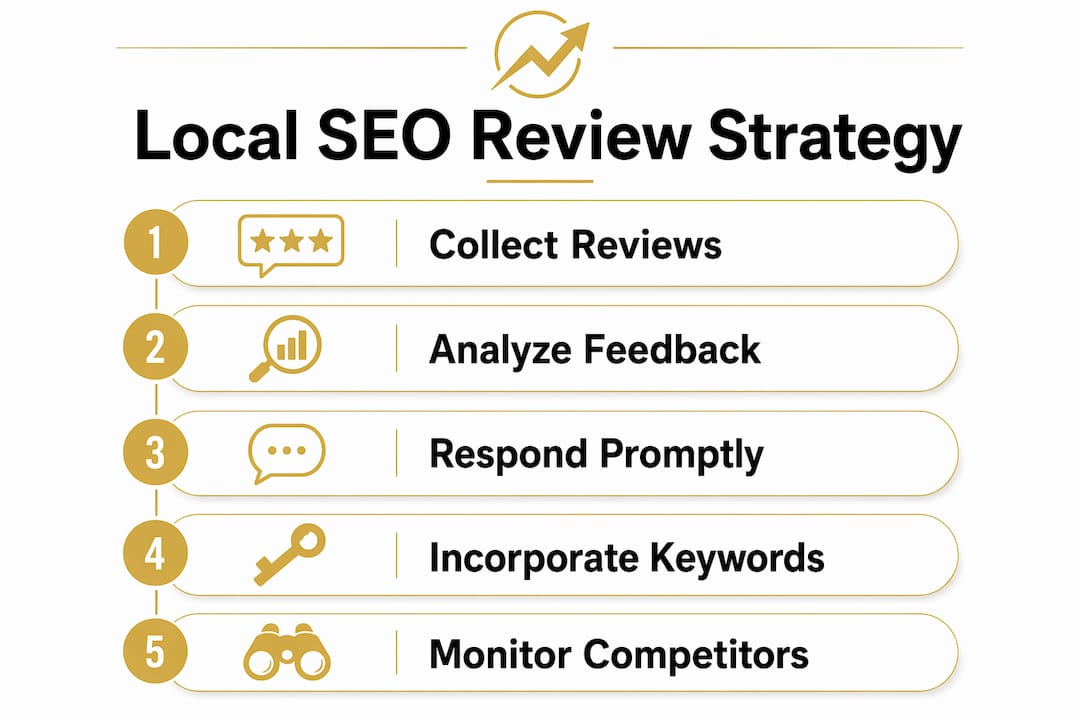
- How to integrate reviews into your local SEO strategy step by step
- How Spinlisting uses reviews to drive measurable local SEO growth
- How to analyze competitor reviews to sharpen your own SEO strategy
- Key Takeaways
How customer reviews build trust and authority with search engines
Reviews do two jobs at once. They convince potential customers to choose you, and they convince Google to show you. Both matter, and they reinforce each other.
“Search engines aren’t just listening to what you have to say about yourself — they’re listening to what other people have to say about you. Reviews are a powerful form of customer content that has huge implications for SEO and boosting organic traffic.” — Yotpo
Google’s algorithm evaluates your business’s expertise, authority, and trustworthiness, a framework often called E-E-A-T. Reviews are one of the clearest signals in that framework because they come from real customers, not from you. Authentic, keyword-rich user-generated content like reviews is almost impossible to replicate with any other tactic. When a customer writes “best HVAC repair in Denver, fast and professional,” they have just handed you a long-tail keyword phrase, a location signal, and a trust signal wrapped in one sentence.
Google also runs manual quality reviews through human raters trained to assess a site’s overall reputation. Those raters read negative reviews too, but they look at the full picture. A business with mostly strong, detailed reviews and a few critical ones reads as legitimate. A business with no reviews, or only generic five-word reviews, raises flags.
Pro Tip: Encourage customers to describe what you did, where, and how the experience went. A review that says “great service” helps less than one that says “replaced my water heater in Scottsdale same day, no mess, fair price.” The specifics are what search engines and future customers actually need.
How reviews directly affect your local pack ranking and map visibility
The local pack, the three-business block that appears at the top of Google Maps results, is where the real competition happens for most local businesses. Reviews are a primary driver of who gets in.

| Ranking Factor | What Google Looks For | Why It Matters |
|---|---|---|
| Star rating | High average | Lower ratings rarely reach top-3 positions |
| Review recency | Reviews within the past 30 days | Old reviews lose ranking weight over time |
| Review volume | Consistent growth, not a one-time spike | Signals ongoing customer activity |
| Review content | Location names, service terms, specific details | Feeds keyword relevance signals |
| Review diversity | Multiple platforms (Google, Facebook, Yelp) | Reinforces credibility across the web |
How to read that table practically:
- A business with 200 reviews and a 4.5-star average will often lose to one with 80 reviews and a 4.9-star average, especially if the 80 reviews are recent.
- A sudden burst of 50 reviews in one week followed by silence looks suspicious to Google and can trigger a review audit.
- Reviews that mention your city, neighborhood, or service type by name strengthen your relevance for those specific searches.
- Platforms beyond Google, including Facebook and industry-specific directories, provide additional credibility signals that reinforce your Google profile.
Review freshness is the factor most businesses underestimate. Even a business with an excellent overall rating will slip in rankings if new reviews stop coming in.
Responding to reviews is an active SEO signal, not just good manners
Responding to reviews signals to Google that your business is actively managed. That activity is a ranking input, not a soft courtesy metric.
- Reply to every review, positive and negative, within 48 hours when possible.
- For positive reviews, thank the customer by name and reference a specific detail from their feedback. Generic “Thanks for the review!” responses add little value.
- For negative reviews, acknowledge the issue, apologize without deflecting, and offer to resolve it offline. Never argue publicly.
- If a customer’s issue gets resolved, ask them to update their review. An updated review from 2 stars to 4 stars is a visible trust signal to every future reader.
- Never suppress, threaten, or filter negative reviews based on sentiment. The Federal Trade Commission has issued fines for exactly this practice, and Google can detect review manipulation.
The SEO benefit of responding goes beyond the direct signal. Responses increase the total word count and keyword density on your Google Business Profile, which Google crawls. A thoughtful response that naturally includes your service type and location adds context that a bare star rating cannot.
How to integrate reviews into your local SEO strategy step by step
A review strategy is not a one-time campaign. It is a system you build and maintain.
- Time your ask correctly. Request a review immediately after a positive experience, while the customer’s satisfaction is fresh. Waiting a week cuts response rates sharply.
- Make it frictionless. Send a direct Google review link via SMS, email, or a QR code at your location. Every extra tap between the customer and the review form loses you responses.
- Train your team. Front-line staff who naturally ask for reviews during checkout or service completion generate far more volume than any automated email sequence alone.
- Add review schema markup to your website. Schema markup tells Google to display star ratings directly in organic search results as rich snippets. Rich snippet star ratings can improve click-through rates significantly, which feeds a positive engagement signal back into your rankings.
- Publish reviews on your website. Create a dedicated page or section where Google can crawl your reviews. This turns customer language into indexed content on your own domain.
- Repurpose reviews across channels. Share standout reviews on social media and in email campaigns. Social engagement around review content builds additional signals that support your overall online authority.
- Audit your review profile monthly. Check your average rating, the date of your most recent review, and your response rate. A local SEO audit that skips the review section is incomplete.
Pro Tip: Use the exact phrases customers repeat most often in their reviews as inspiration for your website copy and Google Business Profile description. If five customers independently call you “the fastest plumber in Austin,” that phrase belongs in your content.
How Spinlisting uses reviews to drive measurable local SEO growth
Spinlisting’s approach treats reviews and Google My Business optimization as a single system, not two separate tasks. The results reflect that integration.
Spinlisting clients see an 83% increase in first-place local search rankings after implementing a combined GMB optimization and review strategy.
Businesses with unclaimed or poorly maintained listings see 5x less organic visibility compared to those with optimized profiles and active review portfolios. That gap is not a coincidence. An optimized GMB profile gives reviews a strong foundation to build on, and reviews give the profile the freshness and credibility signals it needs to rank.
| Metric | Unoptimized Profile | Spinlisting-Optimized Profile |
|---|---|---|
| First-place local ranking rate | Baseline | 83% increase |
| Organic visibility | Standard | Up to 5x higher |
| Review strategy | Ad hoc or none | Systematic, ongoing |
| GMB profile status | Unclaimed or static | Actively maintained |
The pattern Spinlisting sees repeatedly: businesses that rank well on their website but struggle in the local pack almost always have a weak review profile. Once the review velocity and rating quality improve alongside GMB optimization, local pack placement follows within weeks, not months.
How to analyze competitor reviews to sharpen your own SEO strategy
Your competitors’ reviews are a free research tool, and most local businesses ignore them entirely.

Start by pulling the top three businesses in your local pack and reading their most recent 20–30 reviews. Look for the phrases customers use to describe what they value most. If your competitors’ customers consistently mention “fast response time” or “easy parking,” those are signals about what your shared audience prioritizes. If those qualities also describe your business, they should appear in your own review requests and GMB profile copy.
Pay attention to the complaints too. Negative reviews on competitor profiles reveal service gaps you can position against. A competitor with recurring complaints about slow follow-up gives you a concrete differentiator to highlight in your own customer communications and review responses.
Review volume trends also tell a story. A competitor whose reviews have slowed to one or two per month is losing freshness signals, which creates an opening. Consistent review acquisition on your end, while their profile stagnates, can shift local pack rankings over a quarter or two. Tracking this monthly as part of your local search visibility monitoring turns competitor data into a competitive advantage.
For a broader look at how online reviews drive revenue beyond rankings, the connection between review quality and actual business growth is well documented for small and mid-sized businesses in 2026.
Key Takeaways
Customer reviews are the most direct lever local businesses control for improving Google local pack rankings, trust, and organic traffic in 2026.
| Point | Details |
|---|---|
| Rating threshold matters | A 4.8-star average rating or higher is required to compete in top local search results. |
| Freshness beats volume alone | Recent reviews outweigh a large pool of old ones in Google’s ranking signals. |
| Responding boosts SEO | Timely, specific responses signal active management and add keyword-rich content to your profile. |
| Schema markup lifts CTR | Rich snippet star ratings can improve click-through rates significantly. |
| Spinlisting drives results | Clients achieve an 83% increase in first-place rankings through combined GMB and review optimization. |
Ready to turn your review profile into a local ranking asset? Spinlisting’s GMB optimization service combines review strategy with full Google Business Profile management to put your business where local customers are already looking.

Recommended
- Local SEO Audit Checklist: Your 2026 Strategy Guide | Google my Business for SEO / ranking services SEO
- Local SEO Ranking Factors Explained for 2026 | Google my Business for SEO / ranking services SEO
- Improve Local Search Ranking: 2026 Strategy Guide | Google my Business for SEO / ranking services SEO
- Local Business Listing Essentials: Your 2026 Guide | Google my Business for SEO / ranking services SEO