

Business description SEO is the practice of crafting and optimizing your business’s descriptive text across profiles and listings to improve local search visibility and customer trust. Most business owners treat the description field as an afterthought. That is a significant mistake. Google uses your business description to understand what you do, who you serve, and where you operate. When that description is specific, consistent, and keyword-relevant, it reinforces your entity signals across every platform where your business appears. The result is stronger local rankings, better click-through rates, and customers who arrive already knowing you are the right fit.
How does business description SEO impact local search rankings?
Business descriptions are not a primary Google ranking signal, but they contribute to the factors that are. Google’s local pack ranking factors in 2026 prioritize primary category accuracy, review signals, profile completeness, photo freshness, and engagement metrics. Your description supports several of these by providing keyword context that helps Google match your profile to relevant searches.
The description also feeds Google’s AI systems. When a searcher asks a voice assistant or AI overview “who does X near me,” Google pulls structured information from your profile, including your description, to generate an answer. A vague or generic description gives the algorithm less to work with. A specific one, naming your services, customer types, and location, gives it more signal to act on.

Engagement is where descriptions have the most direct impact on rankings. A clear, well-written description convinces a searcher to click, call, or request directions. Listings with rich photo libraries see 520% more calls and 2,717% more direction requests than those without. That same principle applies to descriptions. A complete, specific profile drives engagement, and engagement drives rankings.
Here is what a well-optimized description does for your local SEO:
- Provides keyword relevance that helps Google match your profile to specific search queries
- Reinforces entity signals by naming your services, location, and customer types clearly
- Reduces algorithmic confusion when it matches your website content and listed categories
- Improves click-through rates by giving searchers a clear reason to choose your business
- Feeds AI overviews and voice search with structured, specific information about your business
Pro Tip: Write your description as if you are answering the question “What does this business do, for whom, and where?” That framing naturally produces the specificity Google and customers both need.
What best practices should businesses follow when crafting descriptions for SEO?
The Google Business Profile description field allows up to 750 characters. Most businesses waste it. High-performing descriptions are specific and customer-centric, naming services, location, and customer types rather than relying on generic claims like “family-owned” or “best in town.” Every character you spend on filler is a character not spent on something useful.
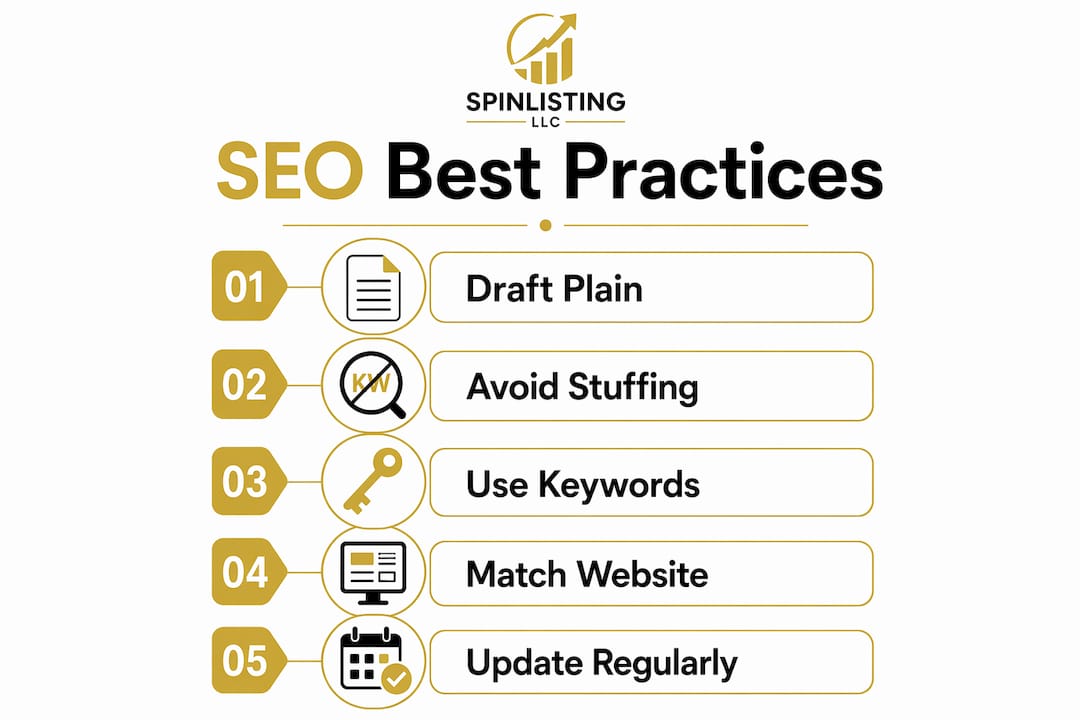
Writing an effective description for SEO follows a clear process:
- Lead with your primary service and location. Put the most important information first. “Austin-based tax preparation firm serving small business owners and freelancers” tells Google and the reader exactly what you do and where.
- Name your specific services. Do not say “we offer a range of services.” Say “we provide bookkeeping, payroll processing, and quarterly tax filing.” Specificity helps search matching.
- Include your customer type. Naming who you serve, such as “residential homeowners,” “e-commerce brands,” or “medical practices,” helps Google connect your profile to the right searches.
- Add a credibility signal. Years in business, a relevant certification, or a verifiable differentiator builds trust. “Licensed by the Texas State Board of Public Accountancy since 2009” is far more convincing than “experienced professionals.”
- Avoid promotional language. Google explicitly prohibits sales offers or promotional claims in descriptions. Violations risk removal or flagging. Save promotions for Google Posts.
- Use keywords naturally. Place your primary service keywords in the first two sentences. Do not repeat them mechanically. Write for a human reader first.
- Update every 6–12 months. Your business changes. Your description should reflect current services, hours, and focus areas. Stale descriptions signal a neglected profile.
Pro Tip: Draft your description in a plain text editor first. Read it aloud. If it sounds like a brochure, rewrite it to sound like a knowledgeable person answering a customer’s question.
Following an SEO best practices checklist when writing descriptions helps you avoid common errors like keyword stuffing, vague service language, and missing geographic markers. These small errors compound over time and reduce your profile’s relevance in local search results.
Why is consistency between business descriptions and website content crucial for SEO?
Google does not take your business profile at face value. Google crawls your linked website to verify that the information in your profile, including your name, address, categories, and services, matches what appears on your site. When those two sources conflict, Google reduces the ranking weight it assigns to your profile. That is a direct penalty for inconsistency.
Consistent business descriptions that match your categories and listed services improve AI comprehension and search matching. Structured data like LocalBusiness schema markup on your website reinforces the connection between your site content and your Google Business Profile. That reinforcement tells Google’s algorithm that your business is exactly what it claims to be, which increases ranking trust.
The description also functions as what practitioners call a “source block.” You write one authoritative version of your business description and deploy it consistently across your website’s About page, directory listings, social media bios, and email signatures. This consistent messaging strengthens entity signals across every platform where your business appears.
| Platform | Where description appears | SEO benefit |
|---|---|---|
| Google Business Profile | Knowledge panel, local pack | Direct keyword relevance and entity signal |
| Business website (About page) | Organic search results | Corroborates profile data for Google |
| Directory listings (Yelp, BBB) | Third-party search results | Reinforces NAP consistency and brand coherence |
| Social media bios | Platform search and Google indexing | Extends entity signals across additional domains |
| Email signatures | No direct SEO value | Maintains brand consistency for customer trust |
The table above shows why treating your description as a one-platform asset misses most of its value. A single, well-crafted description deployed consistently across these platforms creates a web of corroborating signals that Google’s algorithm interprets as a trustworthy, well-established business.
How can businesses measure and optimize their description’s SEO performance?
Measuring the SEO impact of your business description requires tracking the right signals. You cannot isolate the description as a single variable, but you can monitor the metrics that reflect its influence on profile performance and local rankings.
Key performance indicators to track include:
- Local search ranking positions for your primary service keywords in your target area, checked monthly using a local rank tracker
- Google Business Profile engagement metrics, specifically calls, website clicks, and direction requests, available in the profile’s performance dashboard
- Profile views vs. actions ratio, which shows whether searchers who find your profile are converting or bouncing
- Keyword match reports from your profile’s search query data, which reveal what terms are triggering your listing
Regular audits keep your description aligned with your current business reality. Google adds and renames categories quarterly. If your category changes and your description no longer matches, your SEO effectiveness drops regardless of your review count or engagement history. A quarterly description review takes 20 minutes and prevents that drift.
Testing different description versions is also worth doing. Write two versions of your description, one leading with your service and one leading with your location, and monitor engagement metrics over 60 days after each change. The version that produces more calls and clicks is the stronger performer. Apply that learning to your next revision.
Pro Tip: Use your Google Business Profile’s “Search queries” report to find the exact phrases customers use to find you. If those phrases do not appear in your description, add them naturally in your next update.
Connecting your profile to Google Analytics through UTM parameters on your website link lets you track which profile visitors convert on your site. That data shows you whether your description is attracting the right customers, not just more traffic. For a structured approach to measuring these results, a local SEO audit gives you a repeatable framework to assess description performance alongside your full profile.
Key Takeaways
A well-crafted, consistently deployed business description is one of the lowest-effort, highest-return steps in local SEO, because it reinforces entity signals, supports AI comprehension, and converts searchers before they visit your site.
| Point | Details |
|---|---|
| Descriptions support ranking factors | They provide keyword context and feed AI systems that influence local pack visibility. |
| Specificity beats generic claims | Name your services, customer types, and location to maximize search matching and trust. |
| Consistency across platforms matters | Matching your description to your website and directories reduces algorithmic confusion. |
| Promotional language risks removal | Google prohibits sales offers in descriptions; use Google Posts for promotions instead. |
| Regular updates maintain relevance | Review and refresh your description every 6–12 months to reflect business changes. |
Why the description field is the most underused asset in local SEO
Most business owners spend hours on review responses and photo uploads, then write their description in five minutes and never touch it again. That is backwards. The description is the only field in your Google Business Profile where you control the narrative in full sentences. Every other signal, reviews, photos, categories, is either generated by others or constrained to a dropdown. The description is yours.
The businesses I see ranking consistently in competitive local markets treat their description as a living document. They update it when they add a service. They sharpen it when a new competitor enters the market. They test different openings and watch what happens to their call volume. That is not obsessive. That is just paying attention to a field that directly influences how Google and customers understand your business.
The other pattern I notice is that businesses write descriptions for themselves, not for their customers. They lead with how long they have been in business or how passionate they are. Customers do not search for passion. They search for a specific service in a specific place. Lead with that. The local search marketing basics that drive real results are almost always about clarity and specificity, not personality.
One more thing: the “source block” concept is genuinely underused. Write one authoritative description, then paste it everywhere your business appears online. Your Yelp bio, your LinkedIn company page, your chamber of commerce directory listing. Consistent language across those platforms tells Google’s algorithm that all those listings refer to the same real business. That coherence is worth more than most businesses realize.
— Against
How Spinlisting helps you get your business description right
Getting your business description right is one piece of a larger profile optimization picture. Spinlisting specializes in exactly that picture, auditing Google Business Profiles for description accuracy, category alignment, and website consistency, then building a strategy that keeps every signal working together.
Spinlisting’s approach includes content optimization, ongoing performance tracking, and profile audits designed to catch the gaps that cost businesses local rankings. Clients have seen first-place ranking increases of 83% through this kind of consistent, detail-focused work. If your description has not been reviewed in the past year, or if your profile and website are telling Google different stories, that is the place to start. Spinlisting’s 2026 profile optimization guide walks you through every step.
FAQ
What is business description SEO?
Business description SEO is the practice of writing and optimizing your business’s descriptive text on Google Business Profile and other listings to improve local search visibility and customer trust. It involves using specific service keywords, location markers, and customer-type language to help search engines and AI systems understand your business accurately.
Does the Google Business Profile description directly affect rankings?
The description is not a primary ranking factor, but it contributes to keyword relevance and AI comprehension, which support the engagement metrics that do drive local pack rankings. A specific, well-written description also improves click-through rates, which signals relevance to Google.
How long should a Google Business Profile description be?
Google allows up to 750 characters. High-performing descriptions use most of that space with specific service information, location details, and customer-type language rather than generic filler phrases.
How often should I update my business description?
Update your description every 6–12 months, or immediately when you add a new service, change your service area, or earn a new certification. Google updates its category list quarterly, so your description should stay aligned with your current primary category.
Why does my description need to match my website content?
Google crawls your linked website to verify that your profile information is accurate. When your description and website content conflict, Google reduces the ranking trust it assigns to your profile. Consistent language across both platforms strengthens your entity signals and improves local pack visibility.
Recommended
- Local Search Marketing Explained for Business Owners | Google my Business for SEO / ranking services SEO
- Improve Local Search Ranking: 2026 Strategy Guide | Google my Business for SEO / ranking services SEO
- How to Add Local SEO Keywords to Your Listing | Google my Business for SEO / ranking services SEO
- How to Launch Your Local Business Online Presence | Google my Business for SEO / ranking services SEO