

A Google Business Profile is the single most powerful digital asset a local business controls. It determines whether you appear in local search results, how customers perceive you before they visit, and whether Google’s AI recommends you over a competitor down the street. Understanding why Google listings matter is not optional for local business owners in 2026. It is the foundation of every other marketing effort you make.
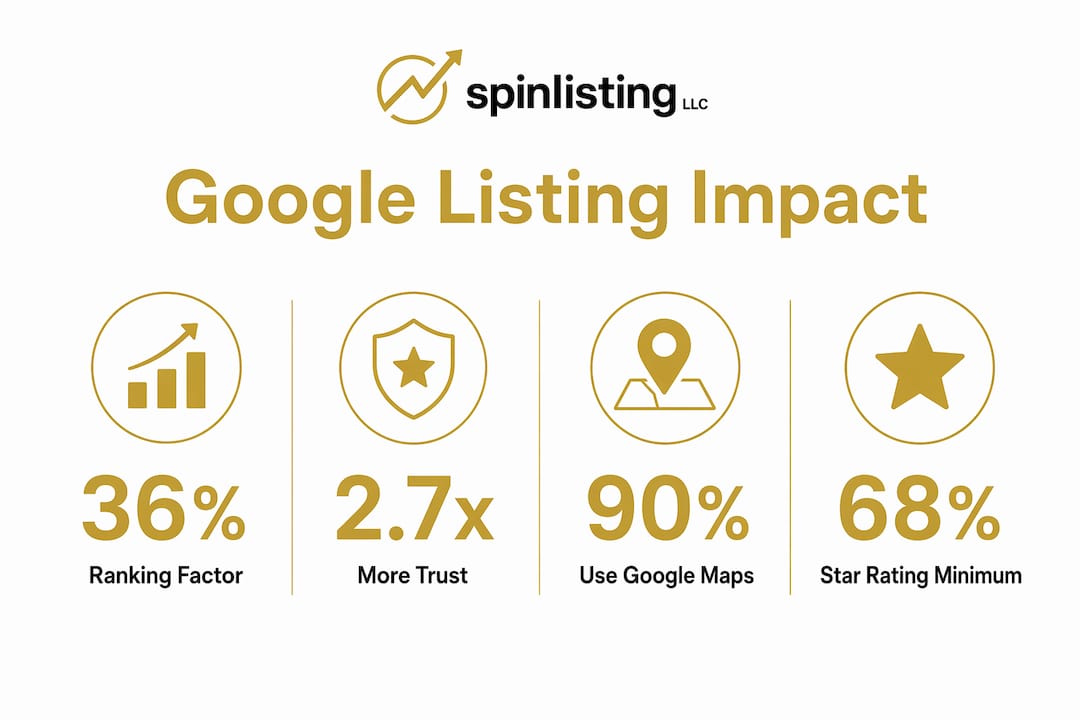
Businesses with claimed, complete, and verified profiles are 2.7 times more likely to be trusted by customers. That single statistic explains more about local marketing ROI than most paid advertising reports ever will.
Why Google listings matter for local search rankings
Google Business Profile signals account for 36% of Local Pack ranking factors, making it the top single ranking input. No other factor, not backlinks, not website speed, not social media presence, carries that much weight in local search placement. If your profile is incomplete or inactive, you are starting every local search at a structural disadvantage.

The Local Pack, the three business results that appear at the top of a Google search with a map, shows up in 93% of local search results. That means nearly every local search your potential customers run will surface a Local Pack before organic website results. Without a listing, you cannot rank in local map results at all.
Google’s AI now pulls directly from active Business Profiles to generate local business overviews and recommendations before users even click a result. An incomplete or inactive profile risks being omitted or inaccurately described in those AI-generated summaries. That is a first impression you never get to correct.
Key ranking signals Google evaluates include:
- Profile completeness: Every field filled in, including categories, hours, services, and description
- Verification status: Claiming and verifying your listing unlocks full management and higher ranking opportunities
- Activity signals: Recent posts, photo uploads, and review responses
- Review quality and volume: Star ratings, recency, and business response rate
- Proximity and relevance: How well your profile matches the searcher’s location and intent
Nearly 90% of consumers use Google Maps for local searches with high purchase intent. The top three Google Maps listings also appear in standard Google Search results, which doubles your visibility without any additional cost.
Does an active profile really affect trust and engagement?
The short answer is yes, and the data is specific. A Google Business Profile is not a static directory entry. It is a live reputation surface that Google evaluates continuously. Every update you make, or fail to make, signals something to both the algorithm and the customer reading your profile.
Profiles without recent updates or photos experience measurable declines in impressions and ranking over time. That decline is not gradual. Businesses that stop posting or uploading photos can see ranking drops within weeks. Regular activity signals to Google that the business is open, relevant, and worth recommending.
Reviews are where trust becomes quantifiable. 68% of consumers avoid businesses rated below 4 stars, and 31% only consider businesses rated 4.5 stars or higher. Those thresholds are not flexible. A 3.8-star rating is not “almost good enough.” For nearly seven out of ten potential customers, it is a reason to choose someone else.
Responding to reviews matters just as much as receiving them. Responding to all reviews can increase revenue by up to 18% and inquiry conversion by 50%. That is a direct, measurable return on the five minutes it takes to write a thoughtful reply.
Key profile elements that directly affect engagement:
- Photos: Listings with photos receive significantly more direction requests and website clicks
- Posts: Weekly updates keep your profile fresh and give customers a reason to engage
- Q&A section: Unanswered questions signal neglect; answered ones build confidence
- Business description: A clear, keyword-rich description helps Google match your profile to relevant searches
Pro Tip: Set a recurring calendar reminder every two weeks to add a new photo, publish a post, and check for unanswered questions. Consistency beats intensity when it comes to profile activity signals.
Common mistakes local businesses make with their Google listing
The most damaging mistake is treating a Google listing as a one-time setup task. The “set it and forget it” approach leads directly to ranking stagnation and lost customers. Google rewards continuous activity like frequent photo uploads and timely review responses in its local ranking algorithm. A profile that was optimized two years ago and never touched since is not a maintained asset. It is a liability.
The four most common pitfalls local business owners face:
- Outdated hours or contact information. Wrong hours cause failed visits. Failed visits cause negative reviews. Negative reviews compound over time and are extremely difficult to reverse.
- Ignoring reviews, especially negative ones. A business that never responds to reviews appears indifferent. Professional responses to negative feedback reduce reputational damage and improve how prospective customers perceive you.
- Leaving the Q&A section unmanaged. Anyone can post a question or answer on your profile. Unanswered or incorrectly answered questions mislead customers and reflect poorly on your business.
- Failing to flag fake reviews or competitor sabotage. Fake negative reviews are a real risk. Google provides a flagging mechanism, but you must monitor your profile regularly to catch and report them quickly.
Pro Tip: Use Google’s built-in notification settings to receive alerts every time a new review or question appears on your profile. Responding within 24 hours consistently outperforms delayed responses in both customer perception and conversion rates.
Unclaimed or inconsistent listings function as visible red flags to customers. Incorrect phone numbers and outdated addresses do not just cause inconvenience. They drive customers directly to a competitor whose information is accurate.
How to optimize your Google listing for 2026 and beyond
Optimization is not a single event. It is an ongoing practice. The businesses that consistently appear in the top three Local Pack results share one trait: they treat their Google Business Profile as a primary marketing channel, not an afterthought.
Start with the fundamentals:
- Claim and verify your listing. Verification rates have risen to 82% globally, which means an unverified listing now stands out as suspicious to customers who notice it.
- Complete every profile section. Business name, address, phone number, website, hours, categories, services, and description. Leave nothing blank.
- Upload high-quality photos regularly. Exterior shots, interior shots, products, and team photos all contribute to engagement and trust.
- Publish posts consistently. Treat your profile like a lightweight social channel. Promotions, events, and updates all qualify.
- Encourage authentic reviews. Ask satisfied customers directly. A simple follow-up message or in-store sign pointing to your Google profile works well.
- Monitor and respond to every review. Positive and negative. Promptly and professionally.
For owners who want a deeper framework, the local search ranking guide from Spinlisting covers how profile signals interact with proximity and relevance factors in 2026.
The importance of Google listings also extends into how you target local customers on Google Search. A fully optimized profile does not just rank better. It converts better because every element, from photos to reviews to your business description, works together to answer the customer’s unspoken question: “Can I trust this business?”
For businesses just getting started, understanding AI-driven search visibility is increasingly relevant. Google’s AI features now surface profile data before organic results, which means your listing shapes the customer’s first impression even before they visit your website.
Key Takeaways
A well-maintained Google Business Profile is the highest-return local marketing asset available to any business owner, and neglecting it costs more than most owners realize.
| Point | Details |
|---|---|
| Profile signals dominate local rankings | Google Business Profile accounts for 36% of Local Pack ranking factors, more than any other single input. |
| Trust depends on star ratings | 68% of consumers avoid businesses rated below 4 stars, making review management a direct revenue issue. |
| Activity signals matter continuously | Profiles without recent updates lose impressions and ranking; consistent posts and photos prevent this decline. |
| Verification builds credibility | With 82% of listings now verified globally, an unverified profile appears suspicious to customers. |
| Review responses drive revenue | Responding to all reviews can increase revenue by up to 18% and inquiry conversion by 50%. |
Google listings are your first impression, not your website
Most business owners I work with assume their website is their primary digital reputation. That assumption is wrong, and it costs them. Google’s AI prioritizes the Business Profile as the main public-facing source of information about a local business. Your website is secondary to what appears in the Local Pack and the AI-generated summary at the top of the search results page.
The shift I have watched accelerate over the past two years is this: customers form an opinion about a business before they ever click a link. They read the star rating, scan the photos, check the hours, and look at how the owner responds to reviews. All of that happens on the Google listing. A polished website with weak profile management loses to a modest website with an active, well-reviewed profile every time.
The businesses that win local search in 2026 treat their Google Business Profile as a live document that needs attention every week. Not every day, but consistently. The ones that treat it as a one-time setup are invisible to the customers who matter most: people searching right now, with high intent, ready to buy.
For owners who want to understand essential SEO strategies for 2026, the connection between profile activity and AI-driven search placement is the most important shift to understand this year. The businesses that adapt to it early will hold a compounding advantage over those that do not.
— Against
How Spinlisting helps you get more from your Google listing
Local business owners who manage their own Google Business Profile often see results plateau after the initial setup. The profile looks complete, but rankings stay flat and new customer inquiries stay low. That gap between “set up” and “fully optimized” is exactly where Spinlisting operates.
Spinlisting’s Google Business Profile optimization service handles the ongoing work that most owners do not have time for: keyword-enhanced descriptions, regular post publishing, photo strategy, review monitoring, and profile health checks. Clients have seen 83% increases in first-place local rankings through Spinlisting’s approach. If your listing is not generating consistent calls, direction requests, and website visits, the local search ranking strategies at Spinlisting are built specifically to change that.
FAQ
Why do Google listings matter more than a website for local search?
Google Business Profile signals account for 36% of Local Pack ranking factors, making them the top single input in local search. Your website influences organic rankings, but the Local Pack appears above organic results in 93% of local searches.
How often should I update my Google Business Profile?
Post updates, add photos, and respond to reviews at least every two weeks. Profiles with consistent recent activity rank higher and receive more impressions than those with infrequent updates.
What star rating do I need to attract customers?
68% of consumers avoid businesses rated below 4 stars, and 31% only consider businesses at 4.5 stars or higher. Maintaining a rating above 4.0 is the minimum threshold for most local markets.
Does responding to reviews actually help my business?
Responding to all reviews can increase revenue by up to 18% and inquiry conversion by 50%. Even brief, professional responses to negative reviews reduce reputational damage and improve customer confidence.
What happens if my Google listing is unclaimed?
An unclaimed listing cannot be managed, corrected, or optimized. Incorrect information like old hours or wrong phone numbers drives customers to competitors, and the listing signals low credibility to both Google and potential customers.
Recommended
- How to Launch Your Local Business Online Presence | Google my Business for SEO / ranking services SEO
- Local Business Listing Essentials: Your 2026 Guide | Google my Business for SEO / ranking services SEO
- Improve Local Search Ranking: 2026 Strategy Guide | Google my Business for SEO / ranking services SEO
- Why GMB Optimization Beats Competitors in Local Search | Google my Business for SEO / ranking services SEO