

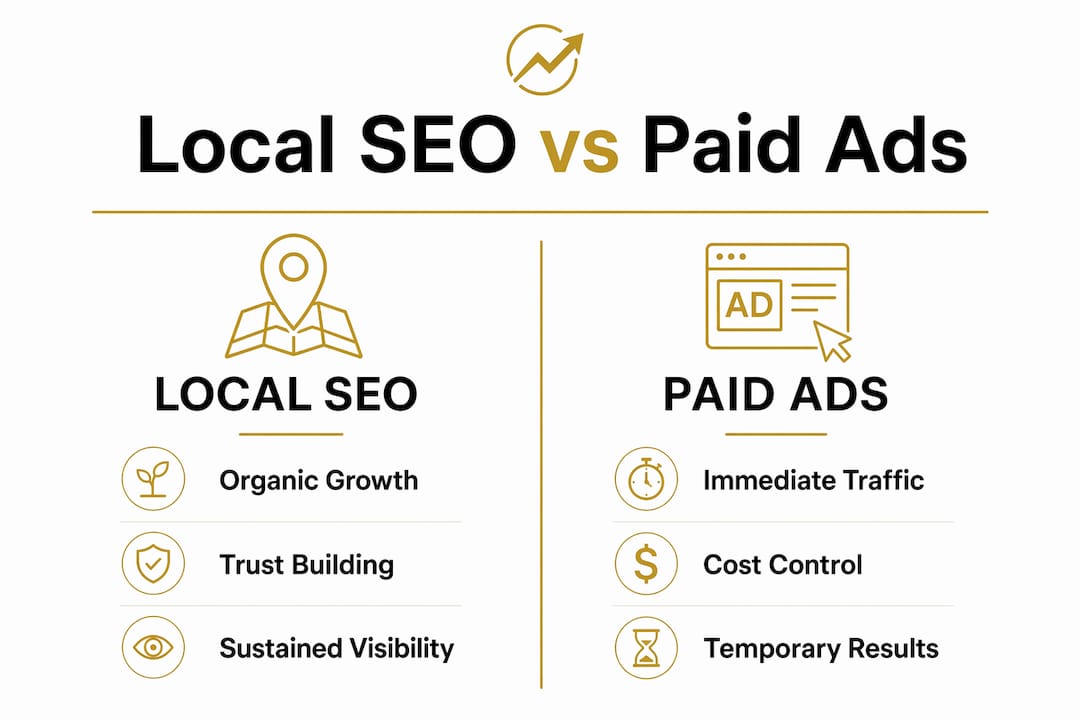
Local SEO is defined as the practice of improving a business’s visibility in geographically targeted search results, while paid ads are purchased placements that deliver immediate traffic through auction-based bidding. Understanding local SEO vs paid ads explained clearly is the first step to spending your marketing budget wisely. Nearly half of all Google searches carry local intent, which means customers are actively looking for businesses near them right now. Both strategies serve that demand, but they work on different timelines, cost structures, and trust signals. Choosing between them, or combining them, depends on what your business needs most at this moment.
How local SEO vs paid ads differ at the core
Local SEO and paid advertising are not interchangeable. They solve the same problem, getting found online, but through completely different mechanisms.
Local SEO builds visibility through organic search. It relies on proximity, relevance, and prominence as the three core ranking signals Google uses to decide which businesses appear in the Local Pack and Google Maps. Proximity measures how close your business is to the searcher. Relevance measures how well your listing matches the search query. Prominence measures how well known and trusted your business is, based on reviews, citations, and backlinks.

Paid advertising, by contrast, buys placement. Paid ads guarantee visibility the moment a campaign goes live, because the auction system places your ad in front of searchers who match your targeting criteria. There is no waiting period. You set a budget, define your audience, and your ad appears.
The key distinction is ownership. Organic rankings belong to your business as long as you maintain them. Paid traffic stops the moment you stop paying.
How local SEO builds sustainable local visibility
Local SEO works by signaling to Google that your business is the most relevant, trusted, and nearby option for a specific search. The process takes months, but the results compound over time.
The core elements of a strong local SEO foundation include:
- Google Business Profile (GBP): A fully completed and regularly updated GBP is the single most important local SEO asset. Google Maps and Local Pack visibility flows directly from this profile.
- NAP consistency: Your business name, address, and phone number must match exactly across every directory, citation, and website. Inconsistencies confuse Google and suppress rankings.
- Local keywords: Pages and listings optimized with city names, neighborhood terms, and service-specific phrases rank for the searches that matter most to your customers.
- Reviews: Volume and recency of Google reviews directly influence prominence scores. A business with 200 recent reviews outranks a competitor with 20 old ones.
- Local backlinks: Links from local news outlets, chambers of commerce, and neighborhood blogs signal community authority.
Trust is a major byproduct of strong local SEO. Organic search results inspire more trust than paid placements because consumers perceive them as earned, not bought. That credibility translates into higher click-through rates and lower bounce rates over time.
Pro Tip: Respond to every Google review, positive or negative. Google treats owner responses as a signal of business activity, and customers read them before deciding to call.
What paid ads offer for immediate local marketing results
Paid advertising delivers what local SEO cannot: traffic on day one. For a new business, a seasonal promotion, or a time-sensitive offer, that speed is worth real money.
The most relevant paid ad formats for local businesses include:
- Google Search Ads: Text ads that appear above organic results for specific keywords. These capture high-intent searches from customers ready to buy.
- Google Local Services Ads: Pay-per-lead ads that appear at the very top of local search results, above standard search ads.
- Facebook and Instagram Ads: Advanced demographic and geographic targeting lets you reach specific audiences by age, location, interests, and behavior.
- Display Ads: Visual banner ads that build brand awareness across websites your target customers visit.
Cost benchmarks matter when planning a paid strategy. Facebook’s average CPM is approximately $13.75 as of 2024 benchmarks. That means reaching 1,000 people costs roughly $13.75 on Facebook, which is a useful baseline for estimating awareness campaign budgets.
The control paid ads offer is genuinely powerful. You can pause a campaign instantly, shift budget between ad sets, and test five different messages in a single week. No other channel gives you that speed of iteration.
The limitation is equally clear. Paid ads do not directly affect organic rankings, so every dollar spent builds no lasting asset. The moment your budget runs out, your visibility disappears.
Pro Tip: Write ad copy that mirrors the exact language your customers use in reviews. Real customer phrasing outperforms polished marketing language in click-through rate tests.
Key differences between local SEO and paid ads
The differences between SEO versus paid marketing come down to five dimensions: timeline, cost, trust, traffic quality, and sustainability.
| Attribute | Local SEO | Paid Ads |
|---|---|---|
| Visibility timeline | 3–6 months to build | Immediate upon launch |
| Cost structure | Upfront time and optimization investment | Ongoing spend per click or impression |
| Trust and credibility | High. Organic results are perceived as earned | Lower. Consumers recognize paid labels |
| Traffic sustainability | Compounds over time with maintenance | Stops when budget stops |
| Best use case | Long-term brand authority and consistent leads | Launches, promotions, and fast traffic needs |
The trust gap deserves more attention than most business owners give it. Consumers consistently treat organic listings as more credible than ads. That perception affects not just whether someone clicks, but whether they call, visit, or buy after clicking. A business that ranks organically in the Local Pack carries an implied endorsement from Google itself.
Cost structure is the other critical difference. Local SEO requires an upfront investment in time, content, and profile optimization, but that investment keeps paying off. Paid ads have a predictable cost per result, which makes budgeting easier, but the math never improves. You pay the same cost per click in year three as you did in year one.
How to integrate local SEO and paid ads for growth
The most effective local digital marketing strategy uses both channels together, with each one compensating for the other’s weakness.
A practical integration approach follows this sequence:
- Launch paid ads immediately. While your local SEO foundation is being built, paid search ads capture the traffic you would otherwise miss. This is especially critical for new businesses with no organic presence.
- Build your Google Business Profile in parallel. Claim, complete, and actively manage your GBP from day one. This is the fastest path to organic Local Pack visibility.
- Use paid ad data to inform SEO. The keywords that drive the most conversions in your paid campaigns are exactly the keywords your SEO content should target. Paid ads give you conversion data in weeks that SEO would take months to generate.
- Reduce paid spend as organic rankings improve. As your local SEO gains traction, shift budget away from keywords where you now rank organically. Reinvest that budget into paid ads for new markets or seasonal pushes.
- Run paid ads during high-value windows. Even businesses with strong organic rankings benefit from paid ads during peak seasons, product launches, or competitive periods when top-of-page visibility is worth the premium.
The common pitfall is treating these channels as an either/or choice. Businesses that rely exclusively on paid ads build no lasting asset and face rising costs as competition increases. Businesses that rely exclusively on local SEO miss immediate revenue opportunities while waiting for rankings to mature. The combination solves both problems.
Pro Tip: Track phone calls and form submissions separately for paid and organic traffic. Knowing which channel drives actual conversions, not just clicks, tells you where to invest next.
Key Takeaways
Local SEO builds lasting organic visibility while paid ads deliver immediate traffic, and the most effective local marketing strategy uses both channels together.
| Point | Details |
|---|---|
| Local SEO is a long-term asset | Organic rankings compound over time and do not disappear when you stop paying. |
| Paid ads deliver immediate results | Search and social ads generate traffic on day one, ideal for launches and promotions. |
| Trust favors organic results | Consumers perceive organic listings as more credible than paid placements. |
| Integration beats exclusivity | Using paid ads while SEO matures prevents revenue gaps and accelerates growth. |
| Google Business Profile is foundational | A fully optimized GBP is the single highest-impact local SEO action for most businesses. |
The channel most business owners underestimate
After working with local businesses across multiple industries, the pattern I see most often is this: owners either spend heavily on paid ads and ignore their organic foundation, or they invest in SEO and refuse to touch paid advertising because it feels like renting visibility. Both positions cost money.
Paid ads are a tactical tool, not a strategy. They work best when they fill a specific gap: a new location that has no rankings yet, a promotion with a hard deadline, or a competitor who is outranking you on a keyword you cannot afford to lose. Using paid ads as a permanent substitute for local SEO is expensive and fragile.
Local SEO, on the other hand, is the foundation everything else sits on. A well-maintained Google Business Profile, consistent citations, and a steady stream of genuine reviews create a presence that keeps working even when you are not actively managing it. The businesses I have seen grow most consistently are the ones that treat local SEO as infrastructure, not a campaign.
My honest recommendation: start with both, measure everything, and shift budget toward whatever is driving actual customers through your door.
— Against
How Spinlisting strengthens your local search foundation
Local SEO results depend almost entirely on how well your Google Business Profile is built and maintained. Most business owners set it up once and forget it, which is exactly why their competitors outrank them.
Spinlisting specializes in Google Business Profile optimization for local businesses, combining local SEO keyword strategy with AI-powered content tools to keep listings accurate, active, and competitive. Spinlisting clients have seen 83% increases in first-place local rankings, and well-maintained listings deliver five times the value of unclaimed ones. If your paid ad budget is working harder than your organic presence, Spinlisting can fix that imbalance and build the foundation your business needs for long-term local growth.
FAQ
What is the main difference between local SEO and paid ads?
Local SEO builds organic visibility through Google Business Profile optimization, citations, and reviews, while paid ads purchase placement through auction-based bidding. Local SEO results last over time; paid traffic stops when the budget stops.
Are paid ads worth it for local businesses?
Paid ads are worth it when you need immediate visibility, such as during a business launch or seasonal promotion. They are less cost-effective as a permanent substitute for organic local SEO because costs do not decrease over time.
How long does local SEO take to show results?
Local SEO typically takes 3–6 months to produce measurable ranking improvements. The timeline depends on competition in your area, the completeness of your Google Business Profile, and the consistency of your citations and reviews.
Can paid ads help my local SEO rankings?
Paid ads do not directly improve organic rankings. They can increase brand awareness and website traffic, which may indirectly support SEO through greater engagement and potential backlink growth.
What is the most important local SEO tactic for a small business?
Claiming and fully optimizing your Google Business Profile is the highest-impact local SEO action for most small businesses. It directly influences Local Pack and Google Maps visibility, which are the primary channels for capturing local search traffic.