

For a local business, first-page Google ranking means your business appears either in the organic blue-link results or in the Local Pack (the map and three-business block) when someone nearby searches for what you offer. The essential first step: claim and verify your Google Business Profile (GBP). Everything else builds on that foundation.
- Local Pack placement comes from GBP signals, reviews, and proximity — and it’s often faster to win than organic rankings.
- Organic first-page listings come from on-site content, backlinks, and technical SEO — slower to build, but valuable for non-map queries.
- Start here: claim your GBP, fill every field, and keep your name, address, and phone number (NAP) identical everywhere it appears online.
Well-maintained listings produce significantly greater value than unclaimed ones — a gap that shows up directly in calls, direction requests, and booked appointments. Spinlisting LLC specializes in exactly this work, turning neglected profiles into consistent local-ranking assets.
Table of Contents
- What “first page” actually looks like for local searches
- Why first-page placement changes your business outcomes
- The ranking signals that actually move the needle
- Your GBP optimization checklist for this week
- How long does it take, and what does it cost?
- How to measure whether it’s working
- How to choose a local SEO or GBP provider
- Key Takeaways
- What actually moves local rankings in 2026
- Spinlisting handles the GBP work so you don’t have to
- Useful sources
What “first page” actually looks like for local searches
Google’s first page for a local query typically shows two distinct result types, and they behave very differently.
The Local Pack appears near the top of the page — sometimes above every organic result — as a map with three business listings. Each listing shows your business name, star rating, address, and a click-to-call button. On mobile, this block dominates the screen. For searches like “plumber near me” or “best pizza in Austin,” the Local Pack is where the majority of clicks go. Ranking here is controlled almost entirely by GBP signals, not your website.
Organic first-page results are the traditional blue links below (or sometimes above) the map. These matter most for informational queries (“how much does a roof repair cost in Denver”) and for businesses in categories where Google doesn’t show a Local Pack. Winning organic positions requires strong on-site SEO, quality content, and backlinks.
The practical decision rule: prioritize the Local Pack first. Local signals — a complete GBP, consistent citations, and genuine reviews — move map-pack rankings faster than site SEO alone. Build your website’s organic presence in parallel, not instead.
Why first-page placement changes your business outcomes
Position matters more than most owners realize. A first-place ranking generates a 39.8% click-through rate, compared with 18.7% for second place and 10.2% for third. Drop to page two and you’re effectively invisible.
For local businesses, the impact includes:
- Increased impressions from people searching your category in your area
- More clicks to your website and calls from the GBP listing itself
- More direction requests — a strong proxy for foot traffic
- Greater perceived trust, since consumers often assume top-ranked businesses are more credible
Local Pack results get disproportionate attention for one simple reason: they’re built for action. One tap calls you. Another opens directions. A third shows your reviews. No website visit required. That convenience gap is why GBP optimization often delivers faster commercial returns than a months-long content campaign.
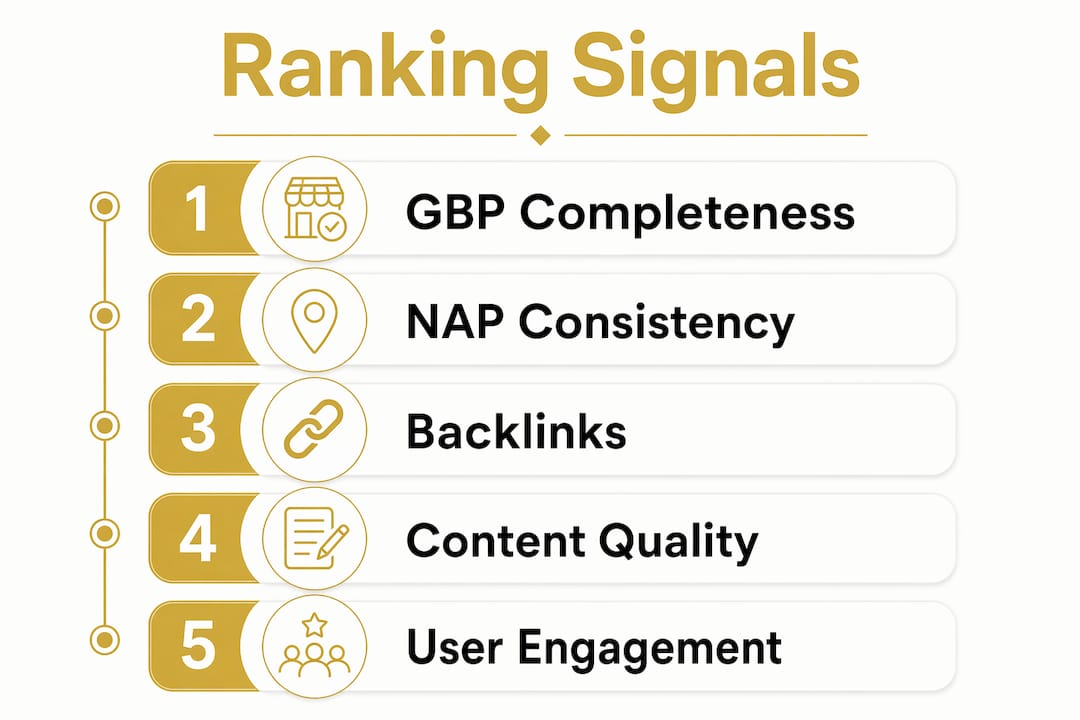
The ranking signals that actually move the needle
Google uses hundreds of ranking factors, but for local businesses they cluster into a manageable set of priorities.
| Signal cluster | Effort | Impact for local |
|---|---|---|
| GBP completeness and categories | Low | Very high |
| NAP consistency and citations | Low–medium | High |
| Reviews (volume, recency, responses) | Ongoing | High |
| Local landing pages with schema | Medium | High |
| Core Web Vitals and mobile speed | Medium | Medium–high |
| Backlinks from local/relevant sites | High | Medium–high |
| Behavioral signals (last click, dwell) | Indirect | Medium |
GBP signals are the fastest lever. After that, backlinks remain a core trust signal — top-ranked pages typically carry significantly stronger backlink profiles than those in positions 2–10. Brand mentions across the web are growing as a ranking signal too, which means local PR, partnerships, and directory listings all contribute even without a direct link.
One underappreciated factor: content satisfaction. If a searcher clicks your result and doesn’t come back to Google, that’s a strong positive signal. Pages that fully answer the question — and load fast on a phone — tend to hold their rankings. Google also now evaluates content at the passage level, so clear, scannable answers within a page can surface independently in AI Overviews and featured snippets.
Your GBP optimization checklist for this week
These are the moves that produce the fastest local visibility gains, roughly in priority order.
- Claim and verify your GBP at business.google.com if you haven’t already.
- Match NAP exactly across your website, GBP, Yelp, Apple Maps, and every directory listing.
- Choose the right primary category — this is the single most influential GBP field. Add secondary categories for every relevant service.
- Write a business description using natural local keywords (“family-owned HVAC in Columbus, OH”) without stuffing.
- Add attributes and services — hours, accessibility features, service areas, and individual service listings with descriptions.
- Upload at least 10 high-quality photos covering your exterior, interior, team, and work. Update them regularly.
- Publish GBP posts weekly — offers, events, or updates keep your profile active and signal engagement.
- Build a local landing page on your website for each service area or location, then link that page to your GBP website field.
- Ask customers for reviews and request specific details (“mention the service you had and the technician’s name”). Respond to every review.
- Fix incorrect citations on major directories using a tool like Moz Local or BrightLocal.
- Add LocalBusiness schema to your website so Google can read your NAP, hours, and service area in structured form.
- Check Core Web Vitals in Google Search Console and fix any pages flagged for slow load or layout shift.
Pro Tip: Avoid orphan pages — if your local landing page isn’t linked from your homepage or main service pages, crawlers may never find it, and it won’t pass authority. Every local page needs at least one internal link from a high-traffic page on your site.
Track your progress through GBP Insights: impressions, clicks to your website, calls, and direction requests are the four numbers that tell you whether your profile is actually driving business.
How long does it take, and what does it cost?
Timelines vary by competition level, but here’s a realistic framework:
- GBP and citation fixes: visible improvement in impressions within 2–6 weeks
- Content and on-site changes: 1–3 months to see ranking movement
- Backlink and authority building: 3–6 months or more for competitive keywords
Cost shapes depend on your approach. DIY work costs mostly time, with optional tool subscriptions (Moz Local, BrightLocal, or similar) running $30–$100/month. A one-time GBP and citation cleanup from a freelancer or small agency typically runs a few hundred to low thousands of dollars. Ongoing monthly management from a local SEO provider generally falls in the mid-three to low-four figures per month, depending on scope and market competitiveness. For budget allocation guidance, the key variable is how many competitors are already active in your category and geography.
How to measure whether it’s working
| KPI | Where to check | Positive signal |
|---|---|---|
| GBP impressions | GBP Insights | Steady week-over-week growth |
| Discovery vs. direct searches | GBP Insights | Rising discovery share |
| Clicks to website | GBP Insights | Increasing from baseline |
| Calls and direction requests | GBP Insights | Growing month over month |
| Organic impressions and clicks | Google Search Console | New queries appearing, CTR rising |
| Average position | Google Search Console | Trending below 10 for target terms |
Google Analytics adds the conversion layer: which GBP or organic visitors actually called, booked, or filled out a form. Without that, you’re measuring visibility, not revenue. Pair GBP Insights with Search Console and at least a basic rank-tracking tool (Semrush, Whitespark, or similar) to get the full picture. Understanding how AI ranking systems now influence which results surface can also help you interpret unexpected position swings.
How to choose a local SEO or GBP provider
Hire help when you’re short on time, facing stiff competition, managing multiple locations, or when three months of DIY work hasn’t moved your GBP impressions.
- Look for real local case studies with before/after GBP metrics — not just “we improved traffic.”
- Expect a clear deliverable list: GBP optimization, citation cleanup, local landing pages, review management, and monthly reporting.
- Ask for a sample roadmap and reporting cadence before signing anything.
- Confirm they measure calls and direction requests, not just keyword rankings.
- Avoid anyone who guarantees a #1 ranking — no provider controls Google’s algorithm.
- Red flags: link schemes, opaque monthly reports, no references, or a pitch that skips GBP entirely.
Pro Tip: Ask for a 30–60 day pilot focused on GBP wins and one or two local landing-page fixes. A good provider can show measurable GBP impression growth within that window. If they can’t, you have your answer before committing to a longer contract.
Key Takeaways
First-page Google ranking for a local business starts with a fully optimized Google Business Profile and consistent local signals that drive map-pack placement before organic rankings.
| Point | Details |
|---|---|
| Local Pack comes first | Prioritize GBP completeness, NAP consistency, and reviews for the fastest local visibility gains. |
| Content satisfaction matters | Pages that fully answer the searcher’s intent and load fast on mobile hold rankings longer. |
| Timeline is realistic | GBP fixes show results in weeks; backlinks and authority take 3–6 months for competitive terms. |
| Measure the right KPIs | Track GBP impressions, calls, and direction requests alongside Search Console position data. |
| Spinlisting delivers results | Spinlisting LLC’s GBP-first approach has produced an 83% increase in first-place rankings for clients. |
What actually moves local rankings in 2026
The conventional wisdom says “do SEO and wait.” The reality for local businesses is more specific and more actionable than that. GBP is not a side task — it’s the primary ranking surface for most local queries, and the gap between a claimed, optimized profile and an unclaimed one is enormous. Spinlisting’s analysis shows that maintained listings carry 5x greater value than unclaimed ones, and the firm’s client work has produced an 83% improvement in first-place rankings through focused GBP and local landing-page work.
What most guides understate: small, consistent wins compound. A complete profile this week, a local landing page next week, ten new reviews next month — each one is a marginal signal, but together they shift your position in ways that a single big push rarely does. The businesses that stay on page one aren’t the ones who did one big SEO project. They’re the ones who kept their profile current, responded to every review, and fixed technical issues before Google noticed them.
Spinlisting handles the GBP work so you don’t have to
Most local business owners know they should optimize their GBP. Few have the time to do it consistently. Spinlisting LLC closes that gap with a done-for-you service covering GBP optimization, local landing pages, citation cleanup, and review management — the exact combination that has driven an 83% increase in first-place rankings for clients.
The lowest-friction starting point is a local SEO audit that identifies exactly where your profile and site are losing visibility. From there, Spinlisting builds a prioritized action plan and handles execution, with monthly reporting tied to the KPIs that matter: impressions, calls, and direction requests. No long-term lock-in required for the initial audit. Visit spinlisting.com to request yours.
Useful sources
- Google: How Search Works — Ranking Results — Google’s own explanation of how pages are ranked; the authoritative starting point for any ranking question.
- Google Search Central: SEO Starter Guide — the official technical foundation for on-site SEO best practices.
- Backlinko: How to Rank Higher on Google in 2026 — detailed breakdown of content satisfaction, brand authority, and passage-level ranking signals.
- Demircode: How to Rank on Google’s First Page — practical guidance on helpful content, technical SEO, and the orphan-page problem.
- Jotform: How to Get on the First Page of Google — accessible overview of local signals and GBP completeness for small businesses.
- Spinlisting: Improve Local Search Ranking — 2026 Strategy Guide — Spinlisting’s own case-study-backed guide to GBP-first local ranking strategy.
- BabyLoveGrowth: SEO Ranking Factors Explained in the AI Era — examines how AI-driven ranking changes affect content and technical signals in 2026.
Recommended
- Improve Local Search Ranking: 2026 Strategy Guide | Google my Business for SEO / ranking services SEO
- Local SEO Ranking Factors Explained for 2026 | Google my Business for SEO / ranking services SEO
- Local Search Marketing Explained for Business Owners | Google my Business for SEO / ranking services SEO
- Why Location Pages Boost Rankings for Local Businesses | Google my Business for SEO / ranking services SEO